
Why content marketing is needed for SEO is one of the most important questions any business owner can ask before investing in search engine optimization — because the answer reveals a fundamental truth about how Google actually works in 2026. Content marketing and SEO are not two separate digital marketing activities that happen to overlap. They are inseparably connected — each making the other more effective, and neither reaching its full potential without the other.
SEO without content marketing is optimization with nothing to optimize. You can perfect your title tags, fix your technical infrastructure, and build an impressive backlink profile — but without substantive, high-quality content that genuinely addresses what your target audience is searching for, your website has nothing for Google to rank. Google’s entire purpose is to find the best written answer to every search query. Content marketing is what produces those answers.
Content marketing without SEO is creation without distribution. You can publish the most insightful, well-written articles in your industry — but without keyword research to align them with actual search demand, without on page optimization to communicate their relevance to Google, and without technical foundations that allow them to be crawled and indexed, that content remains invisible to the organic search audience that represents your highest-value traffic source.
Together, content marketing and SEO form the most powerful sustainable digital marketing combination available to businesses — particularly in Pakistan’s growing digital economy where most competitors have invested in neither seriously. Read What is SEO content writing a complete blog on this topic that actually help to write a blog on it. SEO Content Writing
Table of Contents
- Why Content Marketing Is Needed for SEO — The Core Relationship
- What Is Content Marketing in the Context of SEO?
- How Content Marketing Drives Organic Rankings
- Content Marketing Builds Topical Authority
- How Content Marketing Earns Backlinks Naturally
- Content Marketing and Search Intent Alignment
- How Content Marketing Supports E-E-A-T
- Content Marketing for Featured Snippets and AI Overviews
- Content Types That Support SEO Most Effectively
- How to Build a Content Marketing Strategy for SEO
- Content Marketing vs Paid Advertising for SEO
- Content Marketing for SEO in Pakistan — Specific Opportunities
- Common Content Marketing Mistakes That Hurt SEO
- How to Measure Content Marketing SEO Results
- Frequently Asked Questions
- Conclusion
What Is Content Marketing in the Context of SEO?
Content marketing, in the context of SEO, is the strategic creation and publication of valuable written content — blog posts, guides, articles, case studies, FAQs, and service pages — that targets specific search queries your audience uses, satisfies the search intent behind those queries, and builds your website’s authority and relevance in the eyes of Google over time.
This definition distinguishes SEO-driven content marketing from content marketing in a broader sense. General content marketing might include social media posts, email newsletters, podcasts, and video content created primarily for audience engagement and brand building. SEO content marketing specifically targets Google’s search algorithm — creating content that earns organic search visibility while simultaneously delivering genuine value to readers.
The essential characteristics of content marketing that directly supports SEO include keyword research as the foundation of every content decision, search intent alignment as the primary content format and depth guide, on page optimization applied to every published piece, internal linking strategy that connects all content into a coherent topical cluster, and consistent publication frequency that signals ongoing authority and freshness to Google.
Understanding this specific definition is important because it clarifies that not all content marketing supports SEO equally. A beautifully written blog post on a topic nobody searches produces zero SEO value regardless of its quality. Content marketing is needed for SEO when it is strategically planned around real search demand — which requires keyword research as the indispensable first step in every content decision.
How Content Marketing Drives Organic Rankings
The most direct answer to why content marketing is needed for SEO is that content is what Google ranks. Understanding precisely how content marketing drives organic rankings reveals the mechanism behind this relationship.
Content Creates Rankable Assets
Every piece of content you publish through your content marketing program is a potential ranking asset — a page that Google can evaluate, index, and show to users searching relevant queries. A website with fifty well-optimized, substantive blog posts has fifty potential ranking assets targeting fifty different keywords. A website with no content beyond its service pages has perhaps five to ten potential ranking assets.
Content marketing systematically expands your website’s ranking surface area — creating more pages, targeting more keywords, satisfying more search queries, and attracting more organic traffic from a wider range of search terms than any technically optimized website without content can achieve.
Content Targets the Full Keyword Spectrum
Effective content marketing for SEO targets keywords across the full spectrum of search intent and competition level — from high-volume primary keywords addressed in pillar content, through mid-competition informational terms addressed in comprehensive guides, to low-competition long-tail keywords addressed in specific blog posts and FAQ content.
This diversified keyword targeting through content marketing produces a compounding traffic effect. Each new piece of content adds to the total organic traffic your website generates — with no piece reducing the performance of existing content. Unlike paid advertising where budget allocation is zero-sum, content marketing builds a growing library of permanent organic assets.
Content Signals Freshness to Google
Google favors websites that consistently publish new, relevant content — treating regular publication as a signal of an active, authoritative resource worth returning to crawl frequently. A website that publishes consistently once per week trains Googlebot to return regularly, ensuring new content is discovered and indexed quickly. A website that last published content eighteen months ago may experience significantly slower indexation of any new content it does eventually publish.
Content Marketing Builds Topical Authority
Topical authority — the degree to which Google perceives your website as a comprehensive, trustworthy expert resource in a specific subject area — is one of the most important ranking factors in 2026. It is built almost exclusively through content marketing and is one of the clearest explanations of why content marketing is needed for SEO.
What Is Topical Authority?
Topical authority means Google recognizes your website as the go-to resource for a specific topic — not just one article about it, but comprehensive coverage across all meaningful subtopics, questions, and dimensions of the subject. A website with deep topical authority in digital marketing will rank more easily for new digital marketing content it publishes than a website with no established topical authority, even if both pieces of content are equally well-written and optimized.
How Content Marketing Builds Topical Authority
Topical authority is built by publishing comprehensive, interconnected content that covers every significant aspect of your subject area. The content cluster model — where a pillar page covers a broad topic comprehensively and cluster pages cover specific subtopics in detail — is the primary content marketing structure for building topical authority.
Notice what SiteNova Agency has built through our blog series: comprehensive coverage of digital marketing fundamentals, SEO basics, local SEO, Google Business Profile optimization, keyword research, SEO content writing, on page SEO, on page SEO checklist, technical SEO checklist, and now content marketing for SEO. Each piece contributes to our topical authority in digital marketing and SEO — making each new piece we publish more likely to rank quickly because Google has already recognized our depth of coverage in this subject area.
Why Topical Authority Matters More Than Single Article Optimization
A single perfectly optimized article on a competitive keyword, on a website with no other relevant content, will consistently underperform a well-optimized article on the same keyword published on a website with established topical authority in that area. Google’s algorithm evaluates not just individual pages but the overall topical depth and breadth of the entire website they appear on.
This is why content marketing is needed for SEO as an ongoing program — not a one-time project. A single excellent article does not build topical authority. A consistent program of comprehensive content creation across a well-structured subject area does.
How Content Marketing Earns Backlinks Naturally
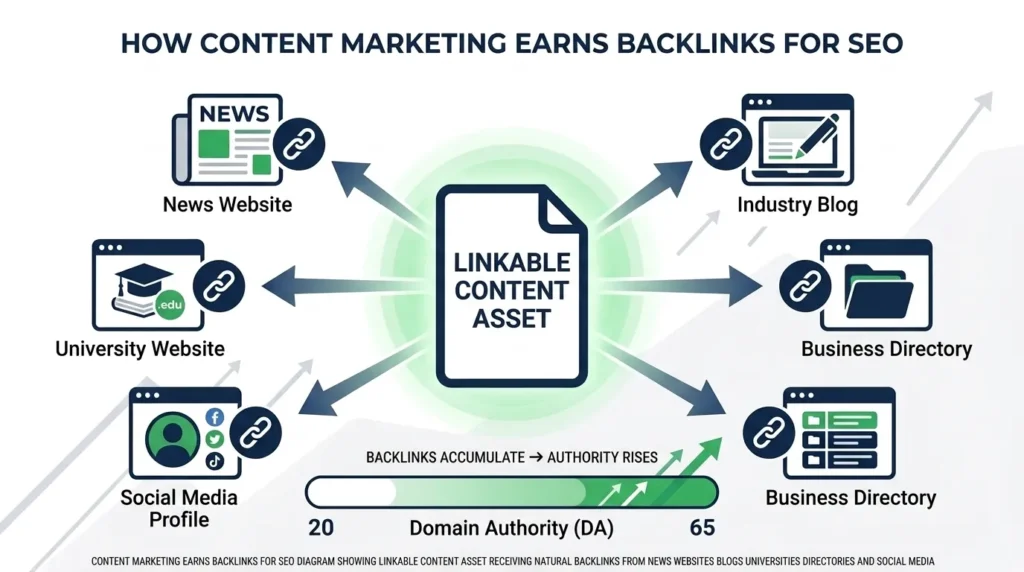
Backlinks — links from other websites pointing to your content — remain one of Google’s strongest ranking signals. Building backlinks through outreach and guest posting is valuable but time-intensive. Content marketing provides something that makes backlink acquisition dramatically easier: genuinely valuable content worth linking to.
The Linkable Asset Concept
Not all content earns backlinks equally. Short, generic blog posts that cover topics already addressed by hundreds of similar articles earn few organic backlinks because other website owners have no compelling reason to link to them over existing options. Comprehensive, original, genuinely useful content — detailed guides, original research, unique data, comprehensive resource lists, expert roundups — earns backlinks organically because it provides something other content does not.
These are called linkable assets — pieces of content so comprehensive or uniquely valuable that other websites naturally want to reference them when covering related topics. Creating linkable assets is a specific content marketing strategy directly in service of SEO link building goals.
Content Types That Earn the Most Backlinks
Original research and data — publishing original survey results, industry statistics, or unique data analyses earns backlinks from every other article that cites those statistics. One original data piece can earn hundreds of backlinks over its lifetime.
Comprehensive ultimate guides — the most thorough guide available on a specific topic becomes the reference resource that other writers cite when covering that topic. Comprehensive guides earn consistent backlinks over time.
Expert roundup posts — compiling insights from multiple industry experts creates content that those experts naturally share and link to from their own websites and social profiles.
Free tools and calculators — interactive tools embedded in content earn backlinks from websites recommending useful resources in your niche.
Infographics and visual content — well-designed visual summaries of complex information earn backlinks from websites that embed the image and link to the original source.
Content Marketing and Search Intent Alignment
Search intent — the underlying goal a user has when typing a query into Google — is the most important concept in content marketing for SEO. Google’s algorithm is specifically designed to identify and satisfy search intent. Content marketing that misaligns with search intent fails to rank regardless of its quality or optimization.
Why Search Intent Makes Content Marketing Essential for SEO
Understanding search intent reveals why content marketing is needed for SEO at a strategic level. Different search queries require fundamentally different content types, formats, and depths to satisfy user intent — and this variation in intent across the thousands of keywords your target audience uses makes a diverse content marketing program essential.
A single service page satisfies transactional intent — users ready to hire or buy. But the majority of search queries in any industry are informational — users researching, learning, and evaluating options before making decisions. Without content marketing that creates informational content — blog posts, guides, FAQs, how-to articles — your website is invisible to users during the research phase of their journey.
The Content Marketing Funnel for SEO
Content marketing for SEO maps content types to different stages of the customer journey — each targeting different search intent:
Awareness stage content targets informational queries — “what is digital marketing,” “why is local SEO important,” “how does Google Ads work.” These broad educational pieces capture users early in their journey, building familiarity with your brand before they are ready to make purchasing decisions.
Consideration stage content targets commercial investigation queries — “best digital marketing agency in Lahore,” “SEO services comparison Pakistan,” “how to choose an SEO agency.” These pieces reach users actively evaluating options — closer to a decision.
Decision stage content targets transactional queries — “hire digital marketing agency Lahore,” “SEO services Pakistan pricing,” “SiteNova Agency reviews.” These pieces — primarily service pages and case studies — capture users ready to act.
A complete content marketing strategy for SEO covers all three stages — capturing users at every point in their journey and guiding them progressively toward conversion.
How Content Marketing Supports E-E-A-T
Google’s E-E-A-T framework — Experience, Expertise, Authoritativeness, and Trust — is central to how Google evaluates content quality and website credibility in 2026. Content marketing is the primary mechanism through which businesses build and demonstrate E-E-A-T signals to Google.
Experience
Content marketing demonstrates first-hand experience when it includes specific examples from real situations, unique insights from direct practice, case studies from actual client work, and observations that only someone who has genuinely done the work would know. Generic content that aggregates information from other sources without original insight demonstrates no experience. Original content marketing built on real expertise demonstrates experience that Google increasingly rewards.
Expertise
A consistent content marketing program covering a subject area in depth — covering every meaningful subtopic, answering every significant question, explaining complex concepts clearly and accurately — demonstrates expertise far more convincingly than any single piece of content. The breadth and depth of your content marketing portfolio signals to Google that your website is operated by genuine experts in your field.
Authoritativeness
Authoritativeness is built when other authoritative sources — other websites, publications, and recognized voices in your industry — reference and link to your content. Content marketing creates the linkable assets that earn these authoritative references. A website that publishes original research, comprehensive guides, and genuinely useful tools attracts citations from authoritative sources that build the authoritativeness signal Google uses to assess ranking worthiness.
Trust
Consistent, accurate, transparent content marketing builds trust — both with Google and with human readers. Publishing content under real author names with genuine credentials, citing verifiable sources, correcting errors when they are identified, and maintaining consistency between what your content promises and what your business delivers all contribute to the trust signals that Google’s quality evaluators assess.
Content Marketing for Featured Snippets and AI Overviews
One of the most compelling reasons why content marketing is needed for SEO in 2026 is its specific ability to capture Featured Snippets and AI Overview citations — two search result formats that deliver enormous visibility even before users click any result.
Featured Snippets
Featured Snippets are the boxed answers that appear at the very top of Google search results — position zero — directly answering a user’s question with extracted text from a web page. They appear for approximately 12% of all searches and dramatically increase click-through rates and brand visibility.
Content marketing earns Featured Snippets through specific content formatting strategies. Clearly worded direct answers immediately following question-format headings are the most common Featured Snippet trigger. Lists, tables, and numbered step-by-step content frequently earn Featured Snippets for their respective query types. The comprehensive FAQ sections included in well-structured content marketing consistently generate Featured Snippet appearances.
AI Overviews
Google’s AI Overviews — the AI-generated summaries appearing at the top of search results for many queries — represent the newest and most significant frontier in content marketing for SEO. AI Overviews cite specific pages whose content they use to generate their summaries — appearing as cited sources within the AI-generated answer.
Appearing as a cited source in AI Overviews drives brand visibility and credibility signals even when users engage with the AI summary rather than clicking through to the website. Content marketing that produces comprehensive, accurately factual, well-structured content is most frequently cited in AI Overviews — because the AI systems generating these summaries prefer authoritative, clearly organized, verified information.
Structured data — schema markup — significantly increases the probability of content being cited in AI Overviews. FAQPage schema, Article schema, and HowTo schema all make content more accessible to Google’s AI systems. For the complete structured data implementation workflow, our technical SEO checklist covers every schema type in detail.
Content Types That Support SEO Most Effectively
Not all content marketing contributes equally to SEO performance. Understanding which content types produce the strongest SEO results helps prioritize your content marketing investment.
Blog Posts and Articles
Blog posts are the workhorses of content marketing for SEO — the highest-volume, most versatile content type for capturing informational search queries. A well-structured blog post targeting a specific keyword with appropriate depth, search intent alignment, and on page optimization is the most direct path from content marketing investment to organic search ranking. For the complete blog post optimization workflow, our on page SEO checklist provides every step.
Pillar Pages
Pillar pages are long-form comprehensive guides that cover a broad topic in its entirety — serving as the cornerstone content piece around which supporting cluster content is organized. A pillar page on “Digital Marketing” might be 5,000 to 8,000 words covering every major channel, strategy, and concept — with internal links to more detailed cluster articles on each subtopic. Pillar pages target broad, high-competition primary keywords and build the topical authority that makes all related content easier to rank.
FAQ Content
FAQ pages and FAQ sections within longer content are among the most effective content marketing tools for SEO in 2026 — directly targeting question-based keywords, qualifying for Featured Snippets, and earning FAQPage schema rich results. Every piece of content marketing should include an FAQ section targeting the specific questions users ask most frequently around the page’s primary topic.
Case Studies
Case studies serve a dual content marketing and SEO purpose — they provide genuine evidence of expertise and results that builds trust with potential clients, while also targeting commercial investigation keywords that buyers use when evaluating options. A case study titled “How We Increased a Lahore Restaurant’s Local SEO Traffic by 340% in 4 Months” targets a specific combination of keywords while providing the social proof that converts consideration-stage readers into decision-stage prospects.
Location Pages
Location pages are a specialized content type where content marketing for SEO directly serves local search visibility. Dedicated pages for each city you serve — with unique, locally relevant content targeting city-specific keywords — are essential content marketing assets for businesses targeting multiple geographic markets. Generic location pages with only the city name swapped provide no content marketing value and minimal SEO benefit.
How to Build a Content Marketing Strategy for SEO
Understanding why content marketing is needed for SEO is valuable — but the practical question is how to build a content marketing strategy that actually produces ranking results. Here is the complete framework:
Step 1 — Conduct Comprehensive Keyword Research
Every content marketing decision for SEO starts with keyword research. Identify the full landscape of keywords your target audience uses — primary keywords for pillar content, secondary keywords for supporting articles, long-tail keywords for specific FAQ and blog content, and local keywords for location-specific pages. For the complete keyword research methodology, our guide on how to do keyword research for SEO covers every step in detail.
Step 2 — Map Keywords to Content Types
Assign each identified keyword to the appropriate content type based on search intent. Informational keywords map to blog posts and guides. Transactional keywords map to service and product pages. Commercial investigation keywords map to comparison articles and case studies. Question keywords map to FAQ content. Local keywords map to location pages.
Step 3 — Build a Content Cluster Architecture
Organize your planned content into clusters — each cluster centered on a pillar page covering a broad topic, surrounded by cluster articles covering specific subtopics. Plan the internal linking structure that will connect each cluster — pillar pages linking to cluster articles, cluster articles linking back to pillar pages and to each other where relevant.
Step 4 — Create an Editorial Calendar
Consistency is one of the most important factors in content marketing for SEO. An editorial calendar — a planned publication schedule showing which content will be published on which dates — transforms content marketing from sporadic to systematic. Plan your editorial calendar quarterly, with specific topics, target keywords, content types, and responsible team members assigned to each piece.
Step 5 — Write for Search Intent and Human Value Simultaneously
Every piece of content must satisfy both dimensions — matching the search intent that determines its ranking eligibility and delivering genuine value that determines its ability to engage readers and build authority. The best content marketing for SEO is content so genuinely useful that it would be worth creating even if Google did not exist — then optimized so Google cannot miss it.
Step 6 — Optimize Every Piece Before Publication
Apply the complete on page SEO optimization workflow to every piece of content before publication — title tag, meta description, URL, headings, keyword placement, image optimization, internal links, and schema markup. Content marketing investment is wasted if the content it produces is not properly optimized for search engines to understand and rank.
Step 7 — Distribute and Promote After Publication
Publish new content across your social media channels, include it in email newsletters, share it with relevant communities, and reach out to websites that might naturally link to it. Content marketing promotion accelerates the organic discovery process — generating early traffic and engagement signals that help Google evaluate new content’s quality more quickly.
Step 8 — Audit, Update, and Improve Existing Content
Content marketing for SEO is not only about creating new content — it is equally about maintaining and improving existing content. Quarterly content audits identify pieces that have declined in rankings, contain outdated information, or have significant content gaps compared to competing pages that have recently outranked them. Refreshing and improving existing content is often faster and more impactful than creating entirely new pieces.

Content Marketing vs Paid Advertising for SEO
A common question for Pakistani businesses is whether to invest in content marketing for SEO or pay for traffic through Google Ads. Understanding the comparison clarifies why content marketing is needed for SEO as a long-term strategy — while paid advertising serves a different, complementary purpose.
| Factor | Content Marketing for SEO | Paid Advertising |
|---|---|---|
| Cost model | Time and expertise investment | Ongoing financial spend per click |
| Speed | 3 to 12 months for significant results | Immediate traffic on launch day |
| Sustainability | Permanent — content ranks indefinitely | Stops entirely when budget stops |
| Trust | High — organic results trusted more | Lower — users recognize and sometimes skip ads |
| Compounding returns | Yes — grows over time | No — flat performance relative to spend |
| Keyword coverage | Unlimited — every piece of content adds coverage | Limited by budget allocation |
| Brand authority | Builds significantly over time | Minimal brand authority contribution |
| Best for | Long-term organic growth foundation | Immediate lead generation, product launches |
The most effective digital marketing strategies for Pakistani businesses use both — content marketing for SEO building the long-term organic foundation while paid advertising generates immediate leads during the months it takes content marketing to produce organic traffic results. Over time, as content marketing compounds its organic traffic, reliance on paid advertising can be reduced — lowering the cost per lead from digital marketing significantly.
Content Marketing for SEO in Pakistan — Specific Opportunities
Pakistan’s digital landscape in 2026 presents specific content marketing opportunities for SEO that Pakistani businesses are uniquely positioned to capture.
Local Market Knowledge Advantage
Pakistani businesses have an inherent advantage in content marketing for local SEO — they understand the local market, local customer behavior, local business challenges, and local context in ways that international competitors creating generic content cannot replicate. Content marketing that incorporates genuine local knowledge — specific examples from Lahore’s business environment, understanding of Pakistani consumer behavior, local case studies — produces content that is more relevant and more authoritative for Pakistani search queries than any internationally produced generic content.
Bilingual Content Opportunity
Content marketing in both English and Urdu reaches significantly larger Pakistani audiences than English-only content. Urdu content marketing for SEO targets a substantial Pakistani search audience that English content misses entirely — while facing dramatically less competition than English content in most industries. Businesses that invest in bilingual content marketing build a double competitive advantage — ranking for both English and Urdu search queries in their target market.
Industry-Specific Content Gaps
Across virtually every Pakistani industry — healthcare, real estate, legal services, education, food and hospitality, professional services — comprehensive, high-quality content marketing is essentially absent. Most Pakistani business websites have minimal content beyond basic service descriptions. This creates extraordinary content marketing opportunities for first movers willing to invest in comprehensive, expert-level content that fills these gaps.
Pakistan-Specific Keyword Opportunities
Content marketing that targets Pakistan-specific keyword variations — “digital marketing agency Lahore,” “SEO services Karachi,” “content marketing Pakistan” — faces significantly lower competition than generic global equivalents. A comprehensive content marketing program targeting Pakistan-specific keywords can achieve page-one rankings in highly competitive niches that would be essentially impossible to compete for on a global scale.
Common Content Marketing Mistakes That Hurt SEO
Even businesses that understand why content marketing is needed for SEO make these recurring mistakes that reduce their content marketing program’s SEO effectiveness:
Publishing Without Keyword Research
Creating content based on topics that seem interesting or relevant — without verifying actual search demand through keyword research — produces content that may be excellent but invisible in search. Every piece of content marketing for SEO must be built around a keyword with verified search volume and realistic ranking opportunity.
Prioritizing Quantity Over Quality
Publishing large volumes of thin, superficial content — short posts that cover topics without genuine depth — triggers Google’s Helpful Content system and can suppress your entire website’s rankings. One comprehensive, genuinely helpful 2,500-word guide consistently outperforms ten shallow 300-word posts targeting the same general topic area.
Inconsistent Publication
Starting a content marketing program enthusiastically and then publishing sporadically — one post this week, then nothing for two months — fails to build the topical authority and crawl frequency consistency that makes content marketing effective for SEO. Google rewards consistent publishers with more frequent crawling and faster indexation of new content.
No Internal Linking Strategy
Publishing content without a deliberate internal linking strategy leaves content isolated — missing the authority distribution and topical clustering signals that make content marketing for SEO most effective. Every piece of content should link to related pieces and receive links from related existing content.
Ignoring Content Freshness
Publishing content and never revisiting it allows it to gradually lose rankings as competitors publish fresher, more comprehensive alternatives. Content marketing for SEO requires regular content auditing and updating — refreshing statistics, expanding thin sections, and improving content quality based on performance data.
Copying Competitor Content
Rewriting competitor content without adding original insight, unique examples, or additional value produces derivative content that Google consistently ranks below the original. Content marketing for SEO requires genuinely original contributions — not sophisticated paraphrasing.
How to Measure Content Marketing SEO Results
Content marketing for SEO without measurement produces effort without direction. These are the key metrics and measurement approaches for evaluating content marketing SEO performance.
Primary SEO Metrics
Organic traffic growth — total organic search traffic to your website, measured in Google Analytics. The most direct measure of whether your content marketing program is building organic search visibility over time.
Keyword rankings — the positions your target pages hold for their primary keywords, tracked monthly in Google Search Console. Content marketing success is visible in consistent upward ranking movement across your target keyword portfolio.
Organic click-through rate — the percentage of Google impressions resulting in clicks, measured in Search Console. Improving CTR through better title tags and meta descriptions is a content marketing optimization that improves results without changing rankings.
Content indexation rate — what percentage of published content is indexed by Google. Low indexation rates indicate technical or quality issues preventing Google from including your content in its index.
Content Engagement Metrics
Average time on page — how long users spend reading your content. High time on page signals genuine user engagement with your content marketing — a positive SEO quality signal.
Bounce rate — the percentage of users who leave immediately after arriving. High bounce rates on content pages indicate content is not satisfying the search intent that brought users to the page.
Pages per session — how many pages users visit per session. Content marketing that successfully guides readers to additional related content produces higher pages per session, distributing traffic across your content cluster and strengthening overall engagement signals.
Backlink Acquisition
New backlinks to content pages — monthly backlink acquisition to your content marketing pieces, tracked in Ahrefs or Google Search Console. Growing backlinks to content indicates your content marketing is creating genuinely linkable assets that build domain authority over time.
Frequently Asked Questions About Content Marketing for SEO
Q: Why is content marketing needed for SEO?
Content marketing is needed for SEO because content is what Google ranks. Without high-quality, keyword-targeted content, your website has nothing for Google to evaluate, understand, and show to users searching for your products or services. SEO provides the technical and strategic framework — keyword research, on page optimization, link building — but content marketing creates the actual pages that rank. Together they form the most sustainable organic growth strategy available.
Q: How much content do I need to publish for SEO results?
There is no universal minimum — results depend on content quality, keyword difficulty, competitive landscape, and your domain authority. For most Pakistani businesses starting from scratch, publishing two to four comprehensive, well-optimized pieces per month consistently produces measurable organic traffic growth within 3 to 6 months. Quality is more important than quantity — two excellent, comprehensive guides per month outperform eight thin, superficial posts.
Q: How long does content marketing take to produce SEO results?
Initial ranking movement typically appears within 4 to 8 weeks of publishing optimized content. Significant organic traffic from content marketing usually develops over 3 to 6 months of consistent publication. Competitive keywords in established markets may take 6 to 12 months to reach page one. The compounding nature of content marketing means results accelerate over time — a 12-month content marketing program produces disproportionately more traffic than a 6-month program.
Q: What type of content is best for SEO?
Comprehensive, well-structured long-form content targeting specific informational keywords with strong search volume and manageable competition produces the strongest SEO results for most businesses. Blog posts, ultimate guides, checklists, and FAQ-rich articles are the most effective content types for building organic search visibility. For a complete guide to writing content that ranks, our guide on what is SEO content writing covers every element of SEO-optimized content creation.
Q: Can I do content marketing for SEO without a professional writer
? Yes — many business owners successfully create their own content marketing for SEO with the right knowledge, keyword research, and on page optimization workflow. The key requirements are genuine subject matter expertise, understanding of search intent for each piece of content, proper keyword research before writing, and consistent on page SEO optimization after writing. Professional content writers add value through stronger writing craft, faster production, and experience with SEO optimization — but are not strictly required for effective content marketing.
Conclusion — Content Marketing and SEO Are Inseparable in 2026
The answer to why content marketing is needed for SEO is ultimately simple: because Google ranks content. Every algorithm update Google has released in the past five years has moved in the same direction — rewarding genuinely helpful, expertly created, comprehensively researched content while penalizing thin, generic, or manipulative alternatives. Content marketing that prioritizes genuine value for human readers, built on a foundation of keyword research and search intent understanding, is precisely what Google’s evolving algorithm is designed to surface and reward.
For Pakistani businesses building their digital presence in 2026, the content marketing opportunity is exceptional. Most competitors produce minimal content. Most industries are underserved by quality local content. The businesses that invest consistently in comprehensive, well-optimized content marketing — building topical authority, earning natural backlinks, capturing featured snippets, and serving every stage of the customer journey — will build organic search positions that compound in value and become increasingly difficult for later entrants to challenge.
Content marketing for SEO is not a short-term tactic — it is a long-term business investment that builds the most durable competitive advantage available in digital marketing. Start with keyword research. Build your content cluster architecture. Publish consistently. Optimize every piece. Measure results and improve continuously.
At SiteNova Agency, content marketing and SEO are the twin foundations of every digital strategy we build for clients across Pakistan and internationally. Our team handles the complete process — keyword research, content strategy, content creation, on page optimization, and performance tracking — delivering organic growth that compounds month after month. Visit our SEO Services page to learn how professional content marketing and SEO can transform your business’s organic search performance.