
Google AI Overviews — the AI-generated answer summaries that appear at the very top of Google search results — represent the most significant change to organic search visibility since Featured Snippets launched in 2014. Understanding how to rank in AI Overviews is no longer optional knowledge for businesses serious about SEO in 2026. It is essential.
When a user searches an informational or conversational query on Google, an AI Overview often appears before any organic results — a blue-boxed AI-generated answer that synthesizes information from multiple sources across the web. Below the answer, Google displays citation cards — small thumbnails linking to the specific pages whose content was used to generate the response.
These citation cards are the new position zero. A business cited in an AI Overview for a competitive keyword gains enormous brand visibility — their content is effectively endorsed by Google’s AI as one of the most authoritative, accurate sources on that topic. Users see the citation before they see any organic result, before any ad, and before any other SERP feature.
For businesses in Lahore, Karachi, Islamabad, and across Pakistan building their digital presence, appearing in AI Overviews for industry-relevant queries can generate brand recognition at a scale that would otherwise require significant paid advertising investment.
This guide is part of our advanced SEO series at SiteNova Agency. Before applying AI Overview optimization strategies, ensure your foundational SEO is solid — read our technical SEO checklist and on page SEO checklist. AI Overviews preferentially cite pages that are already technically strong and well-optimized on page. Our SEO Services team implements all of these strategies for clients across Pakistan and internationally.
Table of Contents
- What Are Google AI Overviews and Why Do They Matter for SEO?
- How Google AI Overviews Select and Cite Sources
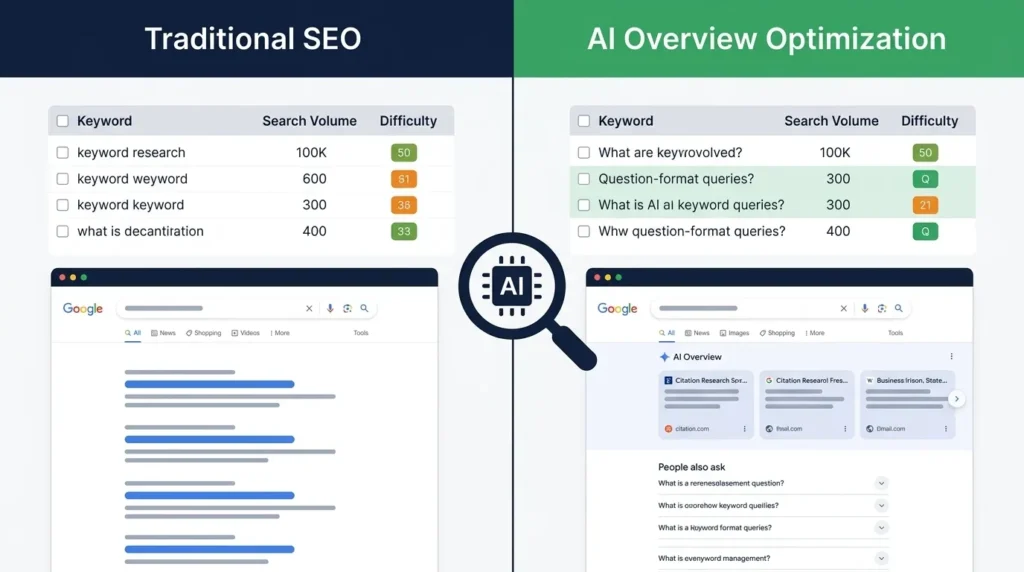
- Why Ranking in AI Overviews Is Different From Traditional SEO
- The Core Requirements to Rank in AI Overviews
- How to Optimize Content Structure for AI Overviews
- E-E-A-T Signals That Make Google Cite Your Content
- Schema Markup and Structured Data for AI Overview Visibility
- Topical Authority — The Biggest Factor in AI Overview Citations
- How Keyword Research Changes for AI Overview Optimization
- Technical SEO Requirements for AI Overview Eligibility
- How to Track Whether Your Content Appears in AI Overviews
- AI Overviews vs Featured Snippets — Key Differences
- AI Overviews for Pakistani Businesses — Specific Opportunities
- Common Mistakes That Prevent AI Overview Citations
- Frequently Asked Questions
- Conclusion
How Google AI Overviews Select and Cite Sources
Understanding how Google selects sources for AI Overview citations is the foundation of optimization strategy. The selection process is not random — it follows identifiable patterns that can be understood and optimized for.
The AI Overview Generation Process
Google’s AI Overview system — powered by Google’s Gemini model integrated into Search — generates answers by:
Step 1 — Query understanding: The system classifies the query by intent, complexity, and whether it warrants an AI Overview at all. Not all queries trigger AI Overviews — complex informational, how-to, and research queries most commonly receive them.
Step 2 — Source retrieval: Google retrieves a broad set of pages related to the query from its index — similar to how Featured Snippets work but drawing from a larger candidate pool.
Step 3 — Content evaluation: The AI evaluates retrieved content against multiple quality signals — factual accuracy, comprehensiveness, source authority, content freshness, and structural clarity.
Step 4 — Answer synthesis and citation: The AI generates an answer by synthesizing information across multiple sources, then surfaces citations from the pages whose specific content contributed to the generated answer.
What Google’s AI Looks for in Cited Sources
Through analysis of thousands of AI Overview citations, consistent patterns emerge in what types of content gets cited:
- Direct, specific answers to the exact question asked — not vague general overviews
- Factually accurate, verifiable information — the AI avoids citing content with demonstrably incorrect claims
- Comprehensive coverage — pages that cover a topic fully, not superficially
- Clear structural signals — headings, bullet points, tables that make information easy to extract
- High E-E-A-T — authoritative sources with demonstrated expertise
- Fresh content — recently updated or published content is preferred over stale pages
Why Ranking in AI Overviews Is Different From Traditional SEO
Traditional SEO optimization — targeting keyword density, building backlinks, achieving first-page organic rankings — remains important. But ranking in AI Overviews requires a meaningfully different optimization mindset that goes beyond traditional search engine optimization.
Traditional SEO vs. AI Overview Optimization
| Factor | Traditional SEO | AI Overview Optimization |
|---|---|---|
| Primary goal | First-page organic ranking | Citation as authoritative source |
| Key ranking signal | Backlinks + on-page optimization | E-E-A-T + content structure + factual accuracy |
| Keyword targeting | Exact-match keyword placement | Semantic coverage + entity optimization |
| Content format | Depends on intent | Structured, directly answerable |
| Page authority | Domain authority weighted heavily | Topical authority more important |
| Freshness | Important for competitive terms | Critical — AI prefers recent content |
| Technical SEO | Important | Essential — poor technical = not cited |
| Schema markup | Helpful | Highly influential for citation selection |
The Generative Engine Optimization (GEO) Shift
The emerging discipline of Generative Engine Optimization — GEO — specifically addresses how to optimize content for AI-generated answer systems including Google AI Overviews, Perplexity AI, ChatGPT Search, and other AI search engines.
GEO is not a replacement for traditional SEO — it is an evolution of it. The foundational elements remain: quality content, technical excellence, E-E-A-T signals. But GEO adds a layer of optimization specifically for how AI systems extract, evaluate, and cite information.
The core GEO principle: write content that an AI can confidently use to answer a specific question — clearly, accurately, and completely. If your content would make an excellent AI answer, it will be cited in AI Overviews. If it requires significant interpretation, lacks factual specificity, or is structurally unclear, it will not.
The Core Requirements to Rank in AI Overviews
Before diving into specific tactics, understanding the non-negotiable requirements for AI Overview citation eligibility clarifies the optimization priority order.
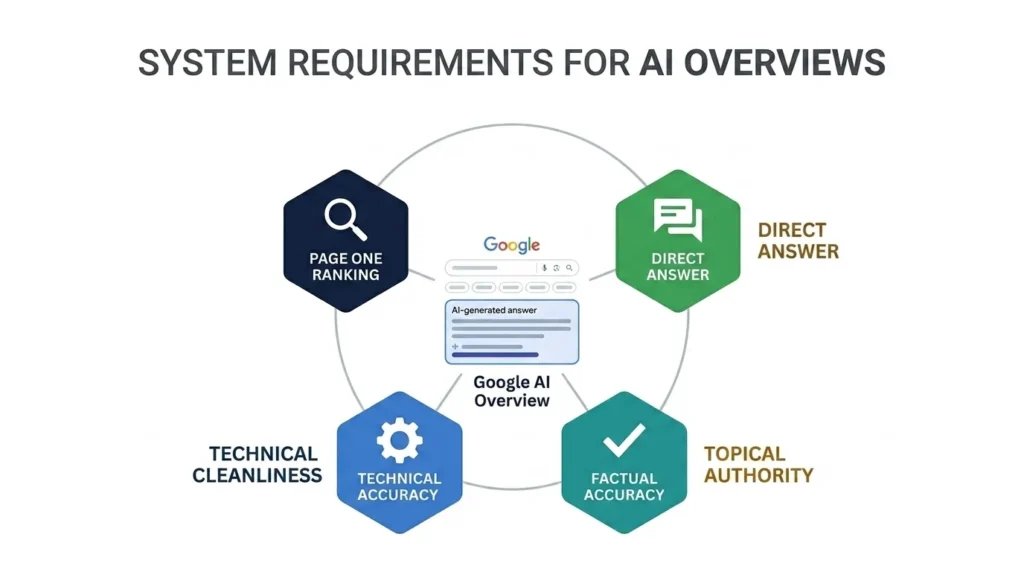
Requirement 1 — The Page Must Already Rank on Page One
This is the most important and most overlooked requirement: Google AI Overviews almost exclusively cite pages that already rank on page one of organic search results for the target query — or are in a strong position for closely related queries.
AI Overviews are not a shortcut to visibility for pages that do not rank. They are an amplification of existing strong rankings. The path to AI Overview citation runs through traditional SEO fundamentals first.
Implication: Focus your first optimization effort on achieving page-one rankings through keyword research, quality content, on page SEO, and link building. AI Overview optimization then maximizes the citation probability of pages already performing well in organic search.
Requirement 2 — Content Must Be Indexable and Technically Clean
Pages with crawl errors, noindex tags, thin content flags, or Core Web Vitals failures are dramatically less likely to be cited in AI Overviews. Google’s AI citation system uses the same quality signals as Google’s organic ranking algorithm — amplified.
Requirement 3 — Content Must Be Factually Accurate
Google’s AI systems are specifically designed to avoid citing content with factual errors — because an error in a cited source becomes an error in the AI-generated answer that millions of users see. Inaccurate content is a disqualifying signal.
Requirement 4 — Content Must Directly Answer the Query
AI Overviews cite content that directly answers the specific question being asked — not content that generally covers the broad topic. A page optimized for “what is SEO” that spends three paragraphs defining digital marketing before reaching SEO will be outcompeted by a page that defines SEO clearly and directly in the first two sentences.
Requirement 5 — The Source Must Demonstrate Topical Authority
A single excellent article on a topic, on a website with no other related content, is far less likely to be cited than the same article on a website with deep topical coverage of that subject area. Topical authority — demonstrated by consistent, comprehensive content across related topics — is a strong AI citation signal.
How to Optimize Content Structure for AI Overviews
Content structure is one of the most directly actionable optimization levers for AI Overview citation. Google’s AI extracts specific passages from pages — and pages structured to make extraction easy are cited more frequently.
Write Direct Answers Immediately After Question-Format Headings
The most reliably cited content structure for AI Overviews is a question-format H2 or H3 heading followed immediately by a direct, complete answer in the first one to three sentences of the section.
Structure that gets cited:
H2: What Is On Page SEO?
On page SEO is the optimization of elements within
your actual web pages — title tags, headings, content,
images, and internal links — to improve search engine
rankings and attract more organic traffic.
Structure that does not get cited:
H2: Understanding On Page SEO in Today's Digital Landscape
Search engine optimization has evolved significantly
over the past decade, and on page factors have become
increasingly important as Google's algorithm has grown
more sophisticated...
The first version answers the question immediately. The second delays the answer with context — the AI cannot extract a clean answer from it.
Use Clear Formatting That AI Can Parse
- Definition format: “X is [clear definition]” — the most commonly cited sentence structure in AI Overviews
- List format: Bulleted or numbered lists of specific items — AI Overviews frequently cite lists verbatim
- Table format: Comparison tables are cited as structured data summaries
- Step format: Numbered step-by-step instructions are cited for how-to queries
The Inverted Pyramid Structure
Write every section using inverted pyramid structure — most important information first, supporting detail following. AI systems scan for the core answer and stop when they have enough information to generate the response. If your most important information is buried in paragraph four, the AI may not reach it.
Specific, Quantified Information
AI Overviews strongly prefer concrete, specific information over vague generalities. Compare:
Vague (unlikely to be cited): “It takes some time to rank in AI Overviews — results vary.”
Specific (more likely to be cited): “Most pages cited in AI Overviews achieve citation within 4 to 8 weeks of publishing, provided they already rank in positions 1 to 10 for the target keyword.”
Specific numbers, timeframes, measurements, and defined thresholds give the AI extractable facts — which is precisely what it needs to generate a useful answer.
E-E-A-T Signals That Make Google Cite Your Content
E-E-A-T — Experience, Expertise, Authoritativeness, and Trust — is the quality framework Google uses to evaluate whether content is worth citing in AI Overviews. Pages with strong E-E-A-T signals are cited dramatically more often than pages with weak signals — even when the content itself is similar in quality.
Experience — First-Hand Knowledge Signals
Google’s AI is trained to detect content written from genuine first-hand experience versus content assembled from other sources. Original case studies, real examples from actual client work, specific data from direct practice, and unique observations that only direct experience produces — all signal authentic experience to Google’s citation system.
Actionable: In every piece of content you create for AI Overview optimization, include at least one specific example, case study, or data point from your actual work experience. Generic advice assembled from other sources is the content type least likely to earn AI Overview citations.
Expertise — Demonstrated Subject Matter Depth
Expertise in content is demonstrated not by claiming expertise (“we are experts in SEO”) but by demonstrating it through depth, accuracy, and specificity of information. Content that goes beyond surface-level coverage — explaining not just what but why, how, and under what conditions — signals expertise to Google’s AI.
Author credentials: Ensure every piece of content has a visible author with a complete bio that includes relevant credentials, experience, and links to verifiable professional profiles (LinkedIn, published work). AI systems increasingly use author signals in citation selection.
Authoritativeness — Third-Party Recognition
Authoritativeness is built through external signals — other authoritative websites linking to your content, your brand being mentioned in industry publications, your authors being cited in other articles. These signals tell Google’s AI that your content is recognized by others in the field as valuable and accurate.
Trust — Factual Accuracy and Transparency
Trust is the most weighted E-E-A-T signal for AI Overview citation — because Google’s AI cannot afford to cite inaccurate content. Build trust signals by citing authoritative external sources in your content, correcting errors promptly and visibly, maintaining consistent NAP information, using HTTPS, and writing transparently about methodology and limitations.
Schema Markup and Structured Data for AI Overview Visibility
Schema markup is one of the highest-impact technical optimizations for AI Overview citation probability — yet it remains underimplemented on the majority of Pakistani business websites.
Why Schema Increases AI Overview Citation Probability
Schema markup provides explicit semantic signals that Google’s AI can read directly — without needing to interpret ambiguous natural language. A page with FAQPage schema explicitly tells Google: “These are questions and these are their answers.” An Article schema tells Google: “This was written by this person on this date about this topic.” The AI can use this structured information with much higher confidence than inferring the same information from unstructured text.
Schema Types Most Influential for AI Overview Citations
FAQPage schema: The single most impactful schema type for AI Overview optimization. FAQ sections with proper FAQPage schema markup are cited in AI Overviews at dramatically higher rates than equivalent content without schema.
Implementation: Mark up every FAQ section with FAQPage and Question/Answer schema. Each Question should match the exact text of the visible H3 or question heading. Each Answer should contain the complete, accurate answer — not a truncated version.
Article schema: Signals to Google’s AI that the content is an article — with a specific author, publication date, and modification date. Freshness signals from dateModified are used by the AI to prefer recently updated content.
HowTo schema: For step-by-step instructional content, HowTo schema marks up individual steps with their specific descriptions — giving the AI a structured sequence it can cite as a complete answer to how-to queries.
Speakable schema: A relatively underused schema type that explicitly marks specific passages as ideal for voice and AI-generated answer extraction. Implementing Speakable schema on your most important passages directly tells Google’s AI: “This is the passage you should cite.”
Organization and Author schema: Establishes your brand and author credentials as formal entities in Google’s knowledge graph — strengthening the E-E-A-T authority signals that make citation more likely.
Schema Implementation in WordPress
Rank Math handles FAQPage, Article, HowTo, and Organization schema through its interface — no manual code required. For Speakable schema, manual JSON-LD implementation in the page’s head section is currently required as most plugins do not support it natively.
Verify all schema implementations using Google’s Rich Results Test before and after implementation.
Topical Authority — The Biggest Factor in AI Overview Citations
Of all the optimization signals that influence whether Google cites your content in AI Overviews, topical authority is the most powerful — and the most time-intensive to build. It is also the most defensible competitive advantage once established.
What Topical Authority Means for AI Overviews
Topical authority means Google’s AI has high confidence in your website as a comprehensive, reliable source on a specific subject area — not just one article, but the entire body of content your website has produced on that topic.
A website with deep topical authority in digital marketing — covering every meaningful subtopic comprehensively and accurately — will have its articles cited in AI Overviews for digital marketing queries at significantly higher rates than a website with a single excellent article on the topic surrounded by unrelated content.
This is the most direct explanation of why a content cluster strategy — building interconnected content that covers every dimension of a subject area — is the most important long-term strategy for ranking in AI Overviews.
Building Topical Authority for AI Overview Citation
Map every subtopic in your subject area: Identify every meaningful question, subtopic, and related concept within your core subject. Every unmapped subtopic is a gap in your topical authority that reduces citation probability for your entire content cluster.
Publish comprehensively before competitively: Rather than publishing one perfect article and waiting for it to rank, publish comprehensive coverage of your entire topic cluster — even if individual articles are less polished. Topical coverage breadth is the first requirement; individual article depth builds over time.
Internal linking as authority signals: Connect every piece of content in your cluster through deliberate internal linking. The internal link structure tells Google’s AI how your content is organized and which pages are most central to your topical coverage. Well-linked pillar pages at the center of a content cluster receive the strongest topical authority signal.
Notice how SiteNova Agency’s blog series builds topical authority systematically — from digital marketing fundamentals through SEO basics, keyword research, local SEO, on page SEO, technical SEO, content marketing, and now AI Overview optimization. Each piece strengthens the topical authority signal of the cluster as a whole — making every individual piece more likely to be cited.
How Keyword Research Changes for AI Overview Optimization
Traditional keyword research focuses on search volume, keyword difficulty, and ranking opportunity. AI Overview optimization adds a new dimension: identifying which query types trigger AI Overviews and optimizing content specifically for those patterns.
Query Types That Trigger AI Overviews
Not all searches trigger AI Overviews. Based on current Google behavior, these query types most commonly produce AI Overviews:
Question queries: “What is,” “How does,” “Why is,” “How to,” “When should” — informational questions are the primary AI Overview trigger.
Comparison queries: “X vs Y,” “difference between X and Y,” “which is better X or Y.”
Definition queries: “What is [term],” “define [concept],” “meaning of [term].”
Process queries: “How to [accomplish task],” “steps to [complete process],” “how do I [action].”
Explanation queries: “Why does [phenomenon occur],” “how does [system] work,” “what causes [condition].”
Queries That Rarely Trigger AI Overviews
Navigational queries: “SiteNova Agency website” — users want a specific destination, not an AI answer.
Transactional queries: “buy digital marketing services” — commercial intent queries more commonly show ads and organic results.
Local queries (sometimes): “digital marketing agency near me” — local pack results typically dominate.
Breaking news: Too fast-moving for AI Overview accuracy standards.
AI Overview Keyword Research Process
Step 1: Take your existing keyword target list and filter for question-format and informational intent keywords — these are your highest-probability AI Overview targets.
Step 2: Search each target keyword in Google and note whether an AI Overview appears. Keywords that already trigger AI Overviews for other sources are confirmed targets — Google has decided this query type warrants an AI answer.
Step 3: Analyze which sources are currently cited in the AI Overview for your target queries. Identify their content structure, depth, and E-E-A-T signals — these are the benchmarks your content must exceed.
Step 4: Identify question variations using People Also Ask — every PAA question is a potential AI Overview target. Content that answers multiple related questions within a single comprehensive page has higher AI Overview citation probability than content answering only the primary query.
For the complete keyword research foundation that underlies AI Overview targeting, our guide on how to do keyword research for SEO covers the full methodology that feeds into AI Overview optimization strategy.
Technical SEO Requirements for AI Overview Eligibility
Technical SEO excellence is a prerequisite for AI Overview citation — not a nice-to-have. Google’s AI citation system applies higher technical standards than standard organic ranking because cited content directly represents Google’s AI-generated answers to users.
Page Speed and Core Web Vitals
Pages failing Core Web Vitals thresholds are significantly less likely to receive AI Overview citations. The reasoning is straightforward: Google will not cite a page that delivers a poor user experience to the users who click through from the citation card.
Minimum standards for AI Overview eligibility:
- LCP under 2.5 seconds
- INP under 200 milliseconds
- CLS under 0.1
- Mobile PageSpeed score above 70
Mobile-First Indexing Compliance
Since Google uses mobile-first indexing, pages with mobile version deficiencies — missing content, poor mobile performance, non-responsive design — are evaluated for AI Overview citation based on their mobile quality. A page that looks excellent on desktop but performs poorly on mobile will be assessed on its mobile performance.
Content Freshness and Update Signals
AI Overviews strongly prefer recently published or recently updated content — particularly for topics that evolve over time. The dateModified signal in your Article schema, combined with actual content updates rather than simply changing a date, directly influences citation probability.
Actionable: Review your highest-potential AI Overview content every quarter. Update statistics, add new examples, expand sections where competitor content has become more comprehensive. Each meaningful update refreshes Google’s freshness signal for that page.
Canonical Tags and Duplicate Content
AI Overview systems, like organic ranking systems, will not cite duplicate or near-duplicate content. Ensure all canonical tags are correctly implemented — the canonical version of each page should be the one you want cited.
HTTPS and Trust Signals
All cited pages must use HTTPS. Beyond the basic requirement, pages with security warnings, expired SSL certificates, or mixed content errors will not be cited — these technical issues are treated as trust failures.
How to Track Whether Your Content Appears in AI Overviews
Measuring AI Overview citation performance is still an evolving discipline — Google Search Console does not yet provide direct AI Overview impression or click data separately from organic clicks. However, several tracking approaches provide meaningful insight.
Manual SERP Monitoring
Search your target keywords regularly — at least monthly — and manually check whether AI Overviews appear and whether your content is cited. Screenshot and log citations for each keyword. This manual process is time-consuming but provides the most accurate picture of your current citation status.
Google Search Console — AI Overview Impressions
Google has begun rolling out AI Overview data in Search Console for some accounts. In the Performance report, filter by “AI Overviews” in the Search Type dropdown if the option is available. This shows impressions and clicks attributed specifically to AI Overview citations — track these metrics monthly.
Third-Party AI Overview Tracking Tools
Several SEO tools — including Semrush, Ahrefs, and specialized AI Overview tracking platforms — now provide automated monitoring of AI Overview appearances for tracked keywords. These tools check SERP features at regular intervals and alert you when your content gains or loses AI Overview citations.
Traffic Pattern Analysis
AI Overview citations often produce a distinctive traffic pattern — a spike in branded search impressions as users who saw your brand cited in an AI Overview later search directly for your website. Monitor Google Search Console for branded impression growth after implementing AI Overview optimization strategies.
AI Overviews vs Featured Snippets — Key Differences
Many businesses confuse AI Overviews and Featured Snippets — both appear above organic results, but they function differently and require distinct optimization approaches.
| Factor | Featured Snippets | AI Overviews |
|---|---|---|
| Source | Single page, extracted verbatim | Multiple pages, synthesized |
| Position | Above organic results | Above Featured Snippets |
| Content | Extracted text, table, or list | AI-generated summary |
| Citations | One source (the snippet page) | Multiple sources (citation cards) |
| Click behavior | High CTR to source page | Lower CTR — answer often sufficient |
| Optimization trigger | Exact answer format matching | Comprehensive coverage + E-E-A-T |
| Schema influence | Moderate | High |
| Query types | Specific questions | Broader informational queries |
| Freshness requirement | Moderate | High |
| Topical authority weight | Low | High |
Can You Win Both?
Yes — and you should target both simultaneously. The content structure that earns Featured Snippets — direct answers immediately following question-format headings — also increases AI Overview citation probability. Optimizing for both is not contradictory — it is the most complete SERP feature optimization strategy available.
Pages that hold Featured Snippets for a query are also among the most commonly cited sources in AI Overviews for the same query — because both systems preferentially select content that directly answers a specific question with clear, extractable text.
AI Overviews for Pakistani Businesses — Specific Opportunities
For Pakistani businesses, AI Overviews represent a genuinely significant and underexploited opportunity — for one critical reason: almost no Pakistani businesses are currently optimizing for AI Overview citation. The competitive landscape for AI Overview citations in Pakistan-relevant queries is nearly empty.
Local and Industry-Specific Query Opportunities
Pakistani businesses that publish comprehensive, well-structured content targeting Pakistan-specific informational queries can achieve AI Overview citations with relatively modest content investment — because they face minimal competition from other locally relevant, authoritative sources.
Examples of Pakistan-specific AI Overview opportunities:
- “how does local SEO work in Pakistan”
- “what is the best digital marketing strategy for Pakistani businesses”
- “how to set up Google Business Profile in Pakistan”
- “what are SEO services in Lahore”
For each of these queries, an AI Overview would ideally cite a Pakistan-based source with direct local market knowledge. Currently, most of these queries either trigger no AI Overview or cite generic international sources that lack Pakistan-specific context.
Bilingual AI Overview Opportunity
AI Overviews increasingly appear for Urdu-language queries as Google’s AI becomes more capable in regional languages. Pakistani businesses that publish high-quality Urdu content targeting informational queries have a near-zero-competition opportunity for AI Overview citations in Pakistan’s Urdu-speaking search audience.
Building Entity Recognition for Pakistani Businesses
Google’s knowledge graph — the database of entities (people, places, organizations, concepts) that Google understands — is a significant input to AI Overview citation selection. Businesses that appear as recognized entities in Google’s knowledge graph are cited more readily.
For SiteNova Agency and other Pakistani businesses, building entity recognition involves consistent brand mentions across authoritative sources, Wikidata entity creation (where appropriate), structured Organization schema on your website, and consistent NAP across all online platforms.
Common Mistakes That Prevent AI Overview Citations
Understanding what prevents AI Overview citations is as important as understanding what enables them.
Writing for Keywords Instead of Questions
Content written with keyword density as the primary goal — optimized for how often a phrase appears — is structured for traditional SEO, not AI Overview citation. AI systems look for content written to answer a specific question comprehensively. Reorient your content creation process from keyword targeting to question answering.
Burying Direct Answers
Placing the direct answer to the implied question in the middle or end of a section — after extensive context and background — means the AI may not extract the answer at all. Lead with the answer every time.
Publishing Thin or Surface-Level Content
A 500-word article that covers a topic shallowly will not be cited in AI Overviews — regardless of how well it is technically optimized. AI Overview citation requires substantive, comprehensive content that demonstrates genuine depth of knowledge on the specific topic.
No Schema Markup
Publishing content without FAQPage, Article, and relevant schema markup removes explicit structural signals that increase citation probability. Schema implementation is a direct, implementable action that produces measurable results within weeks.
Neglecting Content Freshness
Publishing content and never updating it — allowing statistics to become outdated, examples to become irrelevant, and information to become inaccurate — is one of the fastest ways to lose AI Overview citations you may have previously earned. Implement a quarterly content review process as part of your standard content marketing workflow. Our guide on content marketing for SEO covers content maintenance strategy in detail.
Ignoring E-E-A-T Signals
Publishing content without visible author information, without citations to authoritative sources, and without demonstrating first-hand expertise produces content Google’s AI cannot confidently cite. Every piece of content should have a visible, credentialed author — not published as “admin” or left anonymous.
Poor Technical Foundations
Content on slow-loading pages, pages with crawl errors, or pages with duplicate content issues will not be cited regardless of content quality. Technical SEO excellence is the prerequisite, not an optional enhancement.
Frequently Asked Questions About Ranking in AI Overviews
Q: What are Google AI Overviews and how do they work?
Google AI Overviews are AI-generated answer summaries that appear at the top of Google search results for informational queries. Powered by Google’s Gemini AI model, they synthesize information from multiple web pages to produce a direct answer, then display citation cards linking to the specific pages whose content contributed to the answer. Pages cited in AI Overviews gain significant brand visibility above all organic search results.
Q: Do I need to rank on page one to appear in AI Overviews?
Yes — in almost all cases. Google’s AI Overview system draws from pages already ranking in strong organic positions for the target query or closely related queries. AI Overviews are an amplification of existing strong rankings, not a bypass route to visibility for pages that do not rank. Focus on achieving page-one organic rankings through quality SEO first, then optimize for AI Overview citation probability.
Q: What type of content is most likely to be cited in AI Overviews?
Content most likely to be cited is comprehensive, factually accurate, and directly answers a specific question — with the answer appearing immediately after a question-format heading, supported by FAQPage or Article schema markup, on a website with established topical authority in the relevant subject area, published by a credentialed author, and technically clean with strong Core Web Vitals scores.
Q: How long does it take to appear in AI Overviews after optimization?
Most pages that achieve AI Overview citations do so within 4 to 8 weeks of implementing optimization changes — provided they are already ranking on page one for the target keyword. Pages that need to build ranking strength first will see AI Overview citations emerge as their organic rankings improve, typically 3 to 6 months after publishing optimized content.
Q: Does schema markup directly guarantee AI Overview citations?
Schema markup does not guarantee citations — nothing does. However, FAQPage schema, Article schema, and HowTo schema measurably increase the probability of citation by providing Google’s AI with explicit structural signals it can use with high confidence. Pages with correct schema implementation are cited more frequently than equivalent pages without schema, all other factors being equal.
Q: How do AI Overviews affect my organic click-through rate?
AI Overviews have a complex effect on CTR. For simple informational queries, AI Overviews can reduce click-through to organic results because the answer is provided directly in the SERP. For complex queries requiring more detail, users often click through to cited sources for the full context. Businesses cited in AI Overviews often see increased branded search impressions — users who encountered the brand in an AI Overview search for it directly later.
Conclusion — AI Overviews Are the New Frontier of Organic Visibility
Ranking in AI Overviews is not a replacement for traditional SEO — it is the natural evolution of it. Every optimization that makes content rank well organically — quality, depth, E-E-A-T, technical excellence, topical authority — also makes content more likely to be cited in AI Overviews. The difference is in execution detail: structured for direct extraction, optimized with schema, fresh and factually accurate, written by credentialed authors on websites with comprehensive topical coverage.
For Pakistani businesses building their digital presence in 2026, the AI Overview opportunity is exceptional precisely because it is underexploited. While global competitors are already competing intensely for AI Overview citations in English-language queries, Pakistan-specific and regional queries remain largely unclaimed. Businesses that build comprehensive, well-structured, E-E-A-T-strong content targeting Pakistan-relevant informational queries now will establish AI Overview citations before competition for those positions develops.
The businesses that understand AI Overviews as the evolution of organic search — not a separate channel — and invest in content that serves both traditional organic ranking and AI citation simultaneously will compound their organic visibility advantage year after year.
At SiteNova Agency, our SEO team implements complete AI Overview optimization strategies for clients across Pakistan and internationally — from content structure and schema markup through topical authority building and technical SEO excellence. Visit our SEO Services page to learn how we help businesses achieve visibility in both traditional organic results and Google AI Overviews.