Table of Contents
- What Is SEO in Digital Marketing?
- Why SEO Is the Most Valuable Digital Marketing Channel
- How Search Engines Work
- The Three Pillars of SEO in Digital Marketing
- On-Page SEO — Optimizing What You Control
- Off-Page SEO — Building Authority and Trust
- Technical SEO — The Foundation Everything Sits On
- Keyword Research — The Starting Point of Every SEO Strategy
- SEO vs Paid Advertising in Digital Marketing
- How Long Does SEO Take to Show Results?
- SEO in Digital Marketing for Pakistani Businesses
- How to Choose the Right SEO Agency
- Frequently Asked Questions
- Conclusion
What Is SEO in Digital Marketing?
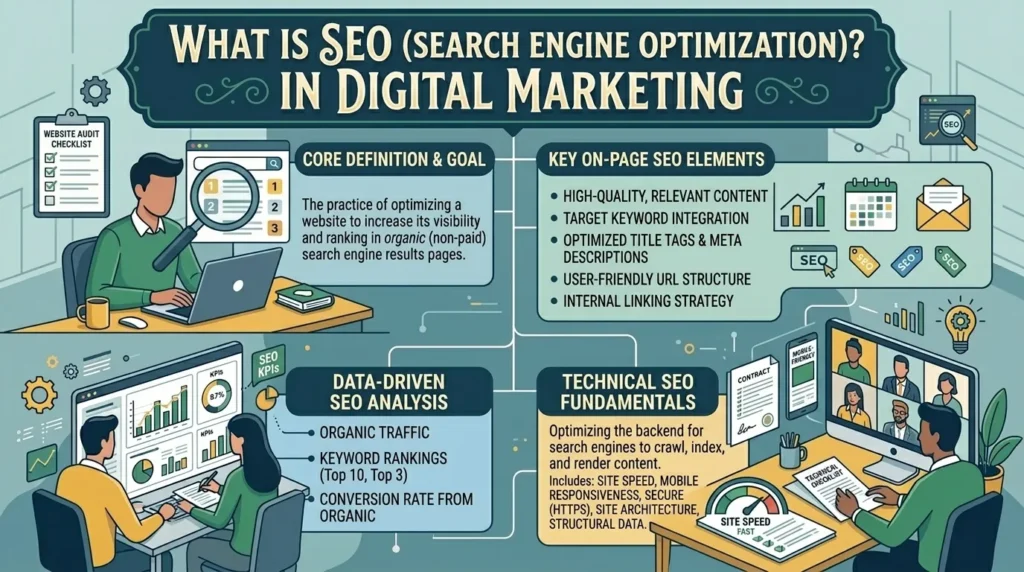
What is SEO in digital marketing — and why does every serious business need to understand it? SEO, or Search Engine Optimization, is the practice of improving your website so it appears at the top of Google and other search engine results pages when your target audience searches for products or services you offer. Within the broader ecosystem of digital marketing, SEO is the channel responsible for earning organic — meaning unpaid — visibility in search results.
Unlike paid advertising where visibility stops the moment your budget runs out, SEO in digital marketing builds a compounding asset. Every optimization you make, every piece of quality content you publish, and every authoritative backlink your website earns contributes to a growing foundation of search visibility that works for your business 24 hours a day, seven days a week — without ongoing ad spend.
For businesses in Lahore, Karachi, Islamabad, and across Pakistan, understanding what SEO means in digital marketing is the first step toward building an online presence that consistently attracts qualified customers and drives sustainable business growth.
Why SEO Is the Most Valuable Digital Marketing Channel
Within digital marketing, businesses have many channels to choose from — social media, paid advertising, email marketing, influencer partnerships, and more. Each channel plays a role. But SEO consistently delivers the highest long-term return on investment of any digital marketing channel, for one fundamental reason: it captures demand that already exists.
When someone searches “digital marketing agency in Lahore” or “best SEO services Pakistan,” they are not browsing passively — they are actively looking for exactly what you offer. SEO in digital marketing positions your business in front of that high-intent audience at the exact moment they are ready to engage.
Consider these realities that make SEO indispensable in any digital marketing strategy:
- 93% of all online experiences begin with a search engine
- The first organic result on Google receives approximately 27% of all clicks
- 75% of users never scroll past the first page of search results
- Organic search drives over 50% of all website traffic across industries
- SEO leads have a 14.6% close rate compared to 1.7% for outbound marketing
These numbers explain why businesses that invest consistently in SEO as part of their digital marketing strategy build a compounding competitive advantage that grows stronger over time.
How Search Engines Work
To understand SEO in digital marketing, you need to understand what search engines actually do — because SEO is fundamentally about aligning your website with how search engines evaluate and rank content.
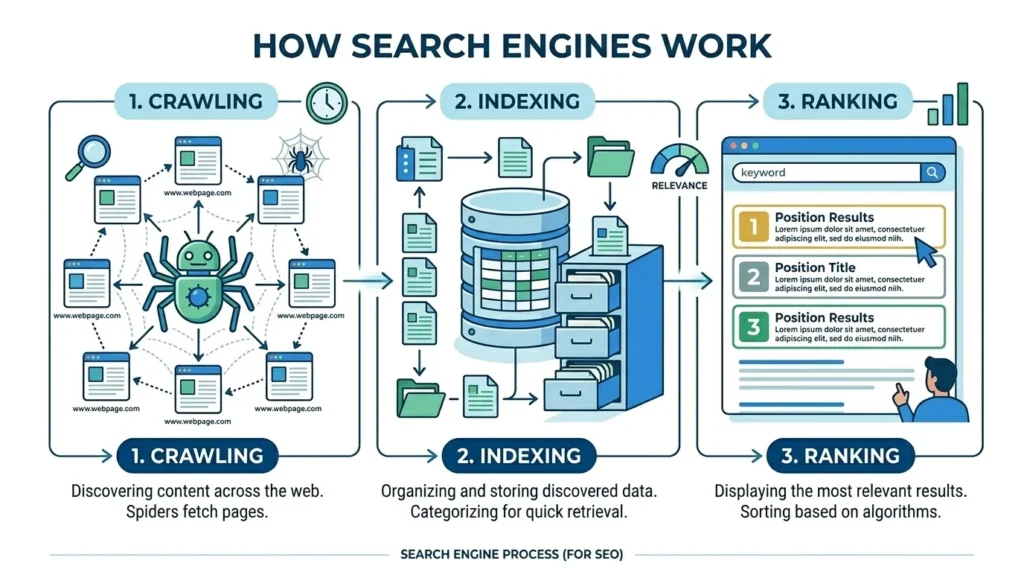
Search engines like Google operate through three core processes:
Crawling
Search engine bots — called crawlers or spiders — continuously browse the internet, following links from page to page and discovering new and updated content. If your website cannot be properly crawled, it cannot be indexed or ranked. Technical SEO ensures your website is fully accessible to these crawlers.
Indexing
Once a page is crawled, Google evaluates whether it should be added to its index — the massive database of web pages that Google draws from when generating search results. Pages with thin content, duplicate content, or technical issues may be crawled but not indexed.
Ranking
When a user enters a search query, Google’s algorithm evaluates all indexed pages relevant to that query and ranks them based on hundreds of factors — including content relevance, page authority, user experience signals, E-E-A-T (Experience, Expertise, Authoritativeness, Trust), and Core Web Vitals performance.
SEO in digital marketing is the process of optimizing your website across all three of these stages — ensuring your pages are crawlable, indexable, and compelling enough to rank at the top of results for your target keywords.
The Three Pillars of SEO in Digital Marketing
SEO in digital marketing is built on three interconnected pillars. Understanding each pillar — and how they work together — is essential for building a strategy that produces consistent, long-term results.
Pillar 1 — On-Page SEO
Everything on your actual web pages that you optimize for search engines and users — content quality, keyword placement, heading structure, meta tags, internal linking, and user experience.
Pillar 2 — Off-Page SEO
Everything that happens outside your website that signals authority and trust to Google — primarily backlinks from other websites, brand mentions, digital PR, and social signals.
Pillar 3 — Technical SEO
The technical infrastructure of your website that determines whether search engines can effectively crawl, index, and understand your content — including site speed, mobile responsiveness, Core Web Vitals, structured data, and URL architecture.
All three pillars must be strong for SEO in digital marketing to deliver consistent results. A website with excellent content but poor technical SEO will struggle to rank. A technically perfect website with no quality content or backlinks will equally fail to compete.
On-Page SEO — Optimizing What You Control
On-page SEO is the most directly controllable element of SEO in digital marketing. It involves optimizing every element on each individual page of your website to align with both user needs and search engine requirements.
Title Tags and Meta Descriptions
Your title tag is the clickable headline that appears in Google search results. It should include your primary keyword near the beginning and stay within 60 characters. Your meta description — the summary text below the title — should include your keyword naturally, communicate clear value, and stay within 155 characters. Together, these elements determine your click-through rate from search results.
Heading Structure (H1, H2, H3)
Every page should have exactly one H1 tag containing your primary keyword. H2 and H3 headings should organize your content logically while incorporating secondary keywords and semantic variations. Proper heading structure helps Google understand your page’s topic hierarchy and helps users navigate your content.
Keyword Placement and Density
Your primary keyword should appear naturally in your first paragraph, in at least two to three H2 subheadings, throughout the body content at a natural density, in your image alt text, and in your URL slug. Keyword stuffing — forcing keywords unnaturally — is penalized by Google and should always be avoided.
Internal Linking
Linking between related pages on your own website distributes page authority, helps Google discover and understand your content structure, and keeps users engaged longer. Every page should have relevant internal links pointing to other useful pages on your site.
Content Quality and Search Intent
The most important on-page SEO factor is whether your content genuinely satisfies the search intent behind your target keyword. Google’s algorithm has become extremely sophisticated at identifying whether a page truly answers what the user was looking for — comprehensively, accurately, and in a format that is easy to consume.
Off-Page SEO — Building Authority and Trust
Off-page SEO refers to actions taken outside your website that influence your search engine rankings. The most powerful off-page SEO signal in digital marketing remains backlinks — links from other websites pointing to yours.
Why Backlinks Matter in SEO
Google treats backlinks as votes of confidence. When a high-authority, relevant website links to your content, it signals to Google that your page is trustworthy and valuable. The more quality backlinks your website earns, the higher your domain authority — and the easier it becomes to rank for competitive keywords.
Not all backlinks are equal. A single link from a highly authoritative, topically relevant website carries far more weight than hundreds of links from low-quality or irrelevant sources. Quality always outweighs quantity in modern SEO.
Ethical Link Building Strategies
- Guest posting — contributing expert articles to relevant industry publications in exchange for an author link
- Digital PR — earning mentions and links from news websites, industry blogs, and authoritative sources through newsworthy content or data
- Linkable asset creation — publishing original research, comprehensive guides, or useful tools that other websites naturally link to
- Local citations — ensuring your business is consistently listed across Pakistani business directories, Google Business Profile, and local listing platforms
Brand Mentions and Social Signals
While not direct ranking factors, brand mentions across the web — even without links — contribute to Google’s understanding of your brand’s authority and reputation. Active social media presence amplifies content reach, which indirectly supports link acquisition.
Technical SEO — The Foundation Everything Sits On
Technical SEO is the infrastructure layer of SEO in digital marketing. Even the best content and strongest backlink profile cannot overcome a website with serious technical problems. Google simply cannot rank pages it cannot properly access, understand, and evaluate.
Core Web Vitals
Google’s Core Web Vitals are a set of specific measurements that assess real-world user experience on your website:
- LCP (Largest Contentful Paint) — how fast your main content loads. Target: under 2.5 seconds
- INP (Interaction to Next Paint) — how quickly your page responds to user interactions. Target: under 200ms
- CLS (Cumulative Layout Shift) — how stable your page layout is as it loads. Target: under 0.1
Pages that fail Core Web Vitals thresholds are at a disadvantage in Google rankings, particularly since these became official ranking signals in 2021.
Mobile Responsiveness
Google uses mobile-first indexing — meaning it primarily evaluates the mobile version of your website for ranking purposes. If your website provides a poor experience on mobile devices, your rankings will suffer regardless of how good your desktop experience is.
Site Architecture and Crawlability
Your website’s URL structure, internal linking architecture, XML sitemap, and robots.txt file all determine how efficiently Google can discover and index your pages. A well-structured website ensures Google can find every important page and understand how they relate to each other.
Page Speed
Slow-loading pages damage both user experience and SEO rankings. Image optimization, browser caching, minified CSS and JavaScript, and quality hosting all contribute to faster page load times that support both user satisfaction and search engine performance.
Keyword Research — The Starting Point of Every SEO Strategy
Keyword research is the process of identifying the exact terms and phrases your target audience uses when searching for information, products, or services related to your business. It is the strategic foundation of SEO in digital marketing — without it, you are optimizing for keywords nobody searches or keywords you cannot realistically rank for.
Effective keyword research involves identifying:
- Primary keywords — your main target terms with significant search volume and clear relevance to your business
- Long-tail keywords — more specific, lower-competition phrases that indicate high purchase intent (for example, “affordable SEO services for small business in Lahore”)
- LSI keywords (Latent Semantic Indexing) — semantically related terms that help Google understand the full context of your content
- Question-based keywords — queries beginning with what, how, why, when, and which that indicate informational intent and are ideal for blog content
- Competitor keywords — terms your competitors are ranking for that represent opportunities for your business
Understanding the search intent behind each keyword — whether the user wants information, wants to navigate to a specific site, or is ready to make a purchase — determines what type of content you should create to satisfy that query and rank effectively.
SEO vs Paid Advertising in Digital Marketing
A common question for businesses new to digital marketing is whether to invest in SEO or pay-per-click (PPC) advertising. The honest answer is that both serve different purposes — and the most effective digital marketing strategies use both in coordination.
| Factor | SEO in Digital Marketing | PPC Advertising |
|---|---|---|
| Cost | Time and expertise investment | Ongoing ad spend required |
| Speed | 3–6 months for results | Immediate traffic |
| Sustainability | Long-term compounding asset | Stops when budget stops |
| Click-through rate | Higher organic trust | Lower — labeled as ads |
| Targeting | Keyword and intent-based | Highly precise demographic targeting |
| Best for | Long-term growth foundation | Product launches, fast lead generation |
| ROI timeline | High over 12+ months | Immediate but ongoing cost |
For most businesses in Pakistan, the recommended approach is to invest in SEO as the long-term foundation of digital marketing while using PPC strategically for immediate demand generation — particularly during the early months when SEO results are still building.
How Long Does SEO Take to Show Results?
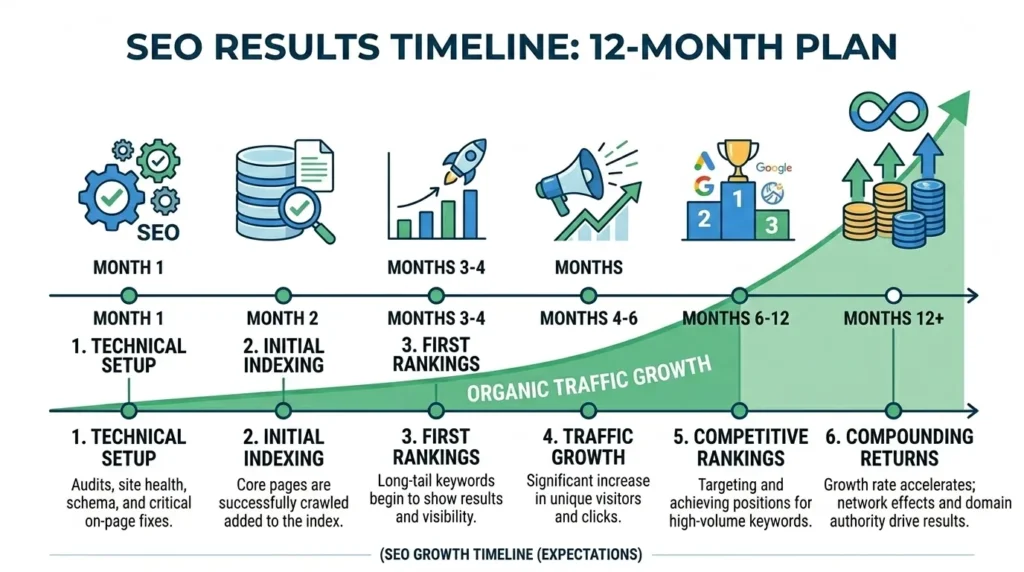
This is one of the most common questions about SEO in digital marketing — and the honest answer requires understanding what “results” means at each stage.
Months 1–2: Technical fixes, on-page optimization, and content creation begin. Google starts crawling and indexing new and improved pages. No significant ranking changes yet.
Months 3–4: Initial ranking movement begins. Lower-competition long-tail keywords start appearing in search results. Organic traffic shows early signs of growth. Backlink acquisition begins producing authority signals.
Months 4–6: Measurable ranking improvements for target keywords. Organic traffic growth becomes clearly visible in Google Search Console and Analytics. Content published in earlier months begins gaining traction.
Months 6–12: Significant rankings improvements for competitive keywords. Organic traffic growth compounds month over month. Domain authority strengthens as backlink profile grows. ROI becomes clearly positive.
12+ months: Top-page and top-3 rankings for competitive keywords become achievable for well-executed strategies. Organic traffic becomes a primary, reliable source of qualified leads. The compounding nature of SEO in digital marketing becomes clearly apparent.
The timeline varies based on your starting domain authority, competition level, budget, and execution quality. Businesses in less competitive niches or targeting local keywords may see faster results. Highly competitive national or international keywords require longer investment periods.
SEO in Digital Marketing for Pakistani Businesses
Pakistan’s digital landscape is evolving rapidly, and the opportunity for businesses to grow through SEO in digital marketing has never been greater. With over 130 million internet users and Google firmly established as the dominant search engine, Pakistani consumers across every industry now search online before making purchasing decisions.
Key SEO opportunities for Pakistani businesses right now:
Local SEO dominance — most Pakistani cities remain significantly underserved in terms of quality local SEO. Businesses in Lahore, Karachi, Islamabad, Rawalpindi, and Faisalabad that invest in local SEO now can establish dominant positions before competition intensifies.
Bilingual content opportunity — creating quality content in both English and Urdu allows businesses to reach significantly larger audiences and rank for keywords that competitors producing only English content are missing entirely.
Google Business Profile — optimizing your Google Business Profile for local search is one of the fastest ways to appear in Google’s local pack results — the map listings that appear above organic results for location-based searches.
Industry-specific keyword gaps — across healthcare, real estate, education, legal services, and professional services in Pakistan, significant keyword opportunities exist where quality, comprehensive content can rank relatively quickly due to limited existing competition.
At SiteNova Agency, we specialize in helping Pakistani businesses build SEO strategies that capitalize on these opportunities — combining technical expertise, quality content creation, and ethical link building to produce rankings that grow your business sustainably. Learn more about our approach on our SEO Services page.
How to Choose the Right SEO Agency
If you are considering working with an SEO agency to execute your digital marketing strategy, choosing the right partner is critical. The wrong agency — especially one using black hat tactics — can do more damage to your website’s rankings than no SEO at all.
Key questions to ask any SEO agency before engaging them:
- What specific SEO strategies and techniques do you use?
- Can you share case studies or examples of results achieved for similar businesses?
- How do you measure and report on SEO performance?
- What does your link building process look like?
- How do you stay current with Google algorithm updates?
- What realistic results can I expect in what timeframe?
Red flags that indicate an agency may be using harmful tactics include guarantees of specific ranking positions within days or weeks, extremely cheap packages offering hundreds of backlinks, no transparency about their methods, and no clear reporting structure.
A reputable SEO agency will always be transparent about their strategy, realistic about timelines, and focused on building genuine authority rather than chasing shortcuts that carry penalty risk.
For an authoritative reference on what Google itself considers best practice in SEO, review Google’s Search Essentials — the official guidelines that define the boundaries of ethical, effective SEO in digital marketing.
Frequently Asked Questions About SEO in Digital Marketing
Q: What is SEO in digital marketing in simple terms?
SEO in digital marketing is the process of improving your website so it appears at the top of Google search results when potential customers search for what you offer — without paying for ads. It involves optimizing your content, website structure, and online authority to earn organic visibility that drives consistent, qualified traffic to your business.
Q: Is SEO part of digital marketing?
Yes — SEO is one of the core channels within digital marketing. While digital marketing encompasses SEO, paid advertising, social media, email marketing, content marketing, and more, SEO is widely considered the most important long-term channel because it captures high-intent search demand and builds a compounding organic traffic asset.
Q: What is the difference between SEO and SEM in digital marketing?
SEO (Search Engine Optimization) refers to earning organic — unpaid — rankings in search results. SEM (Search Engine Marketing) is a broader term that encompasses both SEO and paid search advertising (PPC). In practice, many marketers use SEM to refer specifically to paid search campaigns, while SEO refers to organic optimization.
Q: How much does SEO cost for a business in Pakistan?
SEO costs in Pakistan vary based on competition level, the scope of work, and the agency you work with. Basic local SEO packages may start from PKR 25,000–50,000 per month. Comprehensive SEO campaigns targeting competitive national keywords typically range from PKR 75,000–200,000+ per month. The investment is justified by the long-term organic traffic and lead generation SEO produces.
Q: Can I do SEO myself without hiring an agency?
Basic SEO improvements — optimizing title tags, improving page speed, writing quality content, and setting up Google Search Console — can be done independently with the right knowledge. However, competitive SEO in digital marketing, particularly link building, technical auditing, and advanced content strategy, typically requires specialized expertise to execute effectively.
Conclusion — SEO Is the Long-Term Engine of Digital Marketing Success
Understanding what SEO is in digital marketing is just the beginning. The real value comes from executing an SEO strategy consistently, patiently, and with a genuine commitment to creating content and building a website that earns its rankings through quality.
SEO in digital marketing is not a quick fix or a one-time project. It is an ongoing investment in your business’s most valuable digital asset — its organic search visibility. Every algorithm update Google releases, every new competitor that enters your market, and every piece of content you publish either strengthens or weakens your position in search results.
The businesses that treat SEO as a foundational pillar of their digital marketing strategy — investing consistently in technical excellence, quality content, and ethical link building — are the ones that build dominant, defensible online positions that drive qualified traffic and business growth for years.
SiteNova Agency is a specialized digital marketing and SEO agency based in Lahore, Pakistan. We help businesses across Pakistan and the United States build SEO strategies that produce real, measurable results — from improved rankings and organic traffic to qualified leads and sustainable revenue growth. If you are ready to make SEO work for your business, we are here to help.