Table of Contents
- Introduction — Why SEO Strategy Matters
- What Is White Hat SEO?
- Core White Hat SEO Techniques
- What Is Black Hat SEO?
- Common Black Hat SEO Tactics to Avoid
- Grey Hat SEO — The Middle Ground
- White Hat vs Black Hat SEO — Side-by-Side Comparison
- Why Black Hat SEO Is Never Worth the Risk
- How Google Detects and Penalizes Black Hat Practices
- How to Build a Sustainable White Hat SEO Strategy
- Frequently Asked Questions
- Conclusion
Introduction — Why Your SEO Strategy Defines Your Online Future
Every business today competes for attention in search engine results pages (SERPs). Whether you run a local shop in Lahore or an e-commerce brand targeting US customers, organic search visibility is one of the most powerful — and cost-effective — ways to attract qualified leads.
But here is the critical question: how you pursue those rankings matters just as much as whether you rank at all.
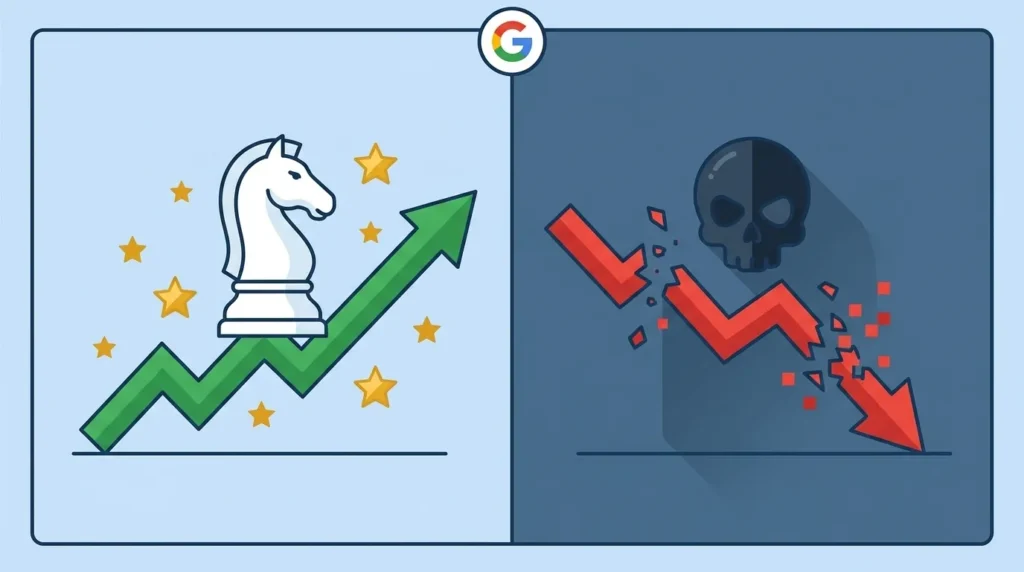
SEO strategies generally fall into two broad categories — white hat SEO and black hat SEO. Understanding the difference between these two approaches is not just academic. It is the difference between building a business asset that grows over time and taking shortcuts that can wipe out your website’s visibility overnight.
This guide breaks down both approaches comprehensively — what they mean, how they work, and why choosing the right path determines your long-term digital success
What Is White Hat SEO?
White hat SEO refers to the use of optimization strategies and techniques that align with search engine guidelines, primarily Google’s Webmaster Guidelines. These are ethical, user-first practices designed to improve a website’s search rankings by genuinely improving its quality, relevance, and authority.
The term “white hat” comes from old Western films where heroes wore white hats — it symbolizes doing things the right way, for the right reasons.
At its core, white hat SEO asks one fundamental question before any action: does this genuinely help the user? If the answer is yes, it is almost always aligned with what Google rewards in its ranking algorithm.
Key Principle of White Hat SEO: Create content and build a website experience so valuable that search engines have no choice but to rank it. Earn your rankings — do not manipulate them.
White hat SEO is not a shortcut. It requires patience, expertise, and consistency. But the results it produces are durable — resistant to algorithm changes and built on a foundation of genuine authority.
Core White Hat SEO Techniques
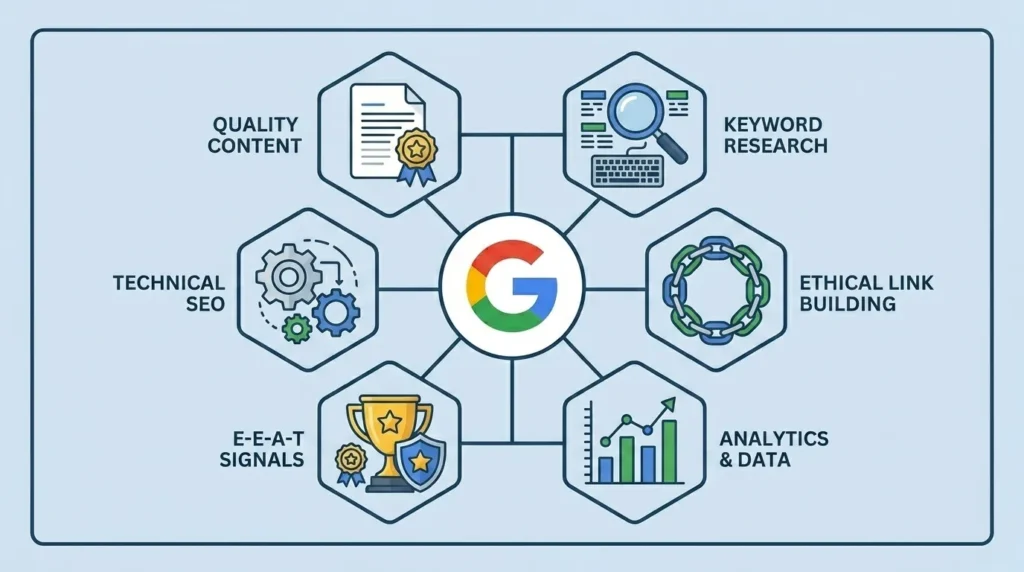
Understanding white hat SEO in practice means knowing which specific techniques fall under this category. Here are the foundational pillars:
High-Quality, Intent-Driven Content Creation
Google’s primary goal is to connect users with the most relevant, trustworthy answer to their search query. White hat SEO fulfills this by creating content that genuinely addresses search intent — whether that intent is informational, navigational, or transactional.
This means writing blog posts, service pages, and landing pages that thoroughly cover a topic, use natural language, include semantic variations of target keywords, and answer the questions your audience is actually asking.
Keyword Research and Semantic Optimization
Effective white hat SEO starts with deep keyword research. This involves identifying not just primary keywords, but also LSI keywords (Latent Semantic Indexing terms), related entities, and long-tail keyword variations that signal topical authority to search engines.
For example, a page targeting “digital marketing agency in Lahore” should also naturally include related terms like online marketing services, SEO company Pakistan, brand visibility, organic search growth, and conversion optimization.
On-Page SEO Optimization
On-page optimization ensures each page is technically structured for both users and search engines. This includes:
- Optimized title tags with primary keyword near the beginning
- Meta descriptions that improve click-through rate (CTR)
- Proper heading hierarchy (H1 once, H2/H3 for structure)
- Internal linking between related pages to pass authority
- Image optimization with descriptive alt text
- URL structure that is short, descriptive, and keyword-relevant
- Schema markup for rich snippets and AI Overview eligibility
Ethical Link Building
Backlinks remain one of Google’s strongest ranking signals. White hat link building focuses on earning links — through guest posting on relevant high-authority websites, creating linkable assets like research reports or tools, digital PR, and building genuine relationships with industry publications.
The key distinction is that white hat links are editorially given — a website links to you because your content genuinely deserves the reference. These links carry real authority and topical relevance.
Technical SEO and Core Web Vitals
White hat SEO includes ensuring your website’s technical foundation is solid. This means fast page load speeds, mobile responsiveness, correct canonical tags, clean crawlability, structured data implementation, and passing Google’s Core Web Vitals thresholds for LCP, INP, and CLS.
E-E-A-T: Experience, Expertise, Authoritativeness, and Trust
Google’s quality evaluator guidelines emphasize E-E-A-T as a key framework for assessing content quality. White hat SEO actively builds these signals through author credentials, first-hand content, trust indicators like reviews and testimonials, and citations from authoritative sources.
What Is Black Hat SEO?
Black hat SEO refers to aggressive optimization tactics that violate search engine guidelines. These practices attempt to manipulate search rankings artificially — exploiting loopholes in Google’s algorithm rather than genuinely earning visibility through quality.
Again, the term comes from old Western films — the villain always wore a black hat.
Black hat techniques prioritize short-term ranking gains over user experience, content quality, or long-term sustainability. While some tactics may produce quick results, they carry severe risks including Google penalties, manual actions, and complete deindexation of a website from search results.
Critical Warning: Any SEO agency that promises first-page rankings within days, guarantees specific ranking positions, or offers hundreds of backlinks for a small fee is almost certainly using black hat tactics. These shortcuts will damage your website’s long-term performance.
Common Black Hat SEO Tactics to Avoid
Keyword Stuffing
Keyword stuffing involves overloading a page with target keywords beyond what reads naturally. For example, repeating “best SEO agency Lahore” eight times on a single page in forced, unnatural ways. Google’s NLP systems now identify keyword density manipulation and penalize pages for it.
Cloaking
Cloaking means showing different content to search engine crawlers than what is shown to human users. A page might show Google high-quality optimized content while displaying low-quality or even unrelated content to actual visitors. This is one of the most serious violations of Google’s guidelines.
Private Blog Networks (PBNs)
A PBN is a network of websites built specifically to create backlinks pointing to a target site. These links are not earned — they are artificially manufactured to fake authority. Google’s spam detection has become highly sophisticated at identifying PBN patterns, and sites caught using them face severe penalties.
Buying Links
Purchasing backlinks — paying websites to include links to your site — is a direct violation of Google’s link spam policies. While some link purchasing may go undetected initially, Google’s SpamBrain AI and manual review teams actively target paid link schemes.
Duplicate and Thin Content
Publishing large volumes of low-quality, duplicated, or auto-generated content to target many keywords simultaneously is a black hat practice. Google’s Helpful Content system directly targets this, downranking websites that prioritize search engine traffic over genuine user value.
Hidden Text and Links
Placing text or links on a page that are invisible to human visitors — using white text on a white background or using CSS to move content off-screen — is a form of deception that Google penalizes.
Doorway Pages
Doorway pages are low-quality pages created to rank for specific keyword variations, designed to funnel users to a different destination. They provide no unique value — they exist solely to manipulate rankings.
Grey Hat SEO — The Middle Ground
Between the clearly ethical white hat approach and the clearly manipulative black hat approach sits a middle zone: grey hat SEO.
Grey hat tactics are not explicitly prohibited by Google’s guidelines, but they push the boundaries of what is considered acceptable. Examples include aggressive anchor text optimization, article spinning with significant rewriting, and some forms of social signal manipulation.
Grey hat SEO carries moderate risk — what Google tolerates today may become a penalized practice in the next algorithm update. Businesses serious about long-term digital growth should build their strategy primarily on white hat foundations.
White Hat vs Black Hat SEO — Side-by-Side Comparison
| Factor | White Hat SEO | Black Hat SEO |
|---|---|---|
| Timeline | 3–12 months | Days to weeks |
| Risk Level | Very Low | Very High |
| Sustainability | Long-term, stable | Short-lived, volatile |
| Google Penalty Risk | Minimal | High — manual or algorithmic |
| Content Quality | Unique, valuable, expert | Thin, duplicate, AI-spun |
| Link Building | Earned, editorial links | Bought, spammy, PBN links |
| User Experience | Central to strategy | Ignored or manipulated |
| ROI | High over time | Low — resets with each penalty |
| Suitable For | Every business | Not recommended for any business |
Why Black Hat SEO Is Never Worth the Risk
The appeal of black hat SEO is understandable — faster results, lower effort, quicker rankings. But the business reality is stark.
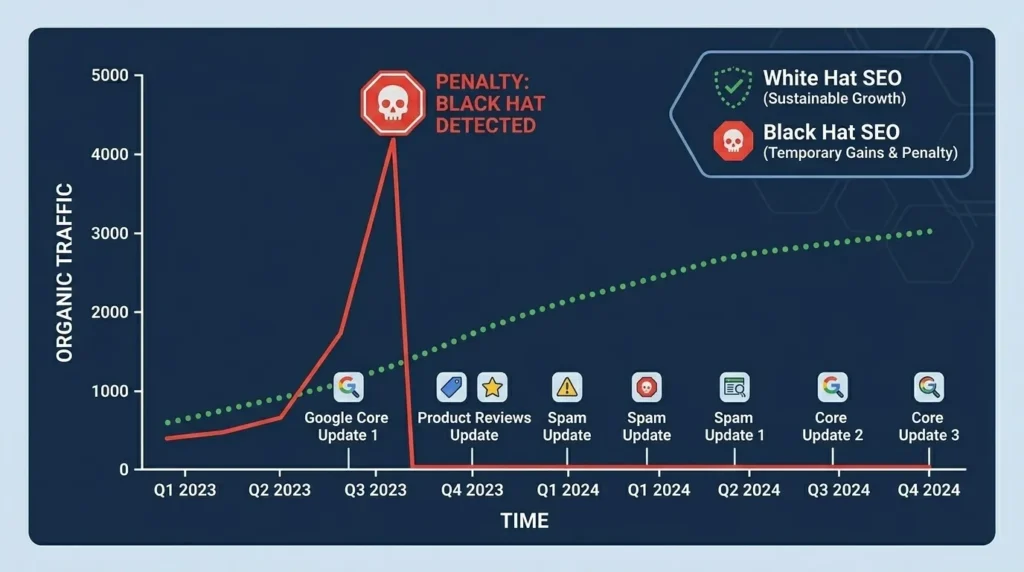
Google rolls out hundreds of algorithm updates every year. Major core updates — like the May 2022 Helpful Content Update, the September 2023 Helpful Content System, and the March 2024 Core Update — have wiped out the rankings of thousands of websites that relied on manipulative tactics overnight.
When a black hat penalty hits, recovery is not just difficult — it is often months-long and sometimes impossible. You do not just lose your rankings. You lose your organic traffic, your leads, your revenue, and in severe cases your domain’s ability to rank at all.
Compare this to white hat SEO: once rankings are established through genuine authority and quality content, they are resistant to algorithm changes. Sites with strong E-E-A-T signals, quality backlink profiles, and genuinely helpful content consistently maintain and improve their positions across Google updates.
💡 Real-World Cost: A business that achieves first-page rankings through black hat tactics for 3 months, then receives a manual penalty, faces a recovery process that typically takes 6–18 months — wiping out all short-term gains and setting the business back significantly further than if they had started with white hat SEO from the beginning.
How Google Detects and Penalizes Black Hat Practices
SpamBrain — Google’s AI-Powered Spam Detector
SpamBrain is Google’s AI-based spam prevention system. It identifies unnatural link patterns, content farms, cloaking behavior, and coordinated manipulation at scale — often before human reviewers even review a site.
Manual Actions
Google’s search quality reviewers issue manual actions when they identify clear violations of webmaster guidelines. A manual action can result in specific pages being removed from search results or an entire domain being penalized. Manual actions are documented in Google Search Console and require formal reconsideration requests to resolve.
Helpful Content System
Now part of Google’s core ranking algorithm, the Helpful Content system assesses whether a website’s content is created primarily for search engines or for actual human readers. Sites with predominantly low-quality, search-engine-first content receive a site-wide classifier that suppresses all rankings.
Link Spam Policies
Google’s algorithms evaluate every link pointing to your site. Unnatural anchor text distribution, links from irrelevant or low-authority domains, sudden spikes in link acquisition, and links from known PBN networks all trigger algorithmic detection.
10. How to Build a Sustainable White Hat SEO Strategy
Step 1 — Conduct a Comprehensive SEO Audit
Before optimizing, understand your current position. A thorough audit covers technical health, on-page factors, content gaps, and backlink profile quality.
Step 2 — Build a Keyword and Topical Authority Map
Identify your primary target keywords, map them to specific pages, and plan supporting content that builds topical authority around your core themes.
Step 3 — Create Content That Genuinely Answers Questions
Every piece of content you publish should address a specific user need better than existing search results. Use People Also Ask, related searches, and competitor gap analysis to ensure comprehensive coverage.
Step 4 — Optimize Technical SEO Foundations
Ensure your website loads fast, is fully mobile-responsive, uses HTTPS, has a clean URL structure, and passes Core Web Vitals. Add schema markup to qualify for rich results.
Step 5 — Build Authority Through Ethical Link Acquisition
Develop a consistent outreach strategy for guest posting on relevant, high-authority websites. Create linkable content assets — original research, industry reports, comprehensive guides — that attract natural editorial links.
Step 6 — Monitor, Measure, and Adapt
Use Google Search Console, Google Analytics, and rank tracking tools to monitor performance monthly. Track keyword movement, organic traffic trends, Core Web Vitals scores, and backlink acquisition.
Related Reading on SiteNova Agency: If you are ready to implement a white hat SEO strategy for your business, explore our SEO Services in Pakistan — where we apply every principle covered in this guide to help businesses in Lahore, Karachi, Islamabad, and beyond achieve sustainable first-page rankings.
11. Frequently Asked Questions
Q: Is white hat SEO really worth the wait?
Yes — without question. White hat SEO builds compounding returns. Every piece of quality content you publish, every authoritative backlink you earn, and every technical improvement you make adds to a growing asset. White hat results, once established, are significantly more durable and defensible.
Q: Can I mix white hat and black hat SEO techniques?
This is what is commonly called grey hat SEO. While some grey hat practices are not explicitly prohibited, they carry unpredictable risk. As Google’s algorithm evolves, the boundary of what is acceptable shifts. Building primarily on white hat foundations protects your investment against future algorithm changes.
Q: How quickly can white hat SEO produce results?
Most businesses see measurable improvement in keyword rankings and organic traffic within 3 to 4 months of consistent white hat SEO implementation. Competitive keywords may take 6 to 12 months to achieve top-page positions.
Q: How do I know if my current SEO agency is using black hat tactics?
Red flags include promises of specific ranking positions within days, very cheap link packages offering hundreds of links, no transparency about techniques being used, no regular performance reporting, and sudden ranking spikes followed by drops.
Q: Does black hat SEO work at all?
Some black hat techniques can produce short-term ranking gains. However, these gains are inherently unstable. Google’s detection systems improve continuously. What works for weeks or months invariably leads to penalties that take far longer to recover from than the gains were worth.
12. Conclusion — Build Rankings That Last
The choice between white hat and black hat SEO is ultimately a choice between building a long-term business asset and chasing short-term results at serious risk.
White hat SEO demands patience, expertise, and consistency. But it is the only approach that produces rankings you can depend on — rankings built on genuine authority, trusted content, and real user value that search engines have no reason to take away.
Black hat SEO, no matter how tempting the shortcuts appear, is a gamble with your business’s online visibility. The penalties are severe, recovery is slow, and the fundamental problem remains: you have not actually earned your rankings.
For businesses in Pakistan and the United States looking to grow their digital presence sustainably, the path is clear: invest in ethical, user-first SEO strategies that earn rankings through quality — and protect those rankings for the long term.
🔗 Further Reading: For the official standard on what Google expects, review Google’s Search Essentials — the authoritative reference directly from Google on what is and is not acceptable in search engine optimization.