Choosing the right platform for your website is one of the most important business decisions you’ll make. Your website is more than just an online presence—it represents your brand, supports your marketing efforts, generates leads, and helps convert visitors into customers.
When business owners start planning a new website, one question almost always comes up:
Should I choose WordPress or invest in a custom website?
The answer depends on your goals, budget, growth plans, and technical requirements.
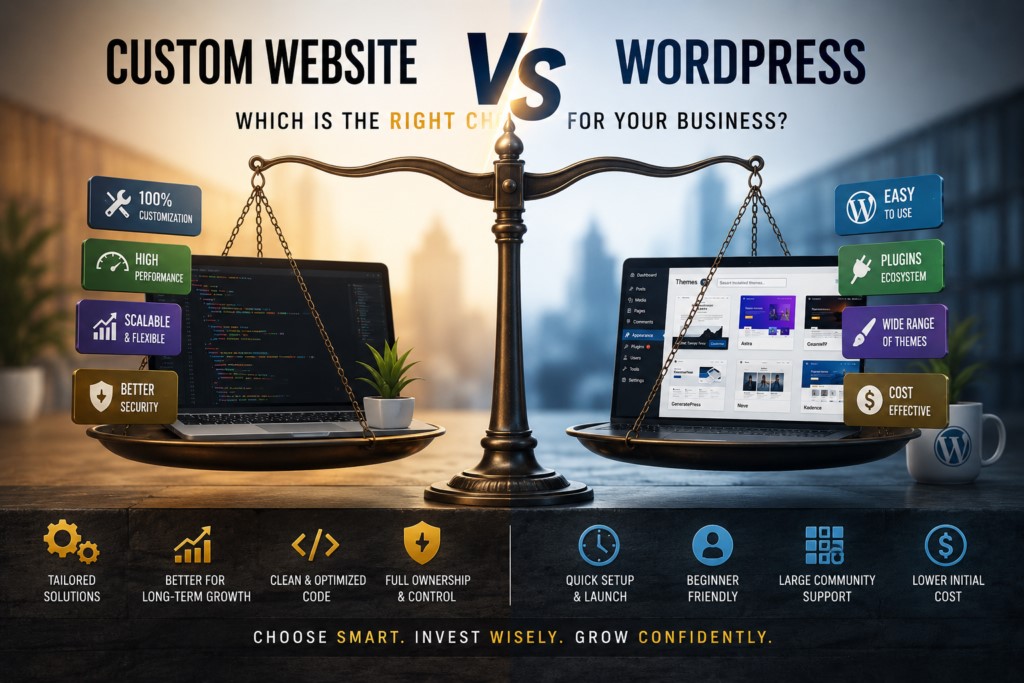
While WordPress powers millions of websites worldwide, custom website development offers flexibility, scalability, and complete control that many growing businesses need.
In this guide, we’ll compare WordPress and custom websites across performance, SEO, security, scalability, maintenance, and long-term return on investment so you can make the right decision for your business.
Understanding the Difference Between WordPress and Custom Websites
Before comparing the two, let’s understand what each option actually means.
What Is WordPress?
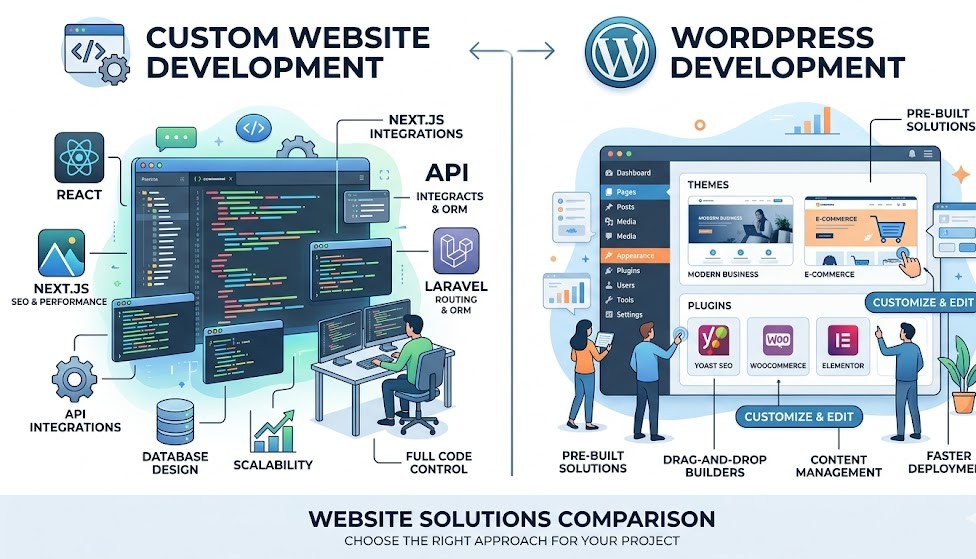
WordPress is a Content Management System (CMS) that allows users to build and manage websites without creating everything from scratch.
It offers:
- Ready-made themes
- Thousands of plugins
- Easy content management
- Faster deployment
- Lower upfront costs
WordPress is popular among:
- Small businesses
- Bloggers
- Portfolio websites
- Local service providers
- Startup companies
What Is a Custom Website?
A custom website is built specifically for your business requirements.
Instead of relying on pre-built themes and plugins, developers create the website architecture, functionality, and design according to your exact needs.
Custom websites typically use technologies such as:
- React
- Next.js
- Laravel
- PHP
- Node.js
- Custom CMS solutions
Custom development gives businesses complete flexibility and control over their digital presence.
Quick Comparison: WordPress vs Custom Website
| Feature | WordPress | Custom Website |
|---|---|---|
| Initial Cost | Lower | Higher |
| Development Time | Faster | Longer |
| SEO Flexibility | Good | Excellent |
| Performance | Good | Excellent |
| Security | Moderate | High |
| Scalability | Limited by setup | Highly scalable |
| Customization | Moderate | Unlimited |
| Maintenance | Plugin dependent | Fully controlled |
| Ownership | Shared ecosystem | Full ownership |
| Long-Term ROI | Moderate | High |
When WordPress Is the Right Choice
WordPress remains one of the best website solutions for many businesses.
You Need a Website Quickly
If speed is your priority, WordPress can launch a professional website within days rather than weeks.
You Have a Limited Budget
For startups and small businesses, WordPress provides an affordable way to establish an online presence.
You Publish Content Frequently
Blogs, news sites, and content-heavy websites benefit from WordPress’s user-friendly content management system.
You Don’t Need Complex Features
If your website only requires:
- Service pages
- Blog posts
- Contact forms
- Basic lead generation
WordPress can often handle these requirements effectively.
When a Custom Website Becomes the Better Investment
Many businesses eventually outgrow WordPress.
As operations become more complex, custom development often provides greater long-term value.
You Need Unique Functionality
Every business operates differently.
Custom websites allow you to build:
- Custom dashboards
- Advanced booking systems
- Membership portals
- CRM integrations
- Automation workflows
- Client management systems
without relying on multiple third-party plugins.
You Want Better Performance
Performance affects:
- User experience
- Search rankings
- Conversion rates
Custom websites eliminate unnecessary code and plugin bloat, resulting in faster loading times.
You Need Advanced Integrations
Growing businesses often need connections between:
- CRM software
- Email marketing platforms
- ERP systems
- Payment gateways
- Customer databases
Custom development makes these integrations much easier.
WordPress vs Custom Website for SEO
SEO is one of the biggest concerns for business owners.
Let’s compare both options.
Technical SEO
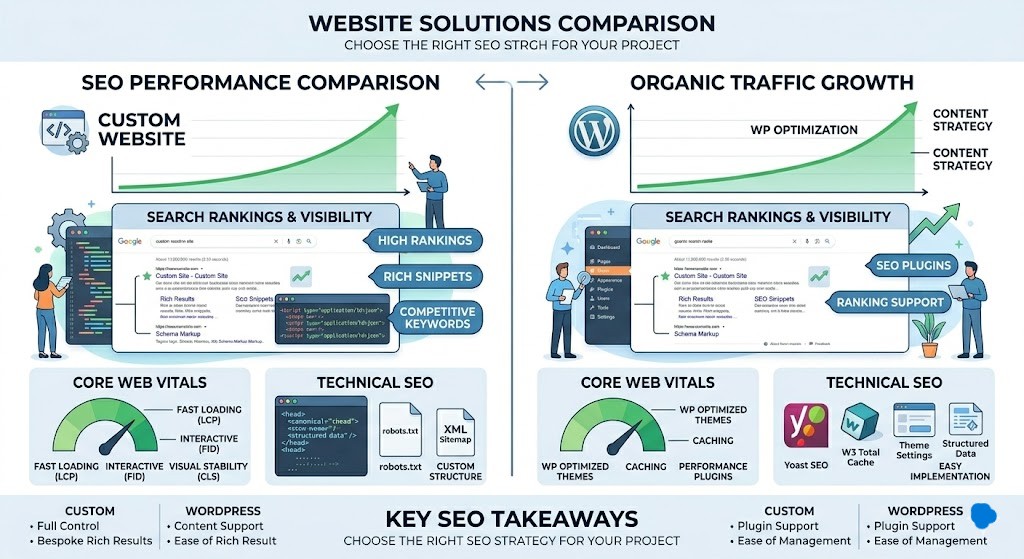
WordPress offers SEO plugins that simplify optimization.
However, custom websites provide complete control over:
- Structured data
- Schema markup
- Metadata
- URL structure
- Crawlability
- Indexability
This level of flexibility can give businesses an advantage in competitive industries.
Core Web Vitals
Google prioritizes user experience.
Core Web Vitals measure:
- Loading speed
- Visual stability
- Interactivity
Custom websites often perform better because developers can optimize code specifically for speed and user experience.
Website Architecture
Custom development allows businesses to create:
- Better internal linking structures
- Optimized navigation
- Advanced content hierarchies
- SEO-friendly architecture
These factors contribute to stronger organic visibility.
Content Management
One area where WordPress excels is content publishing.
For businesses publishing large amounts of content regularly, WordPress remains extremely efficient.
WordPress vs Custom Website for Speed and Performance
Website speed directly impacts:
- SEO rankings
- Bounce rates
- User satisfaction
- Conversions
WordPress Performance Challenges
Many WordPress websites suffer from:
- Excessive plugins
- Heavy themes
- Unoptimized scripts
- Poor hosting environments
These issues can slow down website performance significantly.
Custom Website Performance Benefits
Custom websites can be optimized for:
- Lightweight code
- Faster rendering
- Better caching
- Reduced server requests
- Improved database performance
The result is often a significantly faster user experience.
WordPress vs Custom Website for Security
Cybersecurity is no longer optional.
Every business website stores valuable information.
WordPress Security Risks
WordPress itself is secure, but vulnerabilities often arise from:
- Outdated plugins
- Poorly coded themes
- Third-party extensions
- Weak maintenance practices
Custom Website Security Advantages
Custom websites offer:
- Reduced attack surface
- Secure coding practices
- Custom authentication systems
- Controlled access management
- Enhanced data protection
For businesses handling sensitive customer information, these advantages can be significant.
Scalability: Can Your Website Grow With Your Business?
Many businesses choose a platform based on current needs rather than future growth.
This can become expensive later.
WordPress Scalability
WordPress can scale effectively with proper optimization.
However, as traffic increases and functionality expands, complexity also increases.
Businesses often end up adding:
- More plugins
- More integrations
- More maintenance
which can affect performance.
Custom Website Scalability
Custom websites are designed around business goals.
They can grow without accumulating unnecessary technical debt.
This makes them ideal for:
- Large organizations
- SaaS companies
- Ecommerce businesses
- Enterprise websites
The Hidden Costs Most Business Owners Ignore
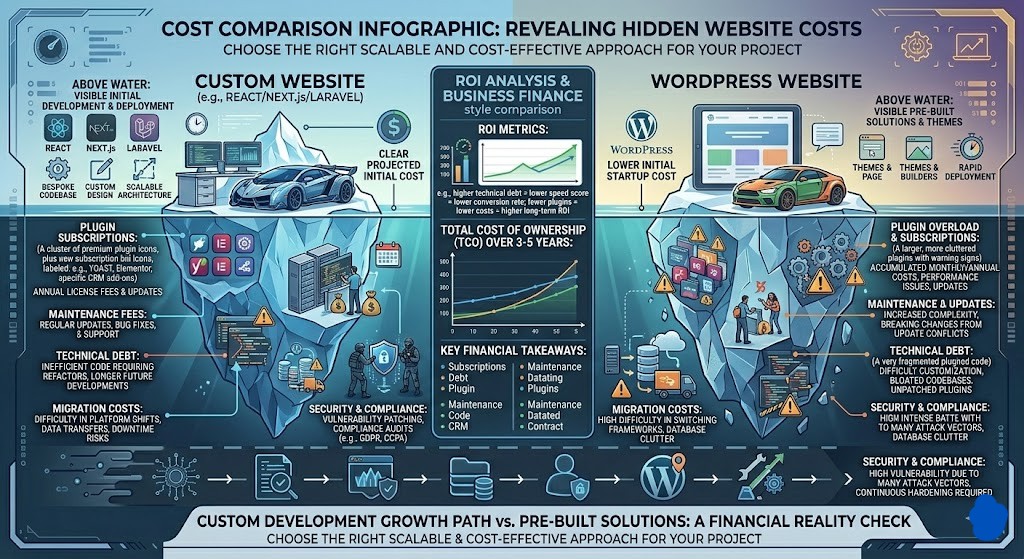
Many comparisons focus only on development costs.
That’s a mistake.
Plugin Renewal Costs
Premium plugins often require annual subscriptions.
Over time, these expenses add up.
Technical Debt
Adding multiple plugins and workarounds creates technical debt.
Eventually, businesses may need a complete rebuild.
Migration Costs
Moving from an outdated website to a better platform can become expensive.
Choosing the right solution early often saves money.
Opportunity Costs
A slow, poorly optimized website may lose:
- Leads
- Sales
- Search rankings
- Customer trust
These hidden costs are often greater than development expenses.
Website Ownership: An Overlooked Factor
One of the most important considerations is ownership.
Full Control Over Your Digital Assets
Custom websites provide complete ownership of:
- Code
- Functionality
- Architecture
- Design
You aren’t restricted by theme limitations or plugin ecosystems.
Easier Future Expansion
As business requirements change, custom development offers greater flexibility for growth and innovation.
Which Option Delivers Better ROI?
The answer depends on your business goals.
WordPress Delivers Better ROI When:
- Budget is limited
- Time-to-launch is critical
- Content publishing is the priority
- Features are relatively simple
Custom Websites Deliver Better ROI When:
- Long-term growth matters
- SEO is highly competitive
- Unique functionality is required
- Performance impacts revenue
- Scalability is essential
Recommendations by Business Type
Small Business
WordPress is often sufficient for basic service websites.
Service-Based Businesses
The best choice depends on growth plans.
Businesses focused on lead generation often benefit from custom website development.
Ecommerce Stores
Complex ecommerce operations usually benefit from custom functionality and performance optimization.
SaaS Companies
Custom development is typically the better choice due to advanced functionality requirements.
Enterprise Organizations
Custom websites provide the scalability, security, and flexibility required at enterprise level.
Why Many Growing Businesses Choose Custom Development
Modern businesses require more than a digital brochure.
They need websites that:
- Generate leads
- Improve conversions
- Support automation
- Integrate with business tools
- Scale efficiently
This is why many organizations eventually move beyond standard website solutions.
Final Verdict: WordPress or Custom Website?
There is no universal winner.
WordPress remains an excellent option for startups, bloggers, and businesses needing a cost-effective website.
However, businesses focused on growth, performance, scalability, advanced functionality, and long-term ROI often benefit more from custom website development.
The best decision depends on where your business is today—and where you want it to be in the future.
If you’re unsure which solution is right for your business, consult experienced web development professionals who can evaluate your requirements and recommend the most effective approach.
At SiteNovaAgency, businesses can receive guidance on web design, website development, SEO, content strategy, keyword research, and ongoing website maintenance to build a stronger digital presence that supports long-term growth.