Table of Contents
- Introduction
- What Is SEO?
- What Is SEM?
- SEO vs SEM: Key Differences
- How SEO Actually Works
- How SEM Actually Works
- Pros and Cons of SEO
- Pros and Cons of SEM
- SEO vs SEM: Cost Comparison
- SEO vs SEM: Which Delivers Better ROI?
- Which One Should Your Business Choose?
- Can You Use SEO and SEM Together?
- Common Mistakes Businesses Make
- How SiteNova Agency Can Help
- Final Thoughts
- FAQs
Introduction
If you’re exploring digital marketing for your business, you’ve almost certainly come across two terms that get thrown around constantly — SEO and SEM. Many business owners assume they’re the same thing, and honestly, it’s an easy mistake to make. Both strategies aim to get your business in front of people searching on Google. Both involve keywords. Both show up on the same search results page.
But here’s the truth: SEO and SEM are fundamentally different strategies, with different costs, different timelines, and different long-term value for your business. Choosing the wrong one — or not understanding how they work together — can waste your marketing budget and slow down your growth.
In this complete guide, we’ll break down SEO vs SEM in detail: how each one works, their real-world pros and cons, how much they cost, which delivers better ROI, and most importantly — which one your business actually needs in 2025.
By the end of this article, you’ll have total clarity on this debate, and you’ll know exactly how to build a smarter digital marketing strategy going forward.
What Is SEO?
SEO (Search Engine Optimization) is the process of improving your website so it ranks higher in the organic, unpaid section of search engine results. When someone searches “best digital marketing agency” or “SEO services near me,” the organic listings are the ones that appear naturally — not the ones marked “Ad.”
SEO is a long-term strategy built on trust signals. Google’s algorithm evaluates hundreds of factors to decide which websites deserve to rank, including content quality, site speed, mobile-friendliness, backlinks, and user experience.
If you want to understand the fundamentals before going further, we’ve already covered this in detail in our guide on what SEO actually means in digital marketing, which is a great starting point if you’re new to the concept.
What Is SEM?
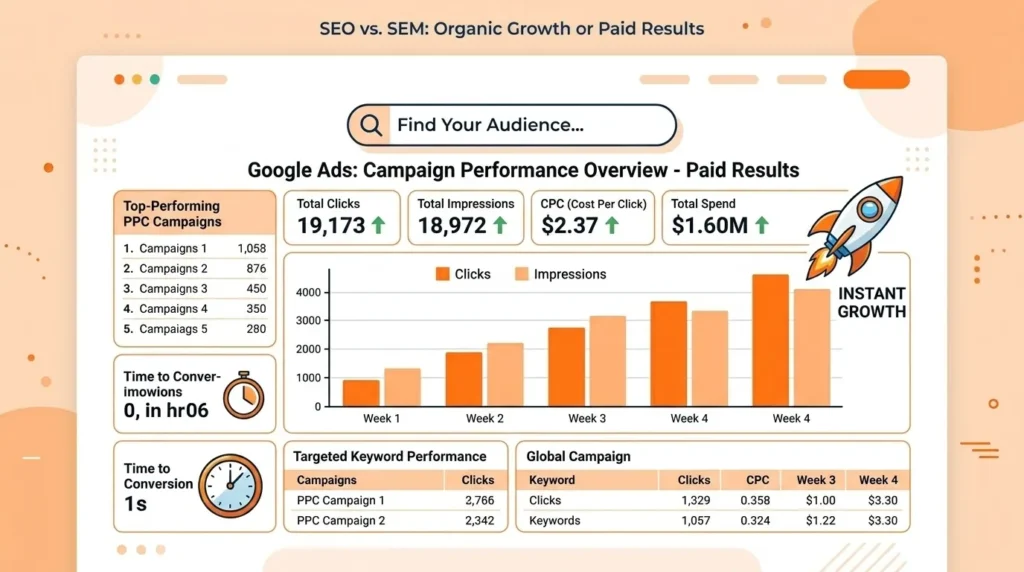
SEM (Search Engine Marketing) refers to paid advertising on search engines — most commonly through Google Ads. With SEM, businesses bid on specific keywords, and when someone searches that keyword, their ad appears at the top of the results page, marked with a small “Ad” label.
Unlike SEO, SEM delivers instant visibility. You don’t have to wait months for Google to trust your website — you simply pay for the placement. The moment your campaign goes live, your ad can appear at the top of page one.
According to Google’s own advertising resources, businesses using Search ads can reach customers at the exact moment they’re searching for related products or services — making SEM one of the most direct forms of intent-based marketing available today.
SEO vs SEM: Key Differences
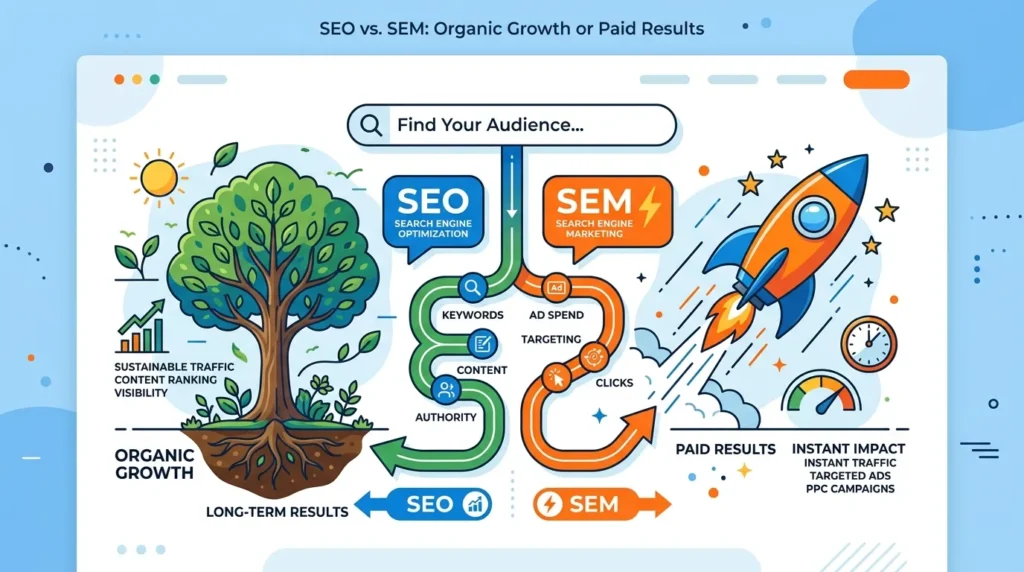
Here’s a side-by-side breakdown to make the comparison crystal clear:
| Factor | SEO | SEM |
|---|---|---|
| Cost Structure | No direct cost per click, but requires time/resource investment | Pay-per-click (PPC) — you pay every time someone clicks |
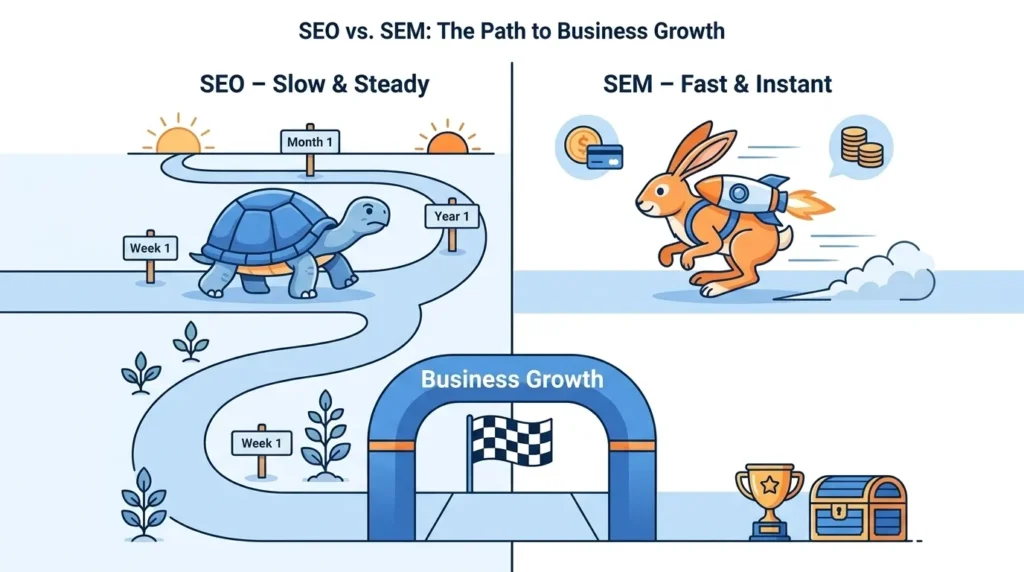
| Speed of Results | Slow — typically 3 to 6 months to see meaningful results | Instant — results within hours of launching a campaign |
| Longevity | Long-term and sustainable once rankings are achieved | Stops immediately the moment you stop paying |
| Trust Factor | Higher — users tend to trust organic results more | Lower — some users actively skip or ignore ads |
| Cost Over Time | Decreases as your rankings improve and stabilize | Remains constant or increases due to competition |
| Control | Limited — rankings depend on Google’s algorithm | Full control — you choose keywords, budget, and timing |
| Best Use Case | Long-term brand building and authority | Quick sales, product launches, time-sensitive promotions |
How SEO Actually Works
SEO isn’t a single action — it’s a combination of strategies working together:
- Keyword Research: Identifying what your target audience is actually searching for
- On-Page Optimization: Optimizing titles, meta descriptions, headers, and content around target keywords
- Technical SEO: Improving site speed, mobile responsiveness, and crawlability
- Content Creation: Publishing valuable, relevant content that answers user questions
- Link Building: Earning backlinks from authoritative websites to build domain trust
Each of these elements works together over time to signal to Google that your website deserves to rank for relevant searches.
How SEM Actually Works
SEM operates on an auction-based bidding system. Here’s the basic process:
- You choose keywords relevant to your business
- You set a budget and bid amount for those keywords
- When someone searches that keyword, Google runs an auction between competing advertisers
- Your ad rank is determined by your bid amount combined with your Quality Score (relevance and landing page experience)
- You pay only when someone clicks your ad (Pay-Per-Click)
This system means SEM rewards both budget and relevance — a well-optimized, lower-budget campaign can sometimes outperform a higher-budget but poorly targeted one.
Pros and Cons of SEO
Pros:
- No direct cost per click or visitor
- Builds long-term authority, trust, and brand credibility
- Higher click-through rates compared to paid ads in most industries
- Sustainable traffic that continues even without ongoing spending
- Improves overall website quality and user experience
Cons:
- Takes several months to show meaningful results
- Requires consistent content creation and link-building effort
- Algorithm updates can impact rankings unexpectedly
- More competitive in saturated industries
Pros and Cons of SEM
Pros:
- Immediate visibility on search engines
- Highly targeted — full control over exact keywords and audience
- Easy to measure ROI through direct ad spend tracking
- Great for time-sensitive campaigns, sales, and product launches
- Flexible budget — scale up or down anytime
Cons:
- Costs can add up quickly, especially in competitive niches
- Traffic stops the moment you stop paying
- Requires ongoing budget management and optimization
- Ad fatigue can reduce performance over time
SEO vs SEM: Cost Comparison
This is one of the most common questions business owners ask, so let’s break it down practically.
SEO Costs: SEO doesn’t have a “cost-per-click,” but it does require investment in content creation, technical optimization, and link building. Many businesses invest anywhere from $500 to $5,000+ per month depending on competition and scope, with the cost typically decreasing in value over time as rankings stabilize and organic traffic compounds.
SEM Costs: SEM operates on a pay-per-click model, meaning your cost depends entirely on keyword competition. In competitive industries like legal services or insurance, cost-per-click can range from $5 to $50+ per click. In lower-competition niches, it can be as low as $0.50 to $2 per click.
The key difference: SEO cost decreases relative to traffic over time, while SEM cost stays linear — you generally pay the same (or more) for each new visitor, no matter how long you’ve been running ads.
SEO vs SEM: Which Delivers Better ROI?
There’s no universal answer — it depends on your business goals and timeline.
SEM typically wins for:
- Short-term campaigns and immediate sales
- Testing new products or markets quickly
- Businesses with limited time to wait for results
SEO typically wins for:
- Long-term brand building and sustainable growth
- Businesses with limited ongoing ad budgets
- Industries where organic trust matters (healthcare, legal, finance)
Most data shows that while SEM delivers faster initial ROI, SEO delivers significantly higher ROI over a 12+ month period because the traffic becomes essentially “free” once rankings are established, while SEM costs continue indefinitely.
Which One Should Your Business Choose?
The honest answer is — you don’t have to choose just one. The smartest businesses use a combination of both strategies depending on their stage of growth.
Choose SEO if:
- You’re building a long-term brand
- You have a limited ongoing marketing budget
- You’re comfortable waiting a few months for compounding results
Choose SEM if:
- You need immediate traffic and sales
- You’re launching a new product or running a time-sensitive promotion
- You have a marketing budget allocated specifically for paid ads
Can You Use SEO and SEM Together?
Absolutely — and this is exactly what we recommend to most of our clients at SiteNova Agency.
Here’s the winning combination strategy:
- Start with SEM to generate immediate traffic, leads, and sales while your SEO foundation is being built
- Invest in SEO simultaneously — content creation, technical optimization, and link building
- Use SEM data (which keywords convert best) to guide your SEO content strategy
- Gradually reduce SEM spend as your organic rankings improve and start generating consistent traffic
- Maintain a smaller SEM budget for specific high-intent keywords or seasonal promotions, while SEO carries the bulk of your traffic long-term
This hybrid approach gives you the best of both worlds: instant visibility now, and sustainable, low-cost traffic in the future.
Common Mistakes Businesses Make
- Relying only on SEM and ignoring SEO — leads to permanently high marketing costs with no long-term asset built
- Expecting instant results from SEO — SEO is a long-term investment, not a quick fix
- Running SEM campaigns without optimized landing pages — wastes budget on clicks that don’t convert
- Targeting overly broad or expensive keywords — drains SEM budget fast without good ROI
- Not tracking conversions properly — without proper analytics, it’s impossible to know what’s actually working
If you’re still building your foundational understanding of digital marketing strategy, our guide on what digital marketing really involves is a useful next read.
How SiteNova Agency Can Help
At SiteNova Agency, we help businesses build winning strategies that combine the long-term power of SEO with the instant impact of SEM. Our team specializes in:
- SEO Services — keyword research, on-page optimization, technical SEO, and link building to grow your organic traffic sustainably
- Keyword Research — identifying high-value keywords that drive real business results
- Content Writing — SEO-optimized blog and website content that ranks and converts
- Web Design — fast, conversion-focused websites that support both your SEO and SEM efforts
Whether you need a full SEO strategy, a high-converting landing page for your SEM campaigns, or both, our team is ready to help you build a digital marketing approach that actually delivers results.
Want to understand how a marketing expert builds these strategies day-to-day? Read our guide: What Is a Freelancer Digital Marketing Specialist?
Contact SiteNova Agency Today and let’s build a marketing strategy that works for your business.
Final Thoughts
SEO and SEM are not competitors fighting for your marketing budget — they’re partners that, when combined correctly, create a digital marketing strategy far more powerful than either one alone.
SEO builds your long-term foundation, brand trust, and sustainable traffic. SEM gives you the immediate visibility and sales you need right now. Understanding the difference between SEO vs SEM isn’t just an academic exercise — it directly affects how you allocate your budget, set your timelines, and measure success.
Whether you choose SEO, SEM, or a combination of both, the real key to success is having a clear strategy aligned with your specific business goals — and the patience to let each channel do what it does best.
FAQs
Q1. Is SEO better than SEM?
Neither is universally “better” — SEO is better for long-term, sustainable growth, while SEM is better for immediate, short-term results. The best strategy usually combines both.
Q2. How long does SEO take to show results?
Typically 3 to 6 months, depending on competition, website authority, and consistency of effort.
Q3. Can small businesses afford SEM?
Yes — SEM budgets are flexible and can start as low as a few dollars per day, making it accessible for small businesses testing the waters.
Q4. Does SEM help with SEO?
SEM doesn’t directly improve organic rankings, but the keyword and conversion data from SEM campaigns can guide a smarter, more effective SEO content strategy.
Q5. Should a new business start with SEO or SEM?
New businesses with limited budgets often benefit from starting with SEM for quick visibility, while building SEO in the background for long-term, sustainable growth.