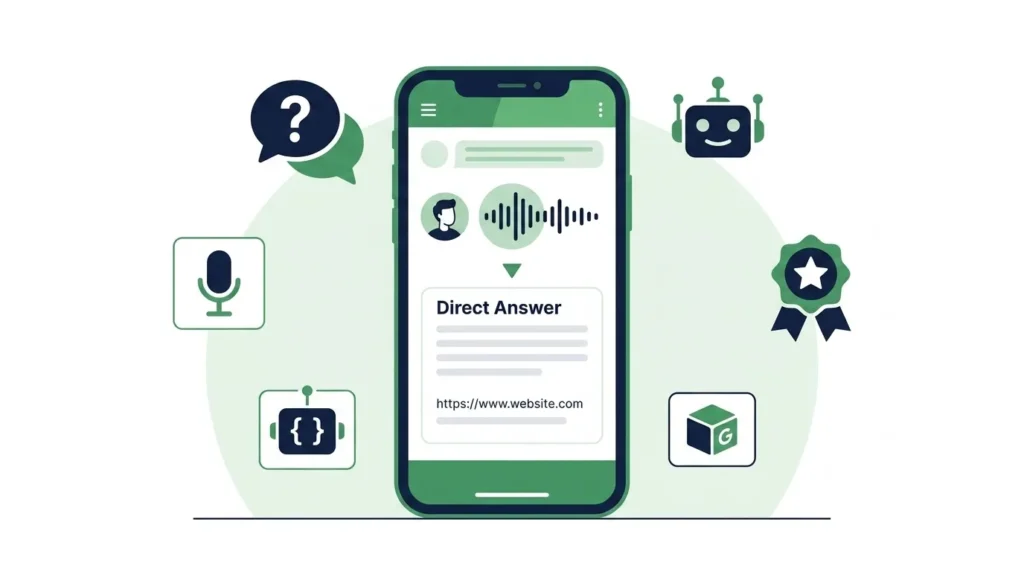
AEO in marketing stands for Answer Engine Optimization — the practice of optimizing your content specifically to be selected, cited, or spoken aloud by AI-powered answer engines when users ask direct questions in search.
Where traditional SEO optimizes content to rank in a list of ten blue links on a search results page, AEO optimizes content to become the direct answer that AI systems surface at the top of those results — or increasingly, instead of those results. Google AI Overviews, Perplexity AI, ChatGPT Search, Bing Copilot, and voice assistants like Siri and Google Assistant are all answer engines — systems that interpret a user’s question and generate or retrieve a direct answer rather than a list of pages to browse.
The distinction matters because the way users interact with search is shifting. A growing proportion of queries — particularly informational, how-to, and definition questions — are answered directly within the search interface itself, without the user clicking through to any website. If your content is cited as the source of that answer, you gain brand visibility, authority signals, and qualified referral traffic. If your content is not cited, it is effectively invisible to users who receive complete answers without needing to click anywhere.
AEO is not a replacement for SEO — it is an evolution of it. The same foundational elements that make content rank well organically — quality, comprehensiveness, technical correctness, E-E-A-T signals — also make content more likely to be selected as a direct answer. But AEO adds a specific layer of optimization focused on how AI systems extract, evaluate, and present information, which requires deliberate structural and strategic decisions beyond standard SEO practice.
This guide covers every dimension of AEO in marketing — from the technical mechanics of how answer engines select content through the specific content formats, schema implementations, and keyword strategies that maximize your probability of being cited across the growing range of AI search interfaces.
For the foundational SEO knowledge that underpins every AEO strategy, our guides on what is SEO in digital marketing, how to rank in AI overviews, and technical SEO checklist provide the complete technical and strategic context that makes AEO implementation significantly more effective.
Table of Contents
- What Is AEO in Marketing?
- AEO vs SEO — What Is the Difference?
- Why AEO Matters in 2026
- How Answer Engines Work
- The Core Principles of Answer Engine Optimization
- How to Optimize Content for AEO
- Schema Markup for AEO
- Voice Search and AEO
- AEO for Google AI Overviews
- AEO for Third-Party AI Search Engines
- How to Find AEO Keyword Opportunities
- AEO Content Formats That Get Cited
- Measuring AEO Performance
- AEO Strategy for Pakistani Businesses
- Common AEO Mistakes to Avoid
- Frequently Asked Questions
- Conclusion
AEO vs SEO — What Is the Difference?
The relationship between AEO and SEO is one of the most important distinctions to understand before building an optimization strategy — because the two disciplines share a foundation but diverge significantly in their specific requirements and success metrics.
What SEO Optimizes For
Traditional SEO optimizes webpages to appear in the ranked list of results that a search engine returns for a given query. The primary success metric is ranking position — appearing in position 1 through 10 on page one of Google’s organic results for target keywords. Secondary metrics include click-through rate from those positions, organic traffic volume, and conversions from that traffic.
SEO’s operating model assumes that users see a list of results and choose which to click based on title, URL, and meta description. The website then earns the traffic, the session, and the opportunity to convert that visitor.
What AEO Optimizes For
AEO optimizes content to be selected as the direct answer to a user’s question — displayed either as a Featured Snippet, an AI Overview citation, a voice search response, or a citation in a third-party AI search engine like Perplexity or ChatGPT Search. The success metric is answer citation — your content being used as the source of the answer, your brand being displayed or spoken in connection with the answer, and qualified users clicking through to your website from answer citations.
AEO’s operating model assumes that users ask a direct question and receive a direct answer — with the answer engine selecting the most credible, clearly structured, factually accurate source available. The website that provides the best-formatted, most accurate, most authoritative answer to the specific question gets cited.
Side-by-Side Comparison
| Factor | SEO | AEO |
|---|---|---|
| Primary goal | Rank in list of results | Be cited as direct answer |
| Success metric | Position 1-10, organic traffic | Answer citation, voice response, AI citation |
| Content format | Comprehensive page content | Direct, structured, question-answering content |
| Keyword targeting | Search volume, keyword difficulty | Question-format queries, conversational language |
| User interaction | User clicks a result | User receives answer directly |
| Traffic model | Click-through to website | Citation visibility + qualified click-through |
| Schema importance | Helpful | Critical |
| E-E-A-T weight | Important | Very important |
| Content length | Comprehensive (longer often better) | Concise direct answers + comprehensive depth |
| Technical SEO | Essential foundation | Essential prerequisite |
The Overlap — Why Both Matter
AEO and SEO are not competing strategies — they are complementary. Pages that are not well-optimized for traditional SEO will not rank well enough to be considered for AEO citations. Google AI Overviews almost exclusively cite pages that already rank on page one for the target query. Perplexity and ChatGPT Search draw from indexed, authoritative web content.
The correct approach is building your SEO foundation first — achieving strong organic rankings through technical SEO, quality content, and link building — and then layering AEO-specific optimizations on top of that foundation to maximize answer citation probability.
Why AEO Matters in 2026
The urgency of AEO in marketing in 2026 comes from the pace at which AI answer engines are changing how users interact with search — and how quickly those changes are affecting the organic traffic that websites depend on.
Zero-Click Searches Are Increasing
A zero-click search is a search query that is satisfied entirely within the search results page — the user gets their answer without clicking any result. Featured snippets, Knowledge Panels, Google AI Overviews, and direct answer boxes all contribute to zero-click rates.
Research consistently shows that zero-click searches account for more than half of all Google searches — a proportion that has grown as Google has expanded the types of queries it answers directly. For informational queries — the category that includes most how-to, what-is, and definition questions — zero-click rates are even higher.
This means that for a business targeting informational keywords, a significant proportion of the users who see their content in search results never click through to the website. If that content is cited as the answer source, the brand still benefits from visibility, authority association, and the minority of users who click through for more detail. If it is not cited, it is invisible in those zero-click interactions.
AI Search Is Becoming Mainstream
Google AI Overviews now appear for a significant proportion of informational and complex queries. Perplexity AI has grown to tens of millions of monthly users who use it as their primary search interface. ChatGPT’s search integration serves millions of queries daily. These AI interfaces are not niche products — they represent a structural shift in how a growing population of users finds information.
For businesses and marketers, this shift means that being cited by AI answer engines is increasingly a component of organic visibility — alongside traditional organic rankings — rather than an optional enhancement.
Voice Search Penetration
Voice search through Google Assistant, Siri, and Alexa continues to grow — particularly on mobile devices and smart speakers. Voice searches are almost entirely informational and conversational in format. They receive exactly one spoken answer — there is no list of results for the user to browse. The website whose content becomes the spoken answer has its content delivered to the user in the most attention-focused interaction modality available.
For local businesses, voice search is particularly important — “what is the best digital marketing agency near me” and “where can I find a web designer in Lahore” are the type of queries that voice search serves, and AEO positions your business to be the spoken answer.
How Answer Engines Work
Understanding the mechanism by which answer engines select and present content is the foundation of effective AEO in marketing — because you cannot optimize for a system you do not understand.
Retrieval-Augmented Generation (RAG)
Most modern AI search engines — including Google AI Overviews, Perplexity AI, and ChatGPT Search — use a process called Retrieval-Augmented Generation. Rather than answering questions purely from their training data (which has a knowledge cutoff and cannot access current information), these systems:
Step 1 — Retrieve: Search the live web for pages relevant to the user’s query, using the same type of indexing and relevance signals that traditional search engines use.
Step 2 — Evaluate: Assess the retrieved pages for authority, factual accuracy, content clarity, and structural clarity — selecting the most credible sources to draw from.
Step 3 — Generate: Synthesize a direct answer from the selected sources using the AI’s language generation capability, citing the pages whose content contributed to the answer.
Step 4 — Present: Display the generated answer with citation links to the source pages.
This process means that AEO is directly accessible through content strategy — you cannot modify the AI’s generation process, but you can maximize the probability that your content is selected in Step 2 by making it authoritative, clearly structured, and directly answering the target question.
How Google Featured Snippets Work
Google Featured Snippets — the boxed answers that appear above organic results for many questions — are an earlier and simpler form of answer engine output. Google’s algorithm identifies the passage in an indexed page that most directly answers the query and displays it as a snippet, citing the source page.
Featured snippets are selected from pages that already rank on page one of organic results — not from the entire web. Making your content snippet-eligible therefore requires both strong organic ranking and specific structural formatting that makes the answer easily extractable.
Voice Search Answer Selection
Voice search through Google Assistant and Siri draws primarily from Featured Snippets for Google-based queries — the spoken answer is almost always the Featured Snippet content read aloud by the assistant. This makes Featured Snippet optimization essentially equivalent to voice search optimization for Google-based voice queries.
The Core Principles of Answer Engine Optimization
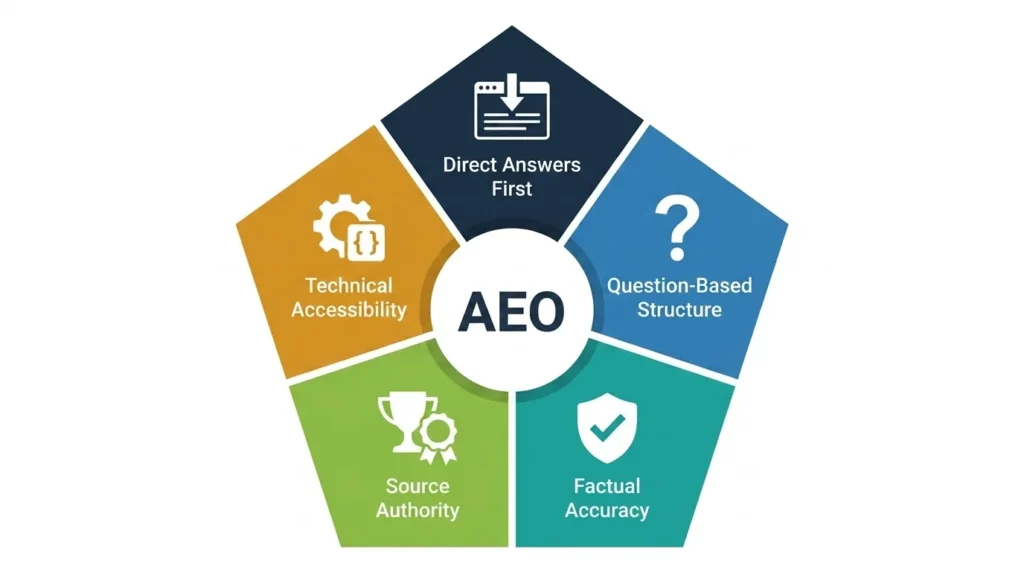
AEO in marketing is built on five principles that collectively determine whether your content is selected as a direct answer or overlooked in favor of a competitor’s more optimally structured content.
Principle 1 — Direct Answers First
Answer engines extract specific passages from your content to use as answers. The passage selected is almost always the most direct, concise statement of the answer to the specific question asked — not the most comprehensive discussion of the topic.
This means every piece of content targeting AEO must contain a clear, direct statement of the answer within the first one to three sentences following the question-format heading. If the direct answer is buried in paragraph four after three paragraphs of context and background, the answer engine will pass over your content in favor of a page that states the answer immediately.
The inverted pyramid structure — most important information first, supporting detail following — is the correct writing approach for AEO. State the answer, then elaborate. Never build to the answer.
Principle 2 — Question-Based Content Structure
Answer engines respond to questions. Content optimized for AEO uses question-format headings (H2 and H3) that directly mirror the queries users ask in search — because the AI needs to match your content to a specific question format.
“What is AEO in marketing?” as an H2 heading followed by a direct definition is more likely to be cited for that query than a heading like “Understanding AEO” followed by a discursive explanation. The question format signals to both Google and AI systems that this specific passage is designed to answer this specific question.
Principle 3 — Factual Accuracy and Verifiability
AI answer engines are specifically designed to avoid surfacing inaccurate content — because an inaccurate answer in a prominent AI-generated response damages the answer engine’s credibility with users. Systems like Google AI Overviews and Perplexity apply additional scrutiny to factual claims and preferentially cite content whose claims are consistent with other authoritative sources.
Every factual claim in AEO-optimized content should be accurate, specific, and consistent with what other credible sources say about the topic. Vague claims (“some time,” “various studies show”), contested claims presented as settled, and demonstrably incorrect information all reduce citation probability.
Principle 4 — Source Authority
Answer engines are not neutral about which sources they cite — they preferentially select content from websites with established authority in the relevant subject area. A page about AEO from a recognized digital marketing publication with strong backlink authority and demonstrated topical coverage of SEO topics is more likely to be cited than an identical page from a website with no SEO-related content history.
Building the topical authority that answer engines recognize requires the systematic content cluster approach — comprehensive coverage of a subject area through interconnected, interlinked content — that our guide on content marketing for SEO covers in full strategic detail.
Principle 5 — Technical Accessibility
Content that answer engines cannot crawl, index, or parse correctly cannot be cited regardless of its quality. Technical prerequisites for AEO are identical to technical prerequisites for SEO — fast page speed, mobile responsiveness, correct indexation, no crawl errors, HTTPS security — plus the additional requirement of structured data markup that makes content meaning explicit to AI systems.
6. How to Optimize Content for AEO
Translating AEO principles into specific, actionable content decisions is where strategy becomes implementation. These are the concrete steps that move content from standard SEO optimization to AEO-ready structure.
Write a Clear Definition in the First Paragraph
For any topic-based content targeting AEO, the opening paragraph should contain a complete definition or direct answer to the primary question the content addresses — within 40 to 60 words. This is the passage most likely to be extracted as a Featured Snippet or AI Overview citation for definition queries.
The definition should follow the format: “[Term] is [complete definition].” Avoid openers that delay the definition — “In today’s rapidly changing digital landscape, many marketers are asking about…” — these bury the answer and reduce AEO citation probability.
Use Question-Format H2 and H3 Headings
Every major subtopic should be headed with the question a user would ask to reach that information — not a topical label. Compare:
Less effective: “H2: Types of AEO Content” More effective: “H2: What Types of Content Work Best for AEO?”
The question format signals to AI extraction systems that the following content is a direct answer to that specific question. It also naturally captures the long-tail question-format keywords that users type into search and voice into voice assistants.
Provide Concise Answers Immediately After Question Headings
After every question-format heading, the first one to three sentences should directly and completely answer the question. The answer should be self-contained — making sense and being useful without requiring the surrounding context. This is what AI systems extract: the passage that most independently answers the question, not the passage that requires reading the whole article to understand.
Structure Lists for Extraction
Numbered lists and bulleted lists are frequently extracted verbatim by Featured Snippets and AI systems for list-format queries (“what are the types of AEO,” “steps to optimize for answer engines”). Format list answers with a brief introductory sentence followed by a clean list — no paragraph prose between list items, no sub-lists that complicate extraction.
Include a FAQ Section on Every Page
FAQ sections are the single most consistently AEO-effective content addition available. A well-structured FAQ section — with question-format headings and direct, concise answers — creates multiple extraction opportunities within a single page, each targeting a different question-format query variation.
Combined with FAQPage schema markup (covered in Section 7), FAQ sections directly qualify for both FAQ rich results in Google’s standard search results and increased citation probability in AI Overview responses.
Answer the Question at Multiple Depths
Effective AEO content addresses the same question at two depths simultaneously: a concise direct answer (40 to 60 words) immediately after the question heading for extraction purposes, followed by a comprehensive explanation (several paragraphs) for users who click through and want full context. This dual-depth structure serves both the zero-click user (who receives the extracted answer) and the click-through user (who reads the full explanation).
Schema Markup for AEO
Schema markup is more directly important for AEO than for traditional SEO — it explicitly tells AI systems what your content means, making citation with higher confidence significantly more likely. A page with correct schema provides explicit semantic signals that AI systems can use without interpretation.
FAQPage Schema
FAQPage schema is the highest-impact schema type for AEO. It explicitly marks up every question and answer pair on your page, telling Google’s systems: “These are questions, and these are their complete, accurate answers.” Pages with correctly implemented FAQPage schema are cited in AI Overviews and featured as FAQ rich results at dramatically higher rates than equivalent content without schema.
Implementation: Every question in your FAQ section should be wrapped in a Question schema object, with the corresponding answer in an acceptedAnswer object. The answer text in your schema should exactly match the visible answer text on the page — no truncated answers, no answers that differ from what the user sees.
In WordPress, Rank Math implements FAQPage schema through its FAQ block in the Gutenberg editor — adding the correct schema automatically as you build the FAQ section. Yoast SEO Premium offers similar functionality.
Speakable Schema
Speakable schema is an underused but highly AEO-relevant markup type — it explicitly designates specific passages on your page as ideal for voice search and AI answer extraction. By implementing Speakable schema on your most answer-ready passages, you are directly signaling to Google Assistant and other voice search systems: “This is the passage you should read aloud for this question.”
Speakable schema requires manual JSON-LD implementation — it is not yet supported through most WordPress SEO plugins’ standard interfaces. The markup identifies specific CSS selectors or XPath expressions pointing to the passage you want designated as speakable.
Article Schema With Author Credentials
Article schema establishes your content as a formal article with a specific author, publication date, and modification date. The author object within Article schema can include the author’s name, URL, and sameAs links to their LinkedIn profile and other professional presences — directly building the author credential signals that contribute to E-E-A-T assessment.
The dateModified attribute in Article schema is particularly important for AEO — answer engines preferentially cite recently updated content because freshness signals accuracy. Updating content substantively (not just changing a date) and reflecting that in the dateModified attribute signals to AI systems that your information is current.
HowTo Schema
For step-by-step instructional content, HowTo schema marks up individual steps with their descriptions, making the complete instruction sequence directly extractable by AI systems. Voice search responses for “how to” queries frequently draw from HowTo schema-marked content because the structured step sequence can be read aloud clearly and in order.
For a complete technical implementation guide covering all schema types relevant to AEO — including verification through Google’s Rich Results Test and Search Console monitoring — our technical SEO checklist covers every schema implementation step with verification process.
Voice Search and AEO
Voice search represents one of the most direct applications of AEO in marketing — because voice queries receive exactly one answer, making AEO citation the difference between complete visibility and complete invisibility for voice-searching users.
How Voice Queries Differ From Typed Queries
Voice queries are longer, more conversational, and more grammatically complete than typed queries. A user who types “AEO marketing” into a search bar will say “what is AEO in marketing and why does it matter” into a voice assistant. This conversational format means voice AEO targets longer, more naturally phrased question keywords — the type that exactly mirror how the question heading in this guide is written.
Voice queries are also overwhelmingly informational — people ask voice assistants questions, not commands. The information-seeking intent of voice queries makes them almost perfectly aligned with the informational content that AEO targets.
Optimizing Specifically for Voice
Write answers at a conversational reading level. Voice assistants read content aloud to users — content that reads naturally when spoken produces better voice search experiences than content dense with technical jargon, parenthetical asides, and complex sentence structures. Read your AEO-targeted passages aloud before publishing — if they sound unnatural spoken, they need rewriting for voice search contexts.
Target conversational question phrases. Voice search queries include natural language connectors that typed queries omit: “what is,” “how do I,” “can you explain,” “what does it mean when.” Include these full phrases in your heading structure rather than abbreviated keyword versions.
Keep answers concise for voice delivery. A voice-delivered answer that runs for three minutes is not useful — voice search users want concise, complete answers they can absorb while doing something else. The 40 to 60 word answer format that works best for Featured Snippet extraction also works best for voice delivery.
Local AEO for voice search. A significant proportion of voice searches have local intent — “near me” queries, business-type queries, and operational queries (“is [business] open now”). For Pakistani businesses with physical locations or local service areas, optimizing Google Business Profile content, local website pages, and schema markup for local AEO captures these high-intent voice queries.
AEO for Google AI Overviews
Google AI Overviews — the AI-generated answer summaries that appear at the top of Google search results for many informational queries — represent the highest-traffic AEO opportunity for most businesses because Google remains the dominant search engine globally.
Our dedicated guide on how to rank in AI overviews covers the complete AI Overview optimization strategy in full detail — including the requirement to already rank on page one, the content structure requirements, the E-E-A-T signals that influence citation selection, and the tracking methods for monitoring AI Overview citation performance.
The key points for AEO context: Google AI Overviews almost exclusively cite pages that already rank in positions 1 through 10 for the target query. AEO optimization for AI Overviews therefore requires strong organic SEO as a prerequisite — not as a parallel track. Pages with correct FAQPage, Article, and Speakable schema are cited more frequently than equivalent pages without schema. Content freshness — genuinely updated content with current dateModified signals — is weighted heavily in AI Overview citation selection.
AEO for Third-Party AI Search Engines
Beyond Google, a growing ecosystem of AI search engines draws from the open web to answer user queries — each with its own citation selection logic that AEO strategy should account for.
Perplexity AI
Perplexity AI functions as an AI-native search engine — users ask questions in natural language and receive cited, sourced answers generated from real-time web content. Perplexity’s user base is tech-savvy, research-oriented, and disproportionately likely to be in decision-making roles — making Perplexity AEO particularly valuable for B2B businesses.
Perplexity draws from authoritative web sources indexed by its own crawler. Content that ranks well in Google tends to also appear in Perplexity’s retrieval — strong organic SEO is the foundation of Perplexity AEO as well. Factual accuracy is especially important for Perplexity citations because its users are specifically evaluating sources alongside answers.
ChatGPT Search
ChatGPT Search — integrated into ChatGPT as a real-time web search capability — draws from Bing’s index for its web retrieval. Businesses with strong Bing search presence (which typically correlates with Google presence but is not identical) have higher citation probability in ChatGPT Search responses.
The content requirements for ChatGPT Search AEO are similar to Google AEO: structured content, direct answers, credible authorship, and factual accuracy. The audience accessing information through ChatGPT Search skews toward technical and professional users who are evaluating content quality critically.
Bing Copilot
Microsoft’s Bing Copilot integrates AI answer generation directly into Bing’s search results — citing web content from Bing’s index. For businesses with international audiences that include significant Windows and Microsoft 365 user populations, Bing Copilot AEO is worth specific attention.
Bing Webmaster Tools provides specific insights into Bing’s crawling and indexing of your website — a free resource that most Pakistani businesses configure but rarely use actively for optimization.
The Common Denominator
Despite their differences, all major AI search engines share the same fundamental AEO requirements: content must be indexed and accessible, factually accurate, clearly structured with direct answers, attributed to credible authors, and from websites with established topical authority. Optimizing for these requirements produces content that performs across all AI search engines simultaneously — not just Google.
How to Find AEO Keyword Opportunities
AEO keyword research differs from traditional keyword research in its focus — instead of identifying high-volume keywords to rank for in a list of results, AEO keyword research identifies the specific questions that trigger direct answer responses and where your content can become that answer.
Question Keyword Research
Start with the same keyword research foundation that underpins all SEO strategy — our guide on how to do keyword research for SEO covers the complete methodology. Then filter your keyword list specifically for question-format terms — queries beginning with what, how, why, when, where, and which.
These question keywords are your AEO primary targets. They match the conversational format of both voice queries and AI Overview-triggering searches. They have clear informational intent that positions your content as a direct answer source rather than a commercial destination.
People Also Ask Mining
Google’s People Also Ask (PAA) boxes are one of the most valuable AEO research resources available — they show the exact questions users ask related to your primary keyword, formatted exactly as they are searched. Every PAA question is a potential AEO target where structured content can earn Featured Snippet or AI Overview citation.
Search your primary keywords and document every PAA question that appears. Each one represents a query where content answering that specific question in a directly extractable format has an AEO opportunity. PAA boxes expand when clicked — revealing additional related questions that extend your AEO keyword map.
Current Featured Snippet Analysis
Search your target keywords and identify which currently show Featured Snippets. These are confirmed AEO-active queries — Google has already decided that this type of query warrants a direct answer. The current Featured Snippet holder is your AEO competitor for that query — analyze their answer format, word count, structure, and why Google selected it, then create content that answers the same question more completely and more clearly.
Conversational Long-Tail Keywords
Voice search and AI search engines receive queries in their full conversational form — not just the two-word typed versions that traditional keyword research has historically focused on. Tools like AnswerThePublic, AlsoAsked, and Semrush’s Topic Research tool specifically surface these conversational long-tail question variants that form the natural language queries AI answer engines process.
AEO Content Formats That Get Cited
Not all content formats are equally likely to be cited by answer engines. Certain structural patterns consistently produce higher citation rates across Featured Snippets, AI Overviews, and voice search responses.
Definition Format
The definition format — “[Term] is [complete definition in one to two sentences]” — is the most reliably cited structure for “what is” queries. It provides a complete, self-contained answer that AI systems can extract and present verbatim. Every article that addresses a definable concept should open with a definition-format statement that can stand alone as an answer.
Numbered Step Lists
For “how to” queries, numbered step lists are extracted by AI systems more frequently than prose explanations. A clear numbered sequence — “Step 1: Do X. Step 2: Do Y. Step 3: Do Z.” — provides the structured, sequential answer that voice delivery and AI presentation require. Combine with HowTo schema for maximum extractability.
Comparison Tables
For comparison queries — “AEO vs SEO,” “first-party vs third-party cookies” — HTML tables are frequently cited in AI Overviews because they condense comparative information into an extractable, clearly structured format. Every article addressing a comparison should include at least one structured comparison table.
Short Answer + Elaboration
The two-depth structure — a 40 to 60 word direct answer followed by comprehensive elaboration — serves both extraction (the short answer is cited) and click-through (the elaboration rewards users who want more). This structure should be the default for every question-format heading in AEO-optimized content.
FAQ Sections
As covered in the schema section, FAQ sections with FAQPage schema are the single most consistently effective AEO addition. A well-constructed FAQ section targeting 5 to 8 specific question variants around a topic creates multiple simultaneous AEO opportunities from a single page.
Measuring AEO Performance
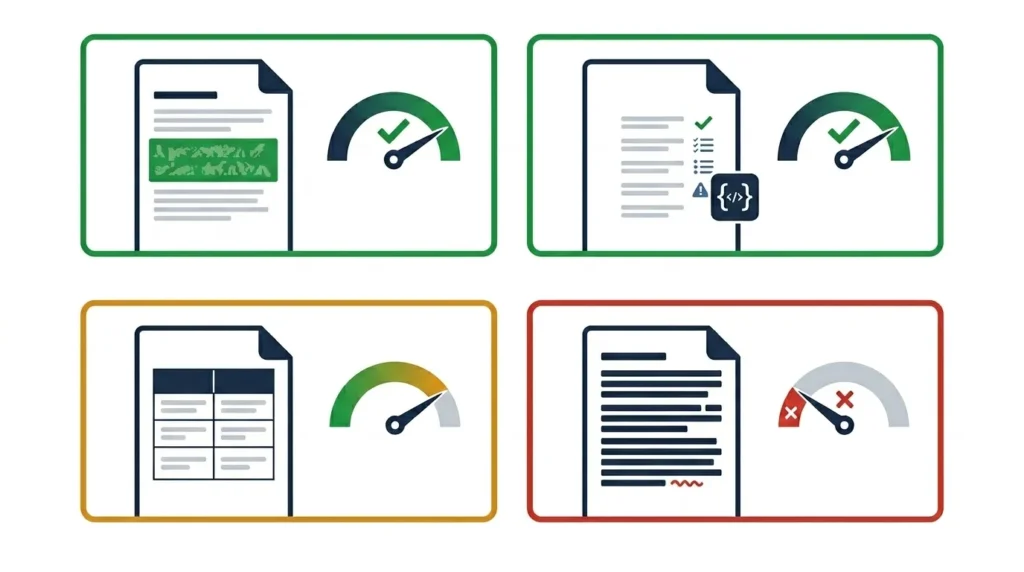
AEO introduces measurement challenges that traditional SEO tracking does not face — because AI Overview appearances, voice search citations, and third-party AI engine citations do not all appear in standard analytics tools. A complete AEO measurement approach combines multiple data sources.
Google Search Console — Featured Snippets and AI Overviews
Google Search Console’s Performance report provides the most direct data on AEO performance for Google-based queries. Filter by search type to see data from Google Search (including AI Overviews) and Google Discover separately. Monitor impressions and clicks for your target question-format keywords — an increase in impressions without a corresponding increase in clicks may indicate AI Overview citations where users receive answers without clicking.
Google is gradually rolling out specific AI Overview performance data in Search Console — including whether your pages are cited in AI Overview responses and how many impressions those citations generate. Enable Search Console notifications and review new data types as they become available.
Manual SERP Monitoring
Search your target keywords regularly — at minimum weekly for your highest-priority AEO targets — and manually document whether AI Overviews appear and whether your content is cited. Screenshot confirmed citations and log them with date and keyword. This manual process is currently the most reliable method for tracking which queries are generating AI Overview citations for your specific content.
Featured Snippet Tracking
Third-party rank tracking tools — Ahrefs, SEMrush, SERPWatcher — include Featured Snippet tracking that shows when your content holds a Featured Snippet position. Featured Snippet gains and losses are a direct proxy for AEO performance on Google for specific queries — monitor weekly for your target question keywords.
Branded Search Volume
A secondary AEO performance indicator is branded search volume — searches for your brand name or “SiteNova Agency” — which tends to increase as AI Overview and voice search citations raise brand awareness among users who heard or read your brand name in an answer context and then searched for you directly. Monitor branded search impressions in Search Console as an indirect AEO awareness metric.
Third-Party AI Engine Presence
Perplexity AI and ChatGPT Search do not provide publisher analytics for citations — you cannot currently track how frequently your content is cited in these engines through official channels. Manual testing — searching relevant questions in each AI engine and documenting citation frequency — provides directional data. Some specialist SEO tools are beginning to add AI citation tracking features; check current tool capabilities as this space is evolving rapidly.
AEO Strategy for Pakistani Businesses
AEO in marketing presents specific opportunities for Pakistani businesses that parallel the AI Overview opportunities discussed in our how to rank in AI overviews guide — with the additional context of Pakistan’s rapidly developing digital landscape.
Near-Zero Competition for Pakistan-Specific AEO
The AEO competitive landscape for Pakistan-specific queries is almost entirely uncontested. Questions like “what is digital marketing for small businesses in Pakistan,” “how does local SEO work in Pakistan,” and “what is AEO in marketing for Pakistani businesses” receive AI Overview responses that either have no cited source or cite international generic content that lacks Pakistan-specific context.
Pakistani businesses that publish comprehensive, well-structured, Pakistan-contextualized content targeting these queries are in a first-mover position with essentially no direct competition for AEO citations on domestically relevant questions. This window of opportunity will not remain open indefinitely as more Pakistani businesses invest in content and SEO.
Bilingual AEO Opportunity
Urdu-language AEO is even more underserved than English-language Pakistani AEO. As Google’s AI systems become more capable in regional languages — a direction Google has consistently invested in — Urdu-language content meeting AEO quality standards will be increasingly cited for Urdu-language queries. Pakistani businesses that begin building high-quality Urdu content now are positioning for an AEO channel that has almost no current competition.
Local Business AEO
For Pakistani service businesses with physical locations — clinics, law firms, agencies, restaurants, retailers — AEO for local queries is directly connected to Google Business Profile optimization and local SEO. Voice searches for local businesses are answered primarily through Google Business Profile data and locally optimized website content. Our guides on why local SEO is important and Google Business Profile for local SEO cover the complete local AEO foundation.
Common AEO Mistakes to Avoid
AEO strategy is undermined by a predictable set of mistakes — most of which involve applying traditional content creation habits to a context that requires a different approach.
Burying the Direct Answer
The most common AEO mistake: writing context-heavy introductions that delay the direct answer to the third or fourth paragraph. AI systems scan for the most direct, complete answer to the specific question — if your answer is buried, the system selects a competitor’s more immediately accessible response. Lead with the answer, every time.
Writing for Reading Rather Than Extraction
Content written as flowing, narrative prose — even excellent, authoritative prose — is harder for AI systems to extract clean answers from than content structured specifically for extraction. The tension between readability and extractability is real — the solution is the two-depth structure (short extractable answer followed by readable elaboration) rather than choosing one at the expense of the other.
Ignoring Schema Markup
Publishing AEO-targeted content without FAQPage, Article, and appropriate schema markup leaves explicit semantic signals unused. Schema markup is the clearest possible signal to AI systems about what your content means — omitting it is the equivalent of writing an excellent answer in a language the system has to interpret rather than one it reads directly.
Targeting Only High-Volume Head Keywords
AEO performs best on specific, question-format long-tail queries — not on broad two-word terms where AI systems generate synthesized answers from many sources rather than citing a specific page. A content strategy focused exclusively on high-volume head terms will not generate AEO citations at the rate that a question-format long-tail strategy produces.
Neglecting Content Freshness
Answer engines specifically filter for current, accurate content — stale information is a citation liability rather than a neutral factor. AEO content requires the same quarterly review and update process that strong SEO content requires. For the complete content freshness maintenance approach, our common SEO mistakes guide covers content staleness as one of the most consistently damaging SEO and AEO errors.
Treating AEO as Separate From SEO
AEO is not a parallel track to SEO — it is an optimization layer built on top of strong SEO foundations. Businesses that attempt AEO without the underlying SEO strength (organic page-one rankings, domain authority, technical SEO correctness) will not achieve meaningful AEO citation rates because answer engines draw from already-authoritative, already-ranking sources.
Frequently Asked Questions About AEO in Marketing
Q: What is AEO in marketing?
AEO in marketing stands for Answer Engine Optimization — the practice of optimizing content to be cited as a direct answer by AI-powered search systems including Google AI Overviews, Perplexity AI, ChatGPT Search, and voice assistants. Where SEO targets ranking in a list of results, AEO targets being selected as the direct answer to a specific question — appearing above organic results, being spoken by voice assistants, or being cited in AI-generated search summaries.
Q: What is the difference between AEO and SEO?
SEO optimizes content to rank in Google’s list of organic search results — the ten blue links. AEO optimizes content to be selected as a direct answer by AI systems — Featured Snippets, AI Overviews, voice search responses, and third-party AI search engine citations. AEO is built on SEO foundations — pages need strong organic rankings to be considered for AEO citation — but adds specific structural, schema, and content formatting requirements that go beyond standard SEO optimization.
Q: Does AEO replace SEO?
No — AEO complements SEO rather than replacing it. Strong organic rankings from SEO are a prerequisite for most AEO citation opportunities, particularly Google AI Overviews which almost exclusively cite pages already ranking on page one. Businesses should build their SEO foundation first and layer AEO optimizations on top — both disciplines reinforce each other and serve complementary user interaction models.
Q: How do I optimize my content for AEO?
Use question-format H2 and H3 headings. Provide direct, concise answers immediately after each question heading — 40 to 60 words. Implement FAQPage schema on FAQ sections. Add Article schema with author credentials and dateModified attributes. Include HowTo schema on step-by-step content. Use comparison tables for comparative questions. Write at a conversational reading level for voice search compatibility. Ensure technical SEO is correct — fast page speed, clean indexation, HTTPS, mobile responsiveness.
Q: Which schema markup is most important for AEO?
FAQPage schema is the single most impactful schema type for AEO — it explicitly marks up question and answer pairs for direct extraction by Google and AI systems. Article schema with author credentials builds E-E-A-T signals that influence citation selection. HowTo schema structures step-by-step content for voice delivery. Speakable schema directly designates passages for voice search and AI answer extraction. Implementing all four on relevant content types provides the most comprehensive AEO schema coverage.
Q: How long does AEO take to produce results?
AEO results appear faster than traditional SEO ranking improvements for pages already in page-one organic positions — structural and schema changes can produce Featured Snippet gains within 2 to 4 weeks of Google recrawling and reindexing the updated page. For pages that need to achieve page-one rankings first, the timeline follows standard SEO timelines — 3 to 6 months for moderate-competition keywords. AI Overview citations for established page-one positions typically appear within 4 to 8 weeks of AEO-specific optimizations being implemented.
Q: Is AEO relevant for Pakistani businesses?
Absolutely — and Pakistani businesses are in an advantageous position because AEO competition for Pakistan-specific queries is extremely low. Most Pakistan-relevant questions that trigger AI Overviews currently receive no Pakistan-specific citation or cite generic international content. Pakistani businesses that publish well-structured, AEO-optimized content targeting Pakistan-specific questions can achieve AI Overview citations with significantly less competition than the same content would face in Western markets.
Conclusion
AEO in marketing is the logical evolution of SEO in a search landscape where AI systems increasingly answer questions directly rather than presenting a list of pages for users to explore. It does not make SEO obsolete — it makes SEO more important as the foundation on which AEO citation probability is built. The businesses that will benefit most from AEO are those that combine strong organic SEO with the specific structural, schema, and content quality investments that make their pages the most extractable, most credible, and most directly answering sources available for their target questions.
For Pakistani businesses, the AEO opportunity is particularly compelling right now. The competitive landscape for AI Overview citations on Pakistan-relevant queries is essentially empty — early movers who invest in AEO-optimized content today will establish citation positions that are significantly harder to displace once competition for those positions develops.
At SiteNova Agency, AEO is integrated into every SEO strategy we build for clients — from content structure and schema implementation through keyword research focused on question-format queries and content freshness maintenance that keeps AI citation eligibility current. Visit our SEO Services page to discuss how AEO fits into your specific digital marketing strategy.