
A guest post is an article written by someone outside a publication’s regular editorial team and published on another website — with the guest author receiving a byline, an author bio, and typically one or more links back to their own website within the content or bio section.
The term covers a wide spectrum. At one end: a recognized industry expert contributing a substantive, original article to a respected trade publication — earning an editorial link from a high-authority domain that meaningfully strengthens their website’s ranking potential. At the other end: a low-quality article spun from existing content and submitted to a link farm directory disguised as a blog — a black hat tactic that Google actively detects and discounts.
Understanding what guest posting actually is — and what it is not — is the most important first step, because the quality difference between legitimate and illegitimate guest posting determines whether it builds your rankings or risks a Google penalty.
A legitimate guest post is an editorial arrangement: a website publishes your content because the content is genuinely valuable to their audience. The backlink you receive is a byproduct of that value — an editorial endorsement from the publication. A link scheme guest post exists only to manufacture the backlink — the content is a pretext, not a contribution.
Google’s guidance distinguishes clearly between the two. Google’s Search Essentials states that links in guest posts can contribute to organic rankings when the guest posting arrangement is editorially legitimate — meaning the publication would accept your article based on content quality regardless of whether a link was included. Links inserted into content that exists only to host them, on websites that exist only to sell placements, are classified as link spam regardless of how the arrangement is packaged.
This distinction matters for every strategic decision covered in this guide. For the foundational framework of ethical versus manipulative SEO tactics, our guide on white hat vs black hat SEO covers the complete risk and reward profile of every link building approach.
Table of Contents
- What Is a Guest Post?
- Why Guest Posting Matters for SEO in 2026
- How Guest Posting Works — The Complete Process
- What Makes a High-Quality Guest Post Opportunity
- How to Find Guest Posting Opportunities
- How to Write a Guest Post Pitch That Gets Accepted
- How to Write a Guest Post That Editors Approve
- Guest Post Author Bio — How to Maximize SEO Value
- Dofollow vs Nofollow Guest Post Links
- Guest Posting Risks and How to Avoid Them
- Guest Posting vs Other Link Building Strategies
- Guest Posting Strategy for Pakistani Businesses
- How to Scale Guest Posting Without Losing Quality
- Measuring Guest Post SEO Results
- Frequently Asked Questions
- Conclusion
Why Guest Posting Matters for SEO in 2026
Guest posting remains one of the most effective white hat link building strategies available in 2026 — not because it is the only way to earn backlinks, but because it combines multiple SEO benefits simultaneously in a way that few other tactics match.
Backlinks From Relevant, Authoritative Domains
Backlinks are still one of Google’s strongest ranking signals. A website that earns links from relevant, high-authority domains consistently outranks equally good content on websites without those links. Guest posting is a systematic method for earning these links at a pace that content alone rarely achieves.
The key word is relevant. A backlink to a digital marketing agency from a reputable digital marketing publication carries significantly more authority than a link from an unrelated lifestyle blog — because topical relevance amplifies the authority transferred through the link. Google evaluates not just how many sites link to you but how topically aligned those linking sites are to your own subject matter.
E-E-A-T Signal Building
Google’s E-E-A-T framework — Experience, Expertise, Authoritativeness, and Trust — influences how Google evaluates your content’s quality and ranking worthiness. Guest posts on respected industry publications directly build the Authoritativeness and Trust dimensions of E-E-A-T: third parties are publishing your expertise, which Google treats as an external validation of your credibility as a source.
When your content appears in respected industry publications — cited, linked to, and editorially approved — Google’s quality systems recognize those third-party endorsements as authority signals. Over time, consistent guest posting on relevant publications moves your domain toward being recognized as an authoritative source in your subject area.
Brand Visibility and Referral Traffic
Beyond SEO, guest posts deliver direct brand exposure to the target publication’s existing audience — people who are already interested in your industry and may not have encountered your brand through organic search. Some of these readers click through to your website, creating referral traffic that is often highly qualified.
For Pakistani businesses targeting international clients — particularly in the US and UK markets — guest posts on English-language industry publications introduce your brand to decision-makers in those markets who would never encounter a Pakistan-based website through domestic search.
Topical Authority Development
Each guest post on a relevant publication adds a topically associated link to your backlink profile. A digital marketing agency with guest posts on ten different digital marketing publications has a topically concentrated backlink profile that strongly signals domain authority in digital marketing to Google’s topic classification systems.
This topical concentration amplifies the authority transfer beyond what the domain rating of each individual linking site would suggest — topically relevant links from moderate-authority sites can outperform high-authority links from irrelevant domains for keywords in your specific niche.
How Guest Posting Works — The Complete Process
Understanding the complete guest posting workflow — from identifying opportunities through publication and results measurement — removes the ambiguity that causes most guest posting programs to either produce poor results or create link scheme risk.
Stage 1 — Target Identification
Identify websites in your industry or niche that publish guest contributions from external authors. These are websites whose audience would benefit from your expertise, whose domain authority is meaningful (Domain Rating above 30 as a practical minimum for most niches), and whose editorial standards are high enough that a link from them carries genuine authority.
Stage 2 — Audience and Guidelines Research
Before pitching any publication, read their existing content thoroughly — understand their audience, their content style, their typical article depth, and what topics they have recently covered. Find their contributor or guest post guidelines if published (often linked in the footer as “Write for Us” or “Contribute”). Understanding exactly what they want before you pitch dramatically increases acceptance rates.
Stage 3 — Pitch Email
Send a personalized pitch to the appropriate editor or content manager — identifying the specific section of their publication you are targeting, proposing a specific article idea relevant to their audience, demonstrating familiarity with their existing content, and briefly establishing your credentials as a subject matter expert.
Stage 4 — Article Production
If your pitch is accepted, write the article to the publication’s standards — matching their typical length, depth, format, and style. The article should be genuinely valuable and original: content that does not appear elsewhere on the web and that the publication’s audience would find informative without needing to already know who you are.
Stage 5 — Link Integration
Include your links naturally within the article content — a contextual reference to a relevant piece of your own content where the link genuinely helps the reader — and in the author bio section, linking to your homepage or a relevant service or resource page.
Stage 6 — Post-Publication Follow-Through
After publication, promote the guest post through your own social channels (benefiting both you and the publication), monitor the backlink in Ahrefs or Search Console to confirm it is indexed, and track any referral traffic it generates in Google Analytics.
What Makes a High-Quality Guest Post Opportunity
Not all guest post opportunities are equal. Selecting the right targets is the most important strategic decision in a guest posting program — a poorly selected target produces either a worthless link or an actively harmful one.
Domain Authority and Site Health
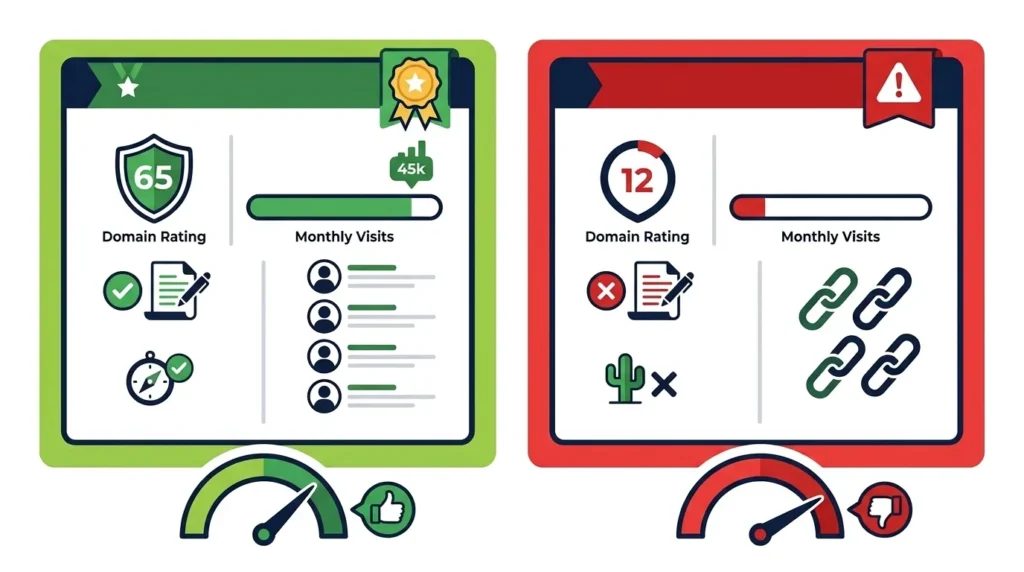
Check the target website’s Domain Rating (Ahrefs) or Domain Authority (Moz). A DR above 30 provides meaningful link equity for most businesses. A DR above 60 is genuinely competitive for almost any industry.
More important than raw DR is organic traffic — a website with DR 40 and 50,000 monthly organic visitors is a more valuable link source than a website with DR 50 and 200 monthly organic visitors. The latter may have inflated authority from purchased links and very little genuine editorial relevance. Use Ahrefs’ traffic estimate or SEMrush to verify that a target website actually receives real organic search traffic, not just nominal DR.
Topical Relevance
The guest post target website should operate in your industry, niche, or a closely adjacent area. A digital marketing agency should target digital marketing, SEO, content marketing, and business publications — not food blogs, travel sites, or automotive forums that have agreed to publish content for payment.
Topical relevance determines whether Google treats the link as an authority signal in your specific subject area or as an irrelevant link from an unrelated domain.
Editorial Standards
High-quality guest post targets have visible editorial standards: they publish original content, they review submissions, their published articles are well-written and substantive, and their “Write for Us” guidelines specify what they are looking for rather than simply promising to publish everything submitted.
A website that publishes whatever anyone sends them — with no editorial review, no content standards, and no genuine readership — is a link farm regardless of what it calls itself.
Red Flags That Indicate Link Schemes
Charging money to publish your article (“sponsored post” or “paid placement” presented as editorial) without a “Sponsored” or “Advertisement” disclosure label is a paid link scheme that violates Google’s guidelines. A link from this type of publication should be treated as a paid link — which Google may detect and discount or penalize.
Sites with excessive outbound links on every page, sites with no real about page or author information, sites with no social presence or engagement, and sites whose content is clearly auto-generated or spun are all link farm signals. Links from these sites produce no SEO value and may produce negative signals.
How to Find Guest Posting Opportunities
Finding legitimate, high-value guest posting targets is a research process — not a shortcut available through bulk lists purchased online. Bulk guest post lists contain the same websites being pitched by thousands of other SEO practitioners, driving down acceptance rates and link value simultaneously.
Google Search Operators
Use specific Google search queries to find publications actively accepting guest contributions in your niche:
"your niche" + "write for us"
"your niche" + "guest post"
"your niche" + "contribute"
"your niche" + "submit an article"
"your niche" + "guest contributor"
For a digital marketing agency: digital marketing "write for us" or SEO blog "guest post guidelines". Review each result manually — eliminating obvious link farms, paid placement sites, and irrelevant publications before adding targets to your outreach list.
Competitor Backlink Analysis
Your competitors who are already ranking above you have already done the research of identifying which publications link to relevant sites in your niche. Their backlink profiles are a ready-made guest posting target list.
Export your top competitors’ backlink profiles using Ahrefs Webmaster Tools or SEMrush. Filter for followed editorial links (not directory listings, not forum links, not sponsored posts). Identify which publications have linked to your competitors through guest posts — these are proven targets in your niche with demonstrated willingness to publish relevant external contributors.
This is the fastest way to build a high-quality target list — you are following the research your competitors have already done rather than starting from scratch.
Industry Publications and Trade Media
Every industry has established trade publications, professional association blogs, and community platforms that publish contributed articles from practitioners. In digital marketing: Search Engine Journal, Search Engine Land, Content Marketing Institute, HubSpot Blog, Moz Blog, Ahrefs Blog. In finance: Forbes, Entrepreneur, Business Insider (contributor network). These tier-one publications have high standards but correspondingly high authority value for accepted contributors.
Start with mid-tier publications (DR 30 to 50) where acceptance rates are more realistic for new guest posters, and use those published articles to demonstrate credibility when pitching tier-one publications later.
Social Media and Content Communities
LinkedIn is underutilized as a guest post discovery channel. Search for editors and content managers at publications in your niche — their profiles often mention what kind of contributions they are looking for, and a warm connection before a cold pitch dramatically increases response rates.
Twitter/X conversations in your niche frequently surface editors mentioning they are looking for contributors on specific topics. Monitoring relevant hashtags and industry conversations creates real-time pitch opportunities that competitors relying only on search operator queries will miss.
How to Write a Guest Post Pitch That Gets Accepted
Pitch quality determines acceptance rate more than any other factor. An excellent article idea pitched poorly gets rejected. A good article idea pitched perfectly to the right editor at the right time gets accepted — and the subsequent guest post produces the backlink and authority benefits the entire exercise is aimed at.
The Anatomy of an Effective Pitch Email
Subject line: Specific and direct — never “Guest Post Submission” or “I Want to Write for You.” Better: “Guest Post Pitch: 5 On-Page SEO Mistakes Pakistani Businesses Miss” or “Article Idea for [Publication Name]: How AI Overviews Are Changing Content Strategy.”
Opening line: Reference something specific about the publication — a recent article you genuinely read, a topic they cover, or a gap you noticed. This is the most important signal that you are not sending a mass template pitch.
The pitch: One to two specific article ideas — with a working title, a two-to-three sentence summary of the angle and what the reader will learn, and why this is relevant to their audience right now. Be specific enough that the editor can evaluate the idea without needing to ask clarifying questions.
Your credentials: Two to three sentences establishing why you are qualified to write about this topic — published work, relevant experience, or specific expertise. Do not oversell; be factual and specific.
The close: A simple, low-friction request: “Would either of these work for your editorial calendar? Happy to adjust the angle or pitch additional ideas if these don’t fit.”
What to avoid: Mentioning that you want a dofollow link in the pitch. Explaining that you are doing this for SEO purposes. Submitting a completed article without a pitch. Sending the same template to fifty publications simultaneously — editors recognize mass pitches immediately.
Personalisation at Scale
Personalizing every pitch is time-consuming but necessary. A framework that balances quality and efficiency: use a template for the structure of each pitch email, but require genuine personalization in the opening reference and the specific article angles proposed. Pitching ten publications with genuine personalization outperforms pitching fifty with obvious templates — both in acceptance rate and in the quality of publications that accept.
How to Write a Guest Post That Editors Approve
Pitch acceptance is not publication. Between acceptance and publication, your article must meet the editorial standards of the target publication — and editors who accepted a pitch based on its concept will reject the actual article if it underdelivers on execution.
Match the Publication’s Content Standards
Before writing a single word, study the publication’s most-shared recent articles. Note the typical word count (most industry publications expect 1,200 to 2,500 words for substantive contributor pieces), the heading structure, the use of examples and data, the tone (conversational or formal), and whether they include subheadings, bullet points, or mostly flowing prose.
Your article should feel like it belongs in that publication — not like content from your blog reformatted and submitted. Editors accept pitched concepts based on their relevance to their audience; they reject submissions that clearly were written for a different purpose or audience.
Originality and Depth
The most common reason guest post submissions are rejected after acceptance is that the submitted article does not deliver the depth the pitch implied. The pitch sold a specific, insightful angle; the article delivered generic content that is widely available across dozens of similar posts.
Every guest post you write should contain at least one element that is original — your own data, your own tested methodology, a case study from your direct experience, or an analysis angle that genuinely differs from what already exists on the topic. This is what gets articles published, shared, and linked to by other writers — which amplifies the original guest post’s authority benefit beyond the initial publication link.
Links Within the Article
Most publications allow one to two contextual links in the body of an article — links to external sources that genuinely support a specific claim or recommendation within the content. Some also allow a link back to the guest author’s website within the content if the reference is genuinely useful to readers.
Link to your own content only where it is genuinely the most useful resource for the reader at that specific point in the article. A forced self-referential link that exists only to create a backlink rather than to serve the reader is visible to editors and damages your reputation with that publication.
For links to external authoritative sources that support claims in your guest post — research citations, official documentation, Google’s own guidance — use high-quality, credible sources. According to Google’s own documentation on link building, editorially given links from content that naturally references related resources are the type of links that contribute to organic ranking improvements.
Guest Post Author Bio — How to Maximize SEO Value
The author bio is the one section of a guest post that is unambiguously yours — the section where your website link appears editorially expected rather than potentially forced. Optimizing the author bio maximizes the SEO and brand value of every guest post you publish.
What an Effective Author Bio Contains
A professional headshot — actual photography of you, not a logo or abstract avatar. Editor and reader trust is built on real identity signals.
Your name and title — clearly establishing who you are and what your expertise is.
A two-to-three sentence description of your expertise — specific enough to be credible, concise enough to be readable. “Samreen Ishaq is the founder of SiteNova Agency, a digital marketing agency in Lahore, Pakistan, specializing in SEO and web design for Pakistani businesses and international clients” is more credible than “Samreen is a digital marketing expert.”
A link to your website — the primary SEO value delivery of the author bio. Link to your homepage or, where specifically relevant to the article topic, a specific service page or resource. For an article about SEO content writing, linking to your SEO services page is more relevant than linking to your homepage — and a topically relevant landing page converts referral traffic better.
Social profile links — LinkedIn at minimum. Social profiles reinforce your identity as a real, credible professional and provide additional brand visibility to readers who want to follow your work.
Anchor Text for Author Bio Links
Most publications automatically link your website URL as the anchor text, or use your name as the anchor. Both are natural anchor text patterns — brand name and URL anchors are the safest anchor text for backlinks because they appear in organic, editorial contexts and do not trigger anchor text manipulation signals.
Avoid negotiating for keyword-rich anchor text in author bio links (“best SEO agency Lahore”) — this is both unusual for bio links (making it look unnatural) and an unnecessary risk for a single link.
Dofollow vs Nofollow Guest Post Links
Understanding the distinction between dofollow and nofollow links is essential for evaluating the SEO value of guest post opportunities — and for knowing when a nofollow link is still worth pursuing despite not directly passing link equity.
Dofollow Links
A dofollow link passes link equity — the authority signal — from the linking page to the destination page. This is the standard link type for editorial links in the body of published content. When Google’s crawlers follow a dofollow link, they consider that page’s authority to flow to your site, contributing to your domain’s overall ranking potential.
Most legitimate guest post links in article body content are dofollow — the publication is editorially endorsing your content by linking to it and allowing that authority to flow.
Nofollow Links
A nofollow link carries the attribute rel="nofollow" in its HTML — telling Google’s crawlers that the linking page is not necessarily endorsing the link destination. Originally introduced to manage comment spam, nofollow links are now commonly applied by publications to all external links as a blanket policy — not specifically because they distrust the linked site but because they are managing their outbound link equity conservatively.
A nofollow link from a guest post does not directly pass link equity in the traditional sense. However, it still delivers real value: brand exposure to the publication’s audience, referral traffic from readers who click it, and authorship attribution signals that contribute to E-E-A-T — your name appearing in a respected publication is a trust signal regardless of the link’s follow status.
Sponsored Links — rel=”sponsored”
Google introduced rel="sponsored" in 2019 specifically to mark paid link placements — any situation where a link’s placement was influenced by payment, including paid guest post placements. Publications that charge for guest posts should use rel="sponsored" on links within that content. A paid link without a sponsored attribute is a guideline violation.
The Practical Decision
Prioritize dofollow opportunities but do not reject nofollow opportunities at high-authority publications. A nofollow link from a DR 80 industry publication delivers brand authority, referral traffic, E-E-A-T signals, and potentially indirect ranking benefits (referral traffic signals and brand search volume increases that correlate with ranking improvements) that make the investment worthwhile even without direct equity transfer.
Guest Posting Risks and How to Avoid Them
Guest posting has clear SEO benefits when done correctly — and real risks when done incorrectly. Understanding the risk profile helps you design a guest posting program that captures the benefits while avoiding the pitfalls that turn a legitimate link building strategy into a penalty risk.
The Primary Risk — Unnatural Link Patterns
Google’s link spam systems evaluate backlink profiles for unnatural patterns. A backlink profile with the following characteristics is flagged as a potential link scheme: a sudden spike in guest post link acquisition over a short period, an unnaturally high proportion of exact-match keyword anchor text in guest post links, links from an implausibly large number of publications for a small or new website, and guest posts that all follow an identical format published across dozens of similar low-quality sites.
Natural link profiles grow gradually, contain diverse anchor text (brand, URL, partial keyword, generic), and include links from a variety of sources (not exclusively guest posts). Build your guest posting program to reflect natural growth patterns — 2 to 4 high-quality placements per month is a realistic, sustainable pace for most businesses.
Over-Optimized Anchor Text
Using exact-match commercial keyword anchor text (like “best SEO agency Lahore”) consistently across guest post links is the most commonly flagged unnatural pattern. Natural editorial links use varied anchor text — the author’s name, the company name, the URL, partial keywords, and generic terms like “this guide” or “this resource.” Keep your guest post anchor text predominantly brand-name, URL, or generic — reserving keyword-rich anchors for a minority of placements where they occur genuinely naturally.
Paying for Guest Post Placements Without Disclosure
Paying for a guest post placement and not disclosing it as sponsored content violates both Google’s guidelines and FTC requirements in the US and equivalent advertising regulations in Pakistan. Beyond the regulatory risk, paid links detected by Google’s systems are discounted and can trigger manual review of the paying site’s entire link profile.
If a publication charges for placements, either ensure the content is labeled as sponsored (removing its value as an editorial link) or find publications that accept editorial contributions without payment.
Guest Posting vs Other Link Building Strategies
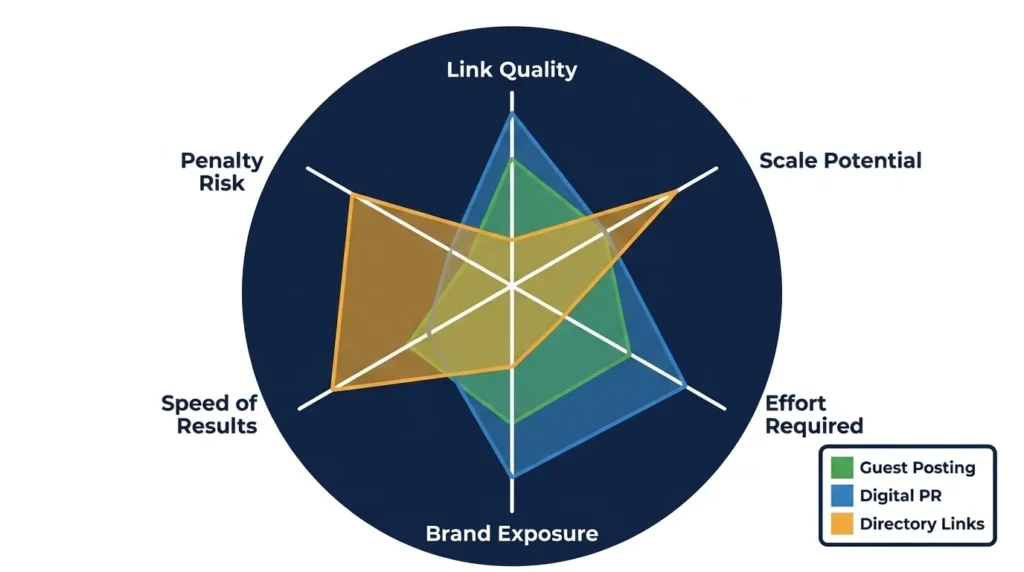
Guest posting is one of several ethical link building strategies available to businesses investing in off-page SEO. Understanding where it fits in the broader link building landscape helps allocate effort appropriately.
| Strategy | Effort Level | Link Quality | Scale | Best For |
|---|---|---|---|---|
| Guest posting | High | High | Medium | Authority building, brand exposure |
| Digital PR | Very high | Very high | Low | Tier-one publication links |
| Broken link building | Medium | Medium-high | Medium | Quick wins on existing content |
| Resource page outreach | Medium | Medium-high | Medium | Reference links in niche topics |
| Content-driven links | Low (after creation) | Very high | Low | Long-term compounding authority |
| Competitor link replication | Medium | Medium-high | Medium | Systematic authority gap closure |
| Directory listings | Low | Low | High | Local citations and NAP consistency |
| Forum and community links | Low | Low | High | Brand visibility, nofollow only |
Guest posting occupies the middle ground — requiring more effort than passive link building (creating linkable content and waiting for organic links) but producing more reliable results at a more consistent pace. It pairs well with digital PR (for tier-one links) and broken link building (for supplementary volume) in a diversified link building strategy.
For a complete overview of how different link building approaches interact with Google’s quality systems — including which tactics are white hat, which are grey hat, and which carry penalty risk — our guide on white hat vs black hat SEO covers the full risk and reward profile of every major off-page SEO approach.
Guest Posting Strategy for Pakistani Businesses
Pakistani businesses face a specific set of circumstances when building a guest posting strategy — circumstances that differ meaningfully from the generic advice produced for Western markets.
Targeting International Publications
Many Pakistani businesses — particularly digital marketing agencies, software development firms, content agencies, and SaaS companies — serve clients primarily in the US, UK, Canada, and Australia. For these businesses, guest posts on English-language international industry publications are the highest-priority link building targets because they build authority in the markets where the clients they want are searching.
A Lahore-based SEO agency that publishes guest posts on Search Engine Journal, Moz Blog, and Content Marketing Institute has established international authority credentials that a domestic Pakistani client list cannot provide. The same agency that publishes only on Pakistani business directories and local news sites has no visible authority signal in the markets it is trying to serve.
Building Authority in Pakistan’s Growing Digital Space
For businesses serving Pakistani customers, the domestic guest posting landscape is less developed than international markets — which creates opportunity. Established Pakistani business publications, technology blogs, startup ecosystem platforms, and industry association websites are actively looking for quality contributed content. Early movers in building relationships with these publications establish category authority before competition for those placements intensifies.
Relevant Pakistani guest posting targets include Dawn Business, The News technology section, ProPakistani, TechJuice, and industry-specific platforms in healthcare, real estate, and education — all of which publish contributed articles from credible practitioners.
Language and Cultural Context
Guest posts targeting Pakistani audiences should address Pakistan-specific context directly — local market conditions, examples drawn from Pakistani businesses, references to Pakistani regulatory environment where relevant, and economic context specific to Pakistan’s digital economy. Generic international content submitted to Pakistani publications reads as out-of-place and is less useful to readers than content written with genuine local knowledge.
For businesses targeting both markets, producing separate content for each audience — rather than submitting the same article to both international and Pakistani publications — is both more editorially appropriate and more effective for building audience trust in each market.
How to Scale Guest Posting Without Losing Quality
The tension in guest posting is between quality and scale. A single writer producing one exceptional guest post per week is a sustainable, high-quality program. Trying to produce twenty guest posts per month typically results in content quality dropping below editorial standards — which means lower acceptance rates, weaker published content, and diminishing SEO returns.
Scaling Through Systematization
Scale guest posting not by lowering quality standards but by systematizing the process so that high-quality output requires less total time per piece.
Build a target database: Maintain a spreadsheet of prospective guest post publications — including domain rating, typical article length, editor contact, guidelines URL, pitch status, and follow-up timeline. A well-maintained database eliminates repeated research for each outreach cycle and allows systematic follow-up without lost opportunities.
Create topic frameworks: Develop a library of article angles that can be quickly customized for different publications’ audiences. A digital marketing agency might have ten strong article frameworks (on keyword research, content strategy, local SEO, technical SEO errors, content measurement) that can be adapted with publication-specific examples and adjusted depth for different audience sophistication levels.
Develop an author bio library: Maintain two to three versions of your author bio in different lengths (50 words, 100 words, 150 words) so you are not rewriting it for each submission.
Diversifying the Guest Posting Team
As a business scales, having only one person who can write and pitch guest posts creates a bottleneck. Building a guest posting capability across multiple team members — each with expertise in different topic areas — allows simultaneous outreach to different publication categories without diluting the expertise signal any single contributor presents.
This is most relevant for agencies where different team members have genuine expertise in different service areas — SEO specialists writing SEO content, web designers writing design content, paid media specialists writing PPC content — each contributing to the firm’s overall link profile across their respective areas of expertise.
Measuring Guest Post SEO Results
Guest posting investment is only justifiable if it produces measurable results. Measuring those results correctly requires tracking at multiple levels — the individual guest post, the link it generates, and the cumulative effect on domain authority and rankings.
Tracking Individual Guest Posts
After each published guest post, record in your tracking database: the publication name, URL, publication date, Domain Rating at time of publication, link type (dofollow/nofollow), anchor text used, and the specific page on your site being linked to.
In Google Analytics, set up a segment for traffic from the publication’s domain — this shows referral traffic attributed specifically to that guest post over time. Some guest posts drive significant referral traffic immediately after publication; others drive very little referral traffic but deliver meaningful link equity.
Tracking Link Indexation
A guest post link only provides SEO value after Google has crawled and indexed the published page. Check that each guest post URL appears in Google’s index within two to four weeks of publication — search Google for the article title in quotation marks to verify it is indexed. In Ahrefs, the Links report for your domain will show the new referring domain once it is indexed.
Tracking Domain Authority Growth
Domain Rating in Ahrefs or Domain Authority in Moz grows as you accumulate links from high-quality referring domains. Track your DR monthly — a consistent upward trend confirms that your guest posting program is building genuine authority. A DR increase of 5 to 10 points over a 12-month guest posting program with 24 to 48 quality placements represents meaningful authority growth that directly improves your ability to rank for competitive keywords.
Tracking Keyword Ranking Improvements
The ultimate measure of guest posting success is keyword ranking improvement. Compare your keyword ranking positions in Google Search Console month over month against your guest posting activity. Rankings for target keywords should improve as domain authority grows — though the relationship is not immediate (expect a 2 to 4 month lag between link acquisition and measurable ranking movement for competitive terms).
For the complete SEO measurement and rank tracking framework that guest posting results should be integrated into, our free SEO audit guide covers the full analytics setup and monitoring process.
Frequently Asked Questions About Guest Posting
Q: What is a guest post in SEO?
In SEO, a guest post is an article written by an external contributor and published on another website — with the guest author receiving a byline and a link back to their own website. The link from the publishing site to the guest author’s website passes authority signals that contribute to the guest author’s domain’s organic search rankings. Guest posting is one of the primary white hat link building strategies used to build backlinks from relevant, authoritative publications.
Q: Does guest posting still work for SEO in 2026?
Yes — guest posting remains one of the most effective white hat link building strategies in 2026. Google has not penalized legitimate guest posting; it has penalized link schemes that use guest posting as a pretext for manufacturing links without genuine editorial value. Guest posts published on relevant, authoritative publications with genuine content value continue to pass meaningful authority signals that improve organic rankings. The key distinction is that the content must be genuinely valuable to the publication’s audience — not simply a vehicle for link insertion.
Q: How many guest posts do I need to improve my rankings?
There is no universal answer — the number of guest posts needed depends on the competitiveness of your target keywords, your current domain authority, and the quality of the publications you are targeting. For moderate-competition keywords in a specific niche, 10 to 20 high-quality guest posts on relevant publications over 6 to 12 months typically produces measurable ranking improvement. For highly competitive keywords, a longer-term program of 24 to 48+ quality placements per year is more realistic.
Q: Is it safe to pay for guest posts?
Paying for a guest post placement without disclosing it as sponsored content violates Google’s link spam guidelines and can result in your site’s links being discounted or penalized. If you pay for a placement, the link should carry a rel="sponsored" attribute and the content should be labeled as sponsored — which removes most of its SEO value. The most effective guest posting programs focus on earning editorial placements based on content quality rather than purchasing placements.
Q: What is the difference between a guest post and a sponsored post?
A guest post is an editorial contribution — the publication accepts it based on content quality and relevance to their audience, without payment for placement. A sponsored post is a paid placement — the publisher charges for inclusion of the content and link. Google distinguishes between the two: editorial links are counted as ranking signals; paid links without sponsorship disclosure violate guidelines and may be penalized.
Q: How do I find websites that accept guest posts?
Use Google search operators: your niche plus “write for us,” “guest post,” “contribute,” or “submit an article.” Analyze your competitors’ backlink profiles in Ahrefs to identify publications that have already accepted guest posts from similar sites. Search LinkedIn for editors at target publications. Review industry publication websites for contributor guidelines linked in their footers. Build a target list of 30 to 50 relevant publications and research each before outreach.
Q: What should I link to from my guest post?
Link to content on your website that is genuinely the most useful resource for the reader at that specific point in the article. The most natural link destinations are comprehensive guides or resources relevant to the article’s topic, your homepage for author bio links, or a specific service page where the article topic is directly related to that service. Avoid linking to commercial landing pages from within article body content — this looks promotional rather than editorial and is more likely to be removed by editors.
Conclusion
Guest posting, done correctly, is one of the most effective and sustainable link building strategies available to businesses that want to build genuine organic authority. The key word in that sentence is correctly — the line between an editorial contribution that builds authority and a link scheme that risks penalties is drawn entirely by whether the content provides genuine value to the publication’s audience, independent of the backlink it generates.
Build your guest posting program on content quality first. Research your targets carefully. Pitch specifically and personally. Write articles that editors are proud to publish and readers genuinely benefit from. Maintain a natural link velocity and diverse anchor text profile. And measure results consistently — tying guest post activity to domain authority growth and keyword ranking improvement over 6 to 12 month horizons.
For Pakistani businesses building organic authority for competitive keywords — whether targeting domestic markets in Lahore, Karachi, and Islamabad or international clients in the US and UK — a consistent, quality-first guest posting program is one of the most reliable paths from current rankings to page-one visibility.
At SiteNova Agency, guest posting is a core component of our link building strategy for SEO clients — identifying the right publications, producing the content, managing outreach, and tracking results as part of a complete off-page SEO program. If you want to discuss how guest posting fits into your specific SEO strategy, visit our guest post page.