
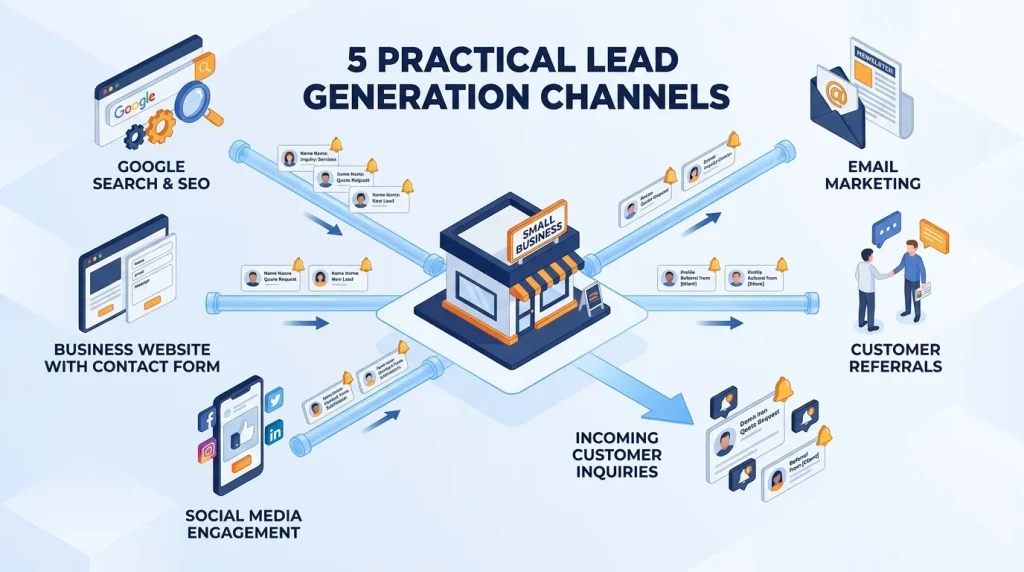
Finding new customers is one of the biggest challenges for a small business. You might have a good website, offer a useful service, and provide competitive prices, but still struggle to get inquiries. The problem is not always your product or service. Sometimes, potential customers simply cannot find you, do not understand what you offer, or are not given a clear reason to contact you.
The right lead generation ideas for small businesses can help you attract people who are genuinely interested in your products or services. Instead of waiting for customers to find you by chance, you can use your website, search engines, referrals, email marketing, and other channels to create more opportunities.
The good news is that you do not need a large marketing budget to begin. Many effective lead generation strategies require more consistency and planning than money.
In this guide, you will learn 21 practical ways to generate leads, choose the right strategies for your business, measure results, and avoid common mistakes that waste time and money.
Table of Contents
- What Is Lead Generation?
- Why Lead Generation Matters for Small Businesses
- 21 Lead Generation Ideas for Small Businesses
- How to Choose the Right Lead Generation Strategy
- Common Lead Generation Mistakes to Avoid
- How to Measure Lead Generation Results
- Frequently Asked Questions
- Final Thoughts
What Is Lead Generation?
Lead generation is the process of attracting potential customers and encouraging them to express interest in your business. A lead could be someone who fills out your contact form, requests a quote, books a consultation, subscribes to your email list, or calls to ask about your services.
For example, imagine you own a small web design business. A local restaurant owner searches Google for website design services, visits your website, reviews your portfolio, and submits a form asking for a price estimate. That person is a lead because they have shown interest in your service.
However, not every lead is equally valuable. Someone who downloads a free guide may be interested in learning, while someone requesting a quote may be closer to making a purchase.
Businesses often distinguish between three types of leads:
- Cold leads: People who match your target audience but have not shown much interest yet.
- Warm leads: People who have interacted with your content, visited your website, or engaged with your business.
- Qualified leads: Potential customers who appear to fit your service, budget, needs, and buying requirements.
The goal is not simply to collect as many names or email addresses as possible. It is to attract the right people and help them take the next step toward becoming customers.
Why Lead Generation Matters for Small Businesses
Small businesses often have limited budgets and smaller teams. Every marketing activity needs to contribute to a clear business goal.
A consistent lead generation process can help you:
Create a more predictable flow of inquiries. Instead of relying entirely on occasional referrals, you can build several channels that introduce new people to your business.
Reach people who need your services. Search engine optimization, targeted content, and relevant advertising can connect you with people already looking for a solution.
Reduce dependence on one marketing channel. If most of your customers come from referrals, you may experience slow periods when recommendations decrease. Additional channels can reduce that dependence.
Improve your marketing decisions. Tracking inquiries, conversions, and sales helps you identify which activities deserve more time and money.
Build customer relationships. Useful content, helpful follow-ups, and clear communication can build trust before a customer decides to buy.
Lead generation does not guarantee immediate sales. Results depend on factors such as your market, competition, pricing, offer, website experience, and how effectively you follow up. The aim is to develop a repeatable process that improves over time.
21 Lead Generation Ideas for Small Businesses
You do not need to implement all 21 strategies at once. Start with a few that match your audience and budget, measure their performance, and expand when you understand what works.
1. Optimize Your Website for Lead Generation
Your website should do more than describe your business. It should help visitors understand your offer and take the next step.
Start by checking whether your homepage clearly explains what you do, who you help, and how people can contact you. Avoid vague headlines that sound impressive but do not explain the actual service.
For example, instead of writing “Innovative Solutions for a Better Future,” a web design business could use “Professional WordPress Websites for Small Businesses.”
Make sure your website includes:
- A clear headline and explanation of your services.
- A visible contact button or quote request option.
- Service pages that answer customer questions.
- Testimonials or genuine examples of previous work, when available.
- A mobile-friendly layout and readable text.
- A simple contact form that asks only for necessary information.
Test your contact form yourself. Confirm that submissions arrive at the correct email address and that visitors receive a confirmation message.
If your website is difficult to navigate, slow, or unclear, potential customers may leave before contacting you. Improving the user experience can make your existing traffic more useful.
2. Use SEO to Attract People Searching for Your Services
Search engine optimization (SEO) helps your website become more visible when people search for relevant information, products, or services.
Unlike paid advertising, organic search traffic does not require paying for every click. However, SEO takes time, and rankings are never guaranteed.
Begin with the phrases your potential customers actually use. A plumber might target “emergency plumber in Austin,” while a web designer might focus on “WordPress website designer for small businesses.”
Build your SEO plan around three areas:
- Keyword research: Identify relevant searches and understand what users want to find.
- On-page SEO: Improve page titles, headings, content, internal links, and page structure.
- Technical SEO: Make sure search engines can access and understand important pages.
If you need help identifying search terms for your website, read our guide to how to do keyword research for SEO.
You can also use our technical SEO checklist to review common technical issues.
Focus on relevant keywords rather than attracting visitors who are unlikely to need your services. One qualified inquiry can be more valuable than hundreds of visits from the wrong audience.
3. Publish Helpful Blog Content
Blogging can introduce your business to people who are researching a problem before they are ready to buy.
Think about the questions customers ask before contacting you. A bookkeeping business might publish articles about preparing financial records, while a web design agency could explain website redesign costs or common website problems.
A useful blog strategy includes different types of content:
- Educational articles: Explain a problem or answer a common question.
- Comparison articles: Help readers evaluate different approaches or solutions.
- Problem-solving guides: Give readers practical steps they can follow.
- Service-related articles: Explain when professional assistance may be useful.
For example, an article about common website conversion problems can attract business owners who are struggling to generate inquiries. The article can then direct interested readers to a relevant service page.
Create content that answers the reader’s question completely. Avoid publishing several articles that repeat the same information simply to target slightly different keywords.
For more guidance, explore our article on SEO content writing.
4. Offer a Useful Free Resource
A free resource can encourage potential customers to share their contact details in exchange for something genuinely useful.
This approach is often called a lead magnet. It works best when the resource solves a specific problem for your target audience.
Examples include:
- A website launch checklist for new business owners.
- A monthly expense planning spreadsheet for freelancers.
- A home maintenance checklist for homeowners.
- A social media content calendar for small businesses.
- A guide to preparing for a professional consultation.
Keep the resource focused. A short checklist that solves one problem can be more useful than a lengthy guide that tries to cover everything.
Place the offer on a relevant page and explain what the reader will receive. If you collect email addresses, tell visitors how their information will be used and obtain any consent required by applicable privacy laws.
Do not ask for unnecessary personal information. The easier it is to access the resource, the less friction there is in the process.
5. Add Clear Calls to Action
A call to action (CTA) tells visitors what to do next.
Without a clear CTA, someone may read your content, find it helpful, and leave without taking any action. A well-placed invitation can turn interest into an inquiry.
Examples include:
- Request a quote.
- Book a consultation.
- Ask a question.
- Download the checklist.
- Get a website review.
- Subscribe for practical tips.
Choose a CTA that matches the page. A visitor reading an introductory educational article may prefer a free checklist, while someone viewing a service page may be ready to request a quote.
Avoid placing too many competing buttons on the same page. If every section asks visitors to do something different, the main action becomes less obvious.
Review your website on both desktop and mobile devices. Make sure the buttons are visible, readable, and easy to use.
6. Create or Improve Your Google Business Profile
If your business is eligible for a Google Business Profile, it can help people discover your business through Google Search and Google Maps.
This is particularly useful for local businesses, such as repair services, salons, consultants, restaurants, and professional service providers.
Start by making sure your business information is accurate. Add the appropriate business category, services, hours, website, and other relevant details.
You should also:
- Keep your opening hours updated.
- Add genuine photos where appropriate.
- Respond professionally to customer reviews.
- Encourage satisfied customers to leave honest feedback.
- Check that your website and business information are consistent.
Google explains that local results are influenced mainly by relevance, distance, and prominence. You can read its official guidelines for improving local rankings.
A complete profile can help customers understand your business, but it does not guarantee a particular ranking or number of inquiries.
If you serve customers at their locations rather than from a public storefront, check Google’s eligibility and address-display requirements before creating or changing your profile.
7. Build an Email List
Email marketing allows you to maintain contact with people who have expressed interest in your business.
Not everyone will purchase the first time they visit your website. Some people need more information, time to compare options, or a reminder when they are ready to make a decision.
You can build an email list by offering a useful resource, publishing a newsletter, or inviting visitors to receive relevant updates.
Once someone subscribes, send emails that provide value rather than constant sales messages.
For example, a web design business might send:
- A welcome email explaining what the subscriber can expect.
- A practical website improvement tip.
- A short guide to common website mistakes.
- An invitation to request a consultation if they need professional help.
Keep emails relevant to the subscriber’s interests, provide a clear unsubscribe option, and follow applicable email marketing and privacy requirements.
A small list of interested subscribers can be more useful than a large list of people who never open your messages.
8. Use Social Media to Start Conversations
Social media can help small businesses build awareness, demonstrate expertise, and connect with potential customers.
You do not need to maintain an active presence on every platform. Choose the channels your target audience uses and focus on publishing useful, consistent content.
For a business serving other businesses, LinkedIn may be a good place to share professional insights and build relationships. A visual business may benefit more from platforms where images and videos play a larger role.
Consider sharing:
- Answers to common customer questions.
- Short explanations of problems you help solve.
- Practical tips from your area of expertise.
- Genuine examples of your work.
- Lessons learned while completing projects.
- Responses to relevant industry discussions.
Avoid making every post a sales pitch. If your content helps people understand a problem or make a better decision, they have a reason to engage with your business.
When someone comments or asks a question, respond naturally. The goal is to build a relevant professional relationship, not to send unsolicited promotional messages to everyone who interacts with your posts.
9. Ask for Referrals
Referrals can be a valuable source of leads because the potential customer already has some context about your business.
Start with satisfied customers, professional contacts, suppliers, and other people who know the quality of your work.
You can make referrals easier by explaining exactly who you help and what type of introduction would be useful.
For example, a freelance web designer could tell a satisfied customer:
“If you know a small business owner who needs a new website, I would appreciate an introduction.”
You do not need to make the request complicated. A simple, respectful conversation is often enough.
If you choose to offer referral rewards, explain the terms clearly and make sure the arrangement complies with any applicable rules. Never pressure customers to recommend you or imply that a positive review is required in exchange for a benefit.
10. Use Testimonials and Genuine Customer Feedback
Potential customers often want reassurance before they spend money with a business they have not worked with before.
Testimonials can help address this concern by showing what previous customers valued about your service.
Ask satisfied clients whether they would be comfortable sharing feedback about their experience. Where possible, use specific comments that explain the problem, the service provided, and the outcome.
For example, “The website was easier to navigate after the redesign” communicates more than a generic statement that the service was excellent.
Use only authentic feedback and obtain permission before publishing identifiable customer information. Do not invent testimonials, edit comments in ways that change their meaning, or display results that cannot be substantiated.
If your business is new and you do not have client testimonials yet, do not fabricate them. You can build credibility through a portfolio, sample projects clearly labelled as examples, detailed service descriptions, and useful educational content.
11. Create Dedicated Landing Pages
A landing page is designed around a specific offer or action.
Sending every potential customer to your homepage may not be the best approach. A person searching for a particular service should ideally land on a page that directly addresses that need.
For example, a cleaning company might create a page for office cleaning, while a web design business could have a dedicated page for WordPress website development.
A useful landing page generally includes:
- A clear headline matching the visitor’s need.
- An explanation of the service and its benefits.
- Details about what is included.
- Relevant examples, qualifications, or genuine reviews.
- Answers to common objections.
- A clear contact form or booking option.
Keep the page focused on one primary goal. Remove unnecessary distractions and make it easy for visitors to understand the next step.
If you create several landing pages, make sure each one provides genuinely useful, distinct information. Avoid publishing near-identical pages with only a city or keyword changed.
12. Test Paid Advertising With a Small Budget
Paid advertising can bring visitors to your offer more quickly than waiting for organic search visibility. However, it can also waste money if your targeting, landing page, or follow-up process is weak.
Google Ads may be suitable when people actively search for the products or services you provide. Social advertising may be more appropriate when you need to reach a defined audience or introduce people to an offer they have not searched for yet.
Before launching a campaign, decide:
- Which audience you want to reach.
- What offer you are promoting.
- What action counts as a conversion.
- How much you can afford to spend testing the campaign.
- How you will track inquiries and sales.
Start with a limited test rather than committing your entire marketing budget immediately.
Measure qualified leads and actual sales, not just clicks. A campaign that generates inexpensive traffic but no meaningful inquiries may be less valuable than one that attracts fewer, more relevant visitors.
Do not increase spending until you understand which keywords, audiences, and offers are producing useful results.
13. Build Partnerships With Complementary Businesses
A partnership can introduce your business to people who already need a related service.
Look for businesses that serve the same type of customer without directly competing with you.
For example:
- A web designer could partner with a copywriter.
- A wedding photographer could build relationships with event planners.
- An accountant could connect with business consultants.
- A home renovation contractor could collaborate with interior designers.
The partnership should offer a genuine benefit to both sides. You might exchange relevant referrals, create a joint educational resource, or host a webinar together.
Start by identifying a small number of suitable businesses and explaining how a collaboration could help their customers. Avoid sending generic partnership messages that do not show an understanding of the other business.
Measure the quality of the referrals over time. A partnership is useful when it creates relevant opportunities, not merely because both businesses have exchanged links or mentioned each other online.
14. Participate in Relevant Online Communities
Online communities can help you understand customer problems and build professional relationships.
Depending on your audience, useful communities may exist on industry forums, LinkedIn groups, Reddit, specialist discussion boards, or professional networks.
The most effective approach is to contribute before promoting your services.
Answer questions clearly, explain practical solutions, and share useful resources when they genuinely fit the discussion. Follow each community’s rules about self-promotion and links.
For example, if business owners frequently ask why their websites are not receiving inquiries, you could explain common causes such as unclear messaging, irrelevant traffic, weak calls to action, or a difficult contact process.
Do not copy and paste the same promotional message into multiple discussions. That approach can damage your reputation and may lead to your content being removed.
Useful participation helps people recognize your expertise naturally. Some may then visit your profile or website when they need further assistance.
15. Offer a Short Consultation or Initial Assessment
Some customers need professional advice before they feel comfortable requesting a full service.
A short consultation can help them explain their situation, understand possible solutions, and decide whether your service is appropriate.
For example, a marketing consultant might offer a short introductory call, while a web designer could provide an initial discussion about website requirements.
Set clear boundaries around the offer. Explain what the consultation includes, how long it lasts, and whether it involves a detailed review or simply an initial conversation.
Avoid promising a complete audit or extensive strategy for free if you cannot realistically deliver it.
You can use a simple booking form to collect the information needed for the conversation. Ask only relevant questions, such as the person’s main challenge and the service they are interested in.
A consultation should help both sides determine whether there is a good fit, rather than becoming a high-pressure sales call.
16. Improve Your Online Reviews
Reviews can influence how people evaluate your business before contacting you.
For eligible businesses, reviews on relevant platforms can provide insight into customer experiences and help potential buyers compare providers.
Build a consistent process for requesting honest feedback after a completed transaction or project.
You can send a polite follow-up email with a direct link to the appropriate review page. Make the request easy to understand, but do not pressure customers to leave only positive feedback.
Respond to reviews professionally, including negative ones. A calm response that acknowledges a concern and offers a reasonable next step can demonstrate that you take customer service seriously.
Do not purchase fake reviews or offer prohibited incentives. Review platform policies and local rules may restrict these practices.
Remember that reviews are only one part of the decision. Your service quality, pricing, communication, and ability to solve the customer’s problem also matter.
17. Use Short Videos to Explain Your Services
Short videos can help people understand a product, service, or process that may be difficult to explain through text alone.
You do not need an expensive camera or a complicated production setup. A clear explanation, useful example, and decent audio are often enough to begin.
Consider creating videos that answer common questions, demonstrate a process, or explain how customers can avoid a frequent mistake.
For example, a website specialist could record a short walkthrough of a confusing contact page and explain how a clearer layout may help visitors find the right information.
A video can be published on a suitable social platform and embedded in a relevant blog post or service page.
Focus on helping the viewer. Use a simple title, explain the problem early, and end with one relevant next step.
Do not assume that video views automatically translate into leads. Give interested viewers a clear way to learn more or contact your business.
18. Simplify Your Lead Capture Forms
A lead capture form should collect enough information to start a useful conversation without making the process unnecessarily difficult.
If a potential customer must complete a long form before asking a basic question, they may abandon it.
Start with the information you genuinely need. For many small service businesses, this could be a name, email address, and brief description of the required service.
You may need additional fields for complex projects, but every extra question should have a clear purpose.
To improve form completion:
- Use clear field labels.
- Explain what happens after submission.
- Make the form work properly on mobile devices.
- Show a helpful confirmation message.
- Test that submissions reach the correct inbox.
- Protect the form against spam.
- Provide an appropriate privacy notice.
Review your form analytics if available. If many people visit the page but very few submit the form, investigate whether the offer, page content, form length, or technical setup could be causing the problem.
19. Follow Up With Leads Promptly
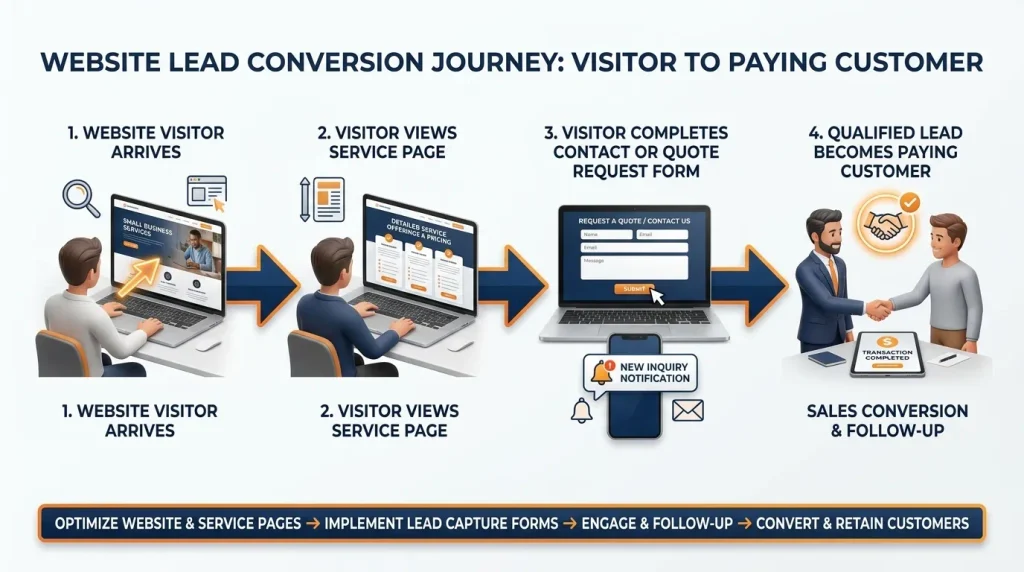
Generating a lead is only the beginning. If you fail to respond, a potential customer may contact another provider.
Create a simple follow-up process so that inquiries do not get lost in your inbox.
When someone requests a quote, acknowledge the inquiry, confirm that you understand their needs, and explain what will happen next.
A basic follow-up process could look like this:
- Initial response: Confirm receipt and provide an expected response time.
- First follow-up: If the person has not replied, send a polite message after an appropriate interval.
- Helpful clarification: Answer outstanding questions or explain the next step.
- Final follow-up: Check whether the person still needs assistance, then stop if they do not respond.
The appropriate timing depends on your industry, the urgency of the inquiry, and the customer’s preferences.
Keep a simple spreadsheet or customer relationship management (CRM) tool to record the lead source, inquiry date, status, and next action.
Respect opt-outs and privacy requirements. Do not repeatedly message people who have asked you to stop.
20. Host a Webinar or Online Workshop
A webinar or online workshop can attract people who want to learn about a specific topic related to your service.
It works best when the subject addresses a real problem rather than serving as a long sales presentation.
For example, a small-business consultant might host a session about improving customer retention, while a web specialist could explain how to prepare for a website redesign.
Choose a focused topic and promote it through relevant channels. You can use a registration form to collect the details needed to send joining instructions.
During the session:
- Explain the problem and why it matters.
- Share practical steps or examples.
- Answer relevant questions.
- Avoid exaggerating the results attendees can expect.
- Offer a suitable next step for people who need additional help.
After the event, send the promised resources and any follow-up information participants have agreed to receive.
A webinar may generate fewer leads than a broad campaign, but attendees who actively participate may be more interested in your subject.
21. Track Lead Sources and Improve What Works
One of the most overlooked lead generation ideas for small businesses is improving the strategies they already use.
Without tracking, it is difficult to know whether your inquiries come from organic search, referrals, email, paid ads, or social media.
You do not need an expensive analytics system to begin. A spreadsheet can record each inquiry, its source, whether it is qualified, and whether it eventually becomes a customer.
For website performance, tools such as Google Analytics and Google Search Console can help you understand how people find and interact with your site. Make sure relevant events and forms are configured correctly before relying on the data.
Review your results regularly. If a blog post attracts visitors but no one takes the next step, check whether it answers the right question and offers a relevant action. If referrals generate strong customers, consider building more professional relationships.
The objective is not to use every marketing channel. It is to identify the channels that attract suitable customers and improve them over time.
How to Choose the Right Lead Generation Strategy
With so many options available, it is easy to spread yourself too thin. A better approach is to select strategies based on your business model, audience, budget, and available time.
If You Have a Very Small Budget
Start with your website, relevant SEO improvements, helpful blog content, referrals, and genuine participation in professional communities.
These activities require effort and consistency, but they do not necessarily require a large advertising budget. Keep in mind that organic visibility and customer relationships can take time to develop.
If You Need Local Customers
Focus on an eligible and well-maintained Google Business Profile, relevant local pages, customer reviews, referrals, and partnerships with nearby businesses.
Make sure your service information and contact details are accurate. Prioritize the locations you genuinely serve rather than creating pages for places where you cannot provide a useful service.
If You Sell Services to Other Businesses
Consider professional networking, educational content, targeted landing pages, partnerships, consultations, and personalized outreach.
Business customers often need to understand the scope of a service, the expected process, and whether the provider can meet their requirements. Make those details easy to find.
If You Already Have Website Traffic
Before investing heavily in more traffic, examine what current visitors do.
Check which pages attract visitors, whether contact forms work, where users leave the site, and which calls to action receive engagement. You may be able to generate more inquiries by improving the existing experience rather than immediately increasing traffic.
A Simple 30-Day Starting Plan
You can use this basic plan to begin without trying to implement all 21 strategies at once.
Week 1: Build the foundation
- Review your website headline and service pages.
- Test your contact forms and email notifications.
- Choose one main conversion goal.
- Create a simple lead-tracking spreadsheet.
Week 2: Improve discoverability
- Research relevant customer search terms.
- Update one important service page.
- Improve your Google Business Profile if eligible.
- Identify common questions for future blog content.
Week 3: Start building relationships
- Publish a useful article or practical resource.
- Contact a few relevant professional connections.
- Ask satisfied customers for honest feedback if appropriate.
- Improve the clarity of your calls to action.
Week 4: Review the results
- Record how many inquiries you received.
- Identify their sources.
- Assess which inquiries were qualified.
- Fix any technical or communication problems.
- Choose the next improvements based on evidence.
This plan is a starting point, not a guarantee of leads within 30 days. If your website is new or receives little traffic, you may need more time to collect meaningful data.
Common Lead Generation Mistakes to Avoid
Even a well-planned strategy can underperform when the basic process is weak. Watch out for these common mistakes.
Trying Every Channel at Once
Managing a blog, email newsletter, multiple social accounts, advertising campaigns, and partnerships simultaneously can become overwhelming.
Choose a small number of suitable channels first. Build a consistent process before expanding.
Attracting the Wrong Audience
A high number of visitors does not necessarily mean a successful lead generation campaign. If your content targets people who are not likely to need your service, you may receive traffic without useful inquiries.
Review search intent, audience targeting, and the relevance of your offer.
Making Your Offer Unclear
Potential customers should understand what you do, who your service is for, and how they can get started.
Avoid vague descriptions and unnecessary industry jargon. Explain the practical problem your service addresses.
Ignoring Follow-Up
Leads can lose interest when responses are delayed or unclear. Set a realistic response time and create a simple process to manage inquiries.
Buying Low-Quality Leads
Purchased lists and poorly targeted lead sources can produce irrelevant inquiries, complaints, and privacy concerns.
Prioritize relevant, permission-based lead acquisition and follow applicable laws and platform policies.
Measuring Only Traffic and Likes
Traffic, impressions, and social engagement can be useful indicators, but they do not show the entire business picture.
Track qualified inquiries, conversion rates, customer acquisition costs, and sales where possible.
Expecting Immediate Results From SEO
SEO can be valuable for long-term lead generation, but it takes time to earn visibility and build trust. Avoid treating a short-term ranking change as proof that a strategy has succeeded or failed.
Review performance over an appropriate period and make improvements based on the available data.
How to Measure Lead Generation Results
You need a few clear metrics to understand whether your lead generation strategy is working.
1. Number of Leads
Count the inquiries generated during a specific period. Define what qualifies as a lead so that you do not mix newsletter subscriptions, spam submissions, and serious sales inquiries without distinction.
2. Lead Conversion Rate
Your lead conversion rate measures the percentage of visitors who complete your chosen lead action.
Formula:
Lead conversion rate = (Number of leads ÷ Number of visitors) × 100
For example, if 500 people visit a landing page and 15 submit the form, the conversion rate is 3%.
This example is an illustration, not a recommended benchmark. Appropriate rates vary by industry, traffic source, offer, and audience.
3. Qualified Lead Rate
Not every inquiry is a good fit. Calculate the percentage of leads that meet your qualification criteria.
Formula:
Qualified lead rate = (Qualified leads ÷ Total leads) × 100
If you receive 30 leads and 12 meet your requirements, your qualified lead rate is 40%.
4. Cost Per Lead
If you spend money on advertising or other lead acquisition activities, calculate how much each lead costs.
Formula:
Cost per lead = Total lead generation spend ÷ Number of leads generated
For example, spending $200 to generate 20 leads results in a cost per lead of $10.
A low cost per lead is not automatically good. If those leads never become customers, the campaign may still be unprofitable.
5. Customer Acquisition Cost
Customer acquisition cost (CAC) estimates how much it costs to acquire a paying customer.
Formula:
Customer acquisition cost = Total acquisition costs ÷ Number of new customers acquired
For a more complete calculation, decide which marketing, sales, and related costs you will include and apply the same method consistently.
6. Return on Marketing Investment
Revenue alone does not show whether a campaign is profitable. Consider the cost of delivering the service, advertising, and other relevant expenses.
A commonly used formula is:
Marketing ROI = ((Revenue attributable to marketing − Marketing cost) ÷ Marketing cost) × 100
For example, if a campaign generates $1,000 in attributable revenue and costs $200, the calculated return using this formula is 400%.
This simplified example does not account for all business expenses or prove that marketing caused every sale. Use reliable attribution data and include the costs relevant to your decision.
Frequently Asked Questions
What are the best lead generation ideas for small businesses?
The best options depend on your audience and budget. Common starting points include website optimization, SEO, useful blog content, referrals, email marketing, local search visibility, and professional partnerships. Choose strategies that connect you with people who are likely to need your product or service.
How can a small business generate leads for free?
You can begin with organic SEO, helpful content, referrals, eligible Google Business Profile activity, professional networking, and relevant online communities. These approaches may require time and consistent effort, and results are not guaranteed. A free strategy is not necessarily cost-free when your time is considered.
How can I generate leads without a website?
You can use professional networking, referrals, relevant online communities, eligible business profiles, and suitable marketplace listings. However, a website can give potential customers a central place to learn about your services, review your work, and contact you.
How long does lead generation take to work?
The timeline depends on the channel. Referrals or targeted outreach may produce inquiries sooner, while SEO and content marketing often require a longer period to build visibility. Your offer, competition, audience, and follow-up process also affect results.
Is SEO better than paid advertising for lead generation?
Neither is universally better. SEO can build long-term organic visibility, while paid advertising can bring targeted traffic more quickly when campaigns are configured effectively. Your budget, timeline, competition, and customer acquisition costs should guide the decision.
How do I generate qualified leads instead of just more leads?
Define your ideal customer, make your offer specific, target relevant searches and audiences, and ask appropriate qualifying questions. Measure how many inquiries fit your requirements and become customers rather than judging performance by lead volume alone.
What is the difference between lead generation and sales?
Lead generation attracts potential customers and encourages them to express interest. Sales involves helping suitable prospects evaluate the offer and complete a purchase. Both processes matter because generating an inquiry does not automatically result in a sale.
Do small businesses need a CRM for lead generation?
Not necessarily at the beginning. A spreadsheet can be sufficient when inquiry volume is low. A customer relationship management (CRM) system becomes more useful as leads increase, several people manage inquiries, or follow-up tasks become difficult to track manually.
Final Thoughts
Effective lead generation is not about using every marketing tactic available. It is about understanding your customers, making your offer clear, and creating a straightforward path from their initial interest to a meaningful conversation.
Start by improving the basics: make your website easy to understand, create useful content, choose relevant channels, and respond to inquiries consistently. Track the results so you can invest more effort in the activities that attract suitable customers.
If your website receives visitors but struggles to turn them into inquiries, review your content, calls to action, contact forms, and service pages before assuming you simply need more traffic.
At SiteNova Agency, the focus is on helping businesses improve their online presence through SEO, keyword research, website improvements, and content. Explore the services available on the website to identify the support that fits your goals.
The most useful lead generation strategy is one you can implement consistently, measure honestly, and improve as you learn more about your customers.