Table of Contents
- What Is Keyword Research for SEO?
- Why Keyword Research Is the Foundation of Every SEO Strategy
- Understanding Keyword Types
- Understanding Search Intent — The Most Important Concept in Keyword Research
- Key Keyword Metrics You Must Understand
- Free Keyword Research Tools
- Paid Keyword Research Tools
- How to Do Keyword Research for SEO — Step by Step
- How to Find Long-Tail Keywords
- How to Analyze Competitor Keywords
- How to Do Local Keyword Research for Pakistani Businesses
- How to Organize Keywords Into a Keyword Map
- LSI Keywords and Semantic SEO — Why They Matter
- Keyword Research for Different Content Types
- Common Keyword Research Mistakes to Avoid
- How to Track Keyword Rankings After Optimization
- Frequently Asked Questions
- Conclusion
What Is Keyword Research for SEO?
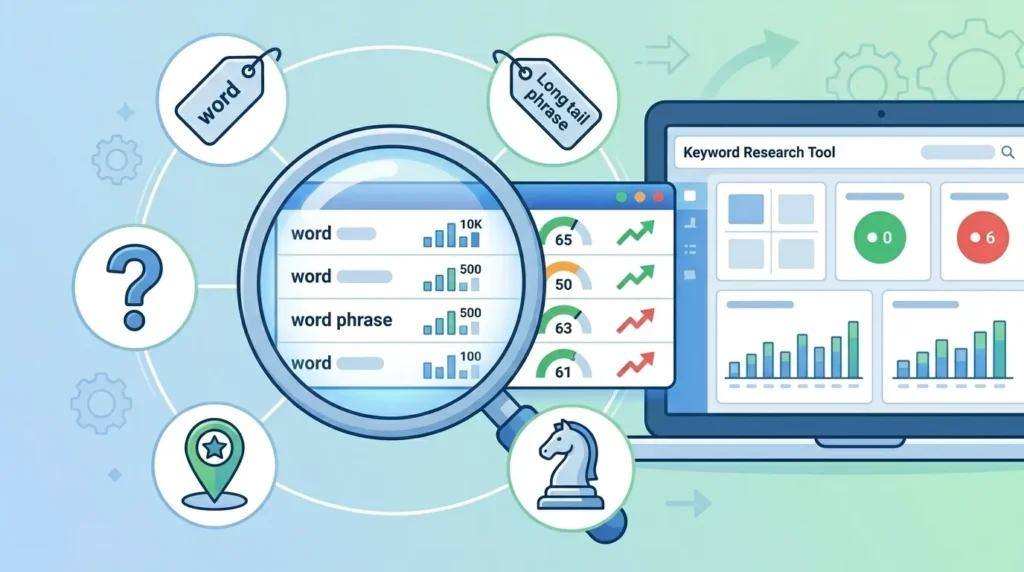
Keyword research for SEO is the process of identifying the exact words, phrases, and questions your target audience types into Google when searching for products, services, or information related to your business. It is the strategic foundation of every successful SEO campaign — the first step that determines which content you create, which pages you optimize, and which opportunities you pursue to grow your organic search visibility.
Without keyword research for SEO, you are essentially guessing what your potential customers are searching for. You might create excellent content about topics nobody searches — or optimize pages for terms that are so competitive you have no realistic chance of ranking. Keyword research eliminates this guesswork, replacing it with data-driven decisions that align your SEO efforts with real search demand.
Think of keyword research as the compass of your SEO strategy. It tells you where to go, which direction to move, and which paths offer the best opportunity for your specific business, website, and competitive situation. Every optimization in every other aspect of SEO — from the content you write to the pages you build to the links you pursue — should be guided by your keyword research findings.
This guide is part of our ongoing SEO education series at SiteNova Agency. Before diving into keyword research, we recommend reading our guide on what SEO is in digital marketing for essential context, and our post on why local SEO is important if your business serves customers in specific Pakistani cities.
Why Keyword Research Is the Foundation of Every SEO Strategy
Every element of a successful SEO strategy flows from keyword research. Here is precisely why it matters so much:
It Connects You With Real Customer Demand
Keyword research shows you exactly what language your potential customers use when looking for what you offer. This is often different from the language businesses use internally. A healthcare clinic might call its service “dermatological consultations” while patients search “skin doctor Lahore.” Keyword research bridges this gap, ensuring your content speaks the language your customers actually use.
It Reveals Market Opportunity
Keyword research quantifies search demand — showing you not just what people search but how many people search it and how difficult it is to rank for. This allows you to identify high-opportunity keywords where significant search volume meets manageable competition — the sweet spot where SEO investment produces the strongest returns.
It Guides Content Strategy
Without keyword research, content creation is guesswork. With it, every piece of content you create has a defined purpose — targeting specific search queries with specific user intent. This ensures your content investment generates organic traffic rather than simply existing on your website without ranking for anything meaningful.
It Reveals Competitor Weaknesses
Keyword research exposes gaps in your competitors’ content strategies — topics they are not covering, keywords they are not targeting, and questions they are not answering. These gaps represent direct opportunities to capture organic traffic they are missing.
It Informs Your Entire Digital Marketing Strategy
The insights from keyword research extend beyond SEO. The language your audience uses in search queries informs your paid advertising targeting, your social media content, your email marketing subject lines, and your overall messaging strategy. Keyword research is intelligence about your market — not just your search rankings.
Understanding Keyword Types
Before learning how to do keyword research for SEO, you need to understand the different types of keywords — because each type serves a different strategic purpose and requires a different approach.
Short-Tail Keywords (Head Terms)
Short-tail keywords are broad, single-word or two-word search terms with very high search volume and extremely high competition. Examples: “SEO,” “marketing,” “website.”
These terms are searched millions of times monthly but are nearly impossible for most businesses to rank for — they are dominated by enormous, established websites with massive domain authority. Short-tail keywords are useful for understanding broad market size but are rarely practical primary targets for most businesses.
Mid-Tail Keywords
Mid-tail keywords are two to three word phrases that balance search volume with more specific intent. Examples: “SEO services,” “digital marketing agency,” “keyword research tool.”
These terms have meaningful search volume and more specific intent than head terms. They are competitive but achievable for businesses with moderate domain authority and strong content. Mid-tail keywords often make excellent primary targets for service pages and pillar content.
Long-Tail Keywords
Long-tail keywords are longer, more specific phrases — typically four or more words — that have lower individual search volume but much higher purchase intent and significantly lower competition. Examples: “how to do keyword research for SEO,” “digital marketing agency in Lahore for small business,” “best free keyword research tools for beginners.”
Long-tail keywords are the most valuable targets for most businesses — particularly those with newer websites or moderate domain authority. While each term has lower individual search volume, they are far easier to rank for, they convert at higher rates because of their specificity, and collectively they account for the majority of all search queries.
Question Keywords
Question keywords are search queries phrased as questions — beginning with what, how, why, when, where, or which. Examples: “how to do keyword research for SEO,” “what is local SEO,” “why is content marketing important.”
Question keywords are ideal for blog content because they precisely match informational search intent. They also appear in Google’s People Also Ask section and are prime targets for Featured Snippet rankings — a position above the first organic result that drives significant click-through traffic.
Local Keywords
Local keywords include geographic modifiers that indicate location-specific search intent. Examples: “SEO agency Lahore,” “digital marketing company Karachi,” “web designer near me.”
For businesses serving specific geographic areas, local keywords are the highest-priority targets. They have strong commercial intent — the user is actively looking for a local solution — and are significantly less competitive than their national counterparts. Our guide on Google Business Profile for local SEO covers local keyword targeting in detail.
Branded Keywords
Branded keywords include your business name or product names. Examples: “SiteNova Agency,” “SiteNova SEO services.”
While you should naturally rank for your own branded terms, the primary value of branded keyword research is monitoring your brand’s search presence and identifying reputation management opportunities.
Understanding Search Intent — The Most Important Concept in Keyword Research
Search intent — also called user intent — is the underlying goal a person has when typing a search query into Google. It is the single most important concept in keyword research for SEO because Google’s algorithm is specifically designed to identify and satisfy search intent. Content that mismatches search intent will not rank regardless of how well it is optimized for other factors.
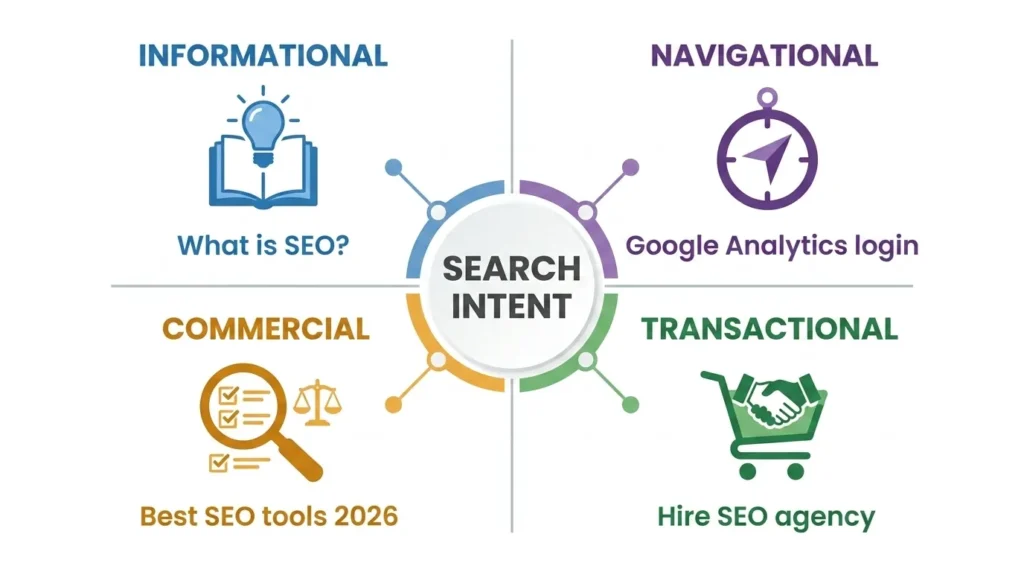
The Four Types of Search Intent
Informational intent — the user wants to learn something. They are researching, not buying. Keywords with informational intent include “what is SEO,” “how does keyword research work,” “why is content marketing important.” The correct content format for informational intent is blog posts, guides, tutorials, and educational articles.
Navigational intent — the user wants to find a specific website or page. Keywords include “Google Analytics login,” “Ahrefs free trial,” “SiteNova Agency contact.” These users already know where they want to go — they are using Google as a navigation tool. Ranking for competitor navigational terms is rarely worthwhile.
Commercial investigation intent — the user is researching before making a purchase decision. Keywords include “best SEO tools 2026,” “Ahrefs vs SEMrush comparison,” “top digital marketing agencies in Lahore.” The correct content format is comparison articles, reviews, case studies, and “best of” lists.
Transactional intent — the user is ready to take action — buy, sign up, contact, or download. Keywords include “hire SEO agency Lahore,” “buy keyword research tool,” “book digital marketing consultation.” The correct content format is service pages, product pages, and landing pages with strong calls to action.
Why Matching Intent Matters
If you create a blog post targeting “SEO agency Lahore” — a transactional keyword — it will not rank because Google knows users searching that term want to find and hire an agency, not read a blog post about agencies. Your service page targeting that keyword will rank instead. Mismatching content format to search intent is one of the most common and most damaging keyword research mistakes.
Always evaluate search intent before creating content for a keyword. Search the keyword yourself and analyze the top three to five results. The type of content ranking on page one tells you exactly what Google believes users want — match that content type.
Key Keyword Metrics You Must Understand
Effective keyword research for SEO requires understanding the metrics that determine whether a keyword is worth targeting. Here are the essential metrics and what they mean:
Search Volume
Search volume is the average number of times a keyword is searched per month. It tells you how much traffic a keyword could potentially drive if you rank for it. Higher search volume means more potential traffic — but also typically more competition.
Important nuance: do not chase high search volume blindly. A keyword searched 200 times per month with low competition and high commercial intent is often far more valuable than one searched 10,000 times per month that is impossible to rank for or attracts users with no purchase intent.
Keyword Difficulty (KD)
Keyword difficulty is a score — typically from 0 to 100 — that estimates how hard it is to rank on page one for a keyword. Higher scores indicate stronger competition. Different tools calculate this differently, but all use backlink data from ranking pages as the primary input.
General guidance for most Pakistani businesses and newer websites:
- KD 0–20: Low difficulty — achievable relatively quickly with good content
- KD 21–40: Moderate difficulty — achievable with consistent SEO effort over 3 to 6 months
- KD 41–60: High difficulty — requires strong domain authority and significant content investment
- KD 61–100: Very high difficulty — dominated by major established websites
Click-Through Rate (CTR) and Search Traffic Potential
Not every search results in a click to a website. Searches with featured snippets, AI Overviews, local packs, and knowledge panels often satisfy the user’s need without a click. The actual traffic a keyword can drive depends not just on search volume but on how much of that volume clicks through to organic results.
Cost Per Click (CPC)
CPC is what advertisers pay per click for a keyword in Google Ads. While not a direct SEO metric, high CPC keywords indicate high commercial value — advertisers pay more for keywords that convert to customers. High CPC with manageable keyword difficulty is an excellent combination for SEO targeting.
Search Trend
Trend data shows whether a keyword’s search volume is growing, stable, or declining. Target keywords with growing or stable trends — not ones that have already peaked and are declining. Google Trends is the best free tool for evaluating keyword trend trajectories.
Free Keyword Research Tools
You do not need an expensive subscription to start doing keyword research for SEO effectively. These free tools provide genuinely useful data:
Google Keyword Planner
Google’s own keyword research tool — available free inside Google Ads — provides search volume ranges, competition levels, and bid estimates for any keyword. While the search volume data is less precise for non-advertisers (showing ranges rather than exact numbers), it is the most authoritative source of keyword data because it comes directly from Google.
Access it at ads.google.com → Tools → Keyword Planner. You do not need to run ads to use it.
Google Search Console
If your website is already live and verified in Google Search Console, the Performance report shows you exactly which keywords your site currently appears for — including impressions, clicks, average position, and click-through rate. This is your most valuable existing keyword intelligence — it shows real performance data for your specific website.
Look for keywords where your site appears in positions 6 to 20 — these are within striking distance of page one with targeted optimization. Improving existing near-page-one positions is often faster and more impactful than targeting entirely new keywords.
Google Autocomplete and Related Searches
Type your seed keyword into Google and observe the autocomplete suggestions — these are real searches people make, ranked by frequency. Scroll to the bottom of the results page and review the “Related searches” section. Both sources provide genuine keyword ideas directly from Google’s search data at zero cost.
People Also Ask
The People Also Ask box appears in Google results for most informational queries. It shows questions real users are asking related to your keyword — and each one is a potential blog post topic, FAQ section entry, or featured snippet opportunity.
Google Trends
Google Trends at trends.google.com shows the relative search popularity of keywords over time and by geographic region. It is invaluable for understanding whether a keyword is growing or declining in popularity and for comparing the relative search interest between multiple keyword options. For Pakistani businesses, you can filter trends data by Pakistan specifically.
Ubersuggest (Free Tier)
Neil Patel’s Ubersuggest offers a limited free tier that provides keyword suggestions, search volume estimates, keyword difficulty scores, and content ideas. The free version limits daily searches but provides enough data for basic keyword research.
Answer the Public
AnswerThePublic.com visualizes the questions, prepositions, and comparisons people search around any seed keyword. It is particularly useful for generating blog content ideas and FAQ content by showing all the question-format keywords related to your topic.
Paid Keyword Research Tools
For more comprehensive keyword research for SEO — particularly for competitive analysis and large-scale content planning — these professional tools provide significantly more data depth:
Ahrefs
Ahrefs is widely considered the most comprehensive SEO tool available. Its Keywords Explorer provides accurate search volume data, keyword difficulty scores, click-through rate estimates, parent topic identification, and SERP analysis for any keyword in any country. Its Site Explorer reveals exactly which keywords any competitor is ranking for — making it invaluable for competitor keyword analysis.
Ahrefs starts from approximately $129 per month, with a $7 seven-day trial available.
SEMrush
SEMrush is a comprehensive digital marketing platform whose keyword research capabilities rival Ahrefs. Its Keyword Magic Tool generates thousands of keyword ideas from a single seed term, organized by topic and search intent. SEMrush also provides keyword gap analysis — showing keywords your competitors rank for that you do not.
SEMrush starts from approximately $139.95 per month with a free trial available.
Moz Keyword Explorer
Moz’s Keyword Explorer provides keyword suggestions, difficulty scores, organic CTR estimates, and priority scores that combine multiple metrics into a single ranking opportunity signal. Moz is known for its conservative, reliable difficulty estimates.
Rank Math and Yoast SEO (WordPress)
For WordPress users — which includes most Pakistani business websites — both Rank Math and Yoast SEO provide in-editor keyword optimization guidance. While not keyword research tools per se, they guide correct keyword placement and density once you have identified your target keywords. For free keyword suggestions within WordPress, Rank Math integrates with Google Search Console to surface keyword opportunities directly in your dashboard.
How to Do Keyword Research for SEO — Step by Step
Now that you understand the foundation, here is the complete step-by-step process for how to do keyword research for SEO effectively:
Step 1 — Define Your Seed Keywords
Seed keywords are the broad terms that describe your business, products, or services. They are the starting point from which you will expand into a comprehensive keyword list.
For SiteNova Agency, seed keywords include: digital marketing, SEO, web design, content marketing, local SEO, keyword research.
For a dentist in Lahore, seed keywords might include: dentist, dental clinic, teeth whitening, dental implants, orthodontist.
Write down every word and phrase that describes what your business does, what problems you solve, and what your customers might search for. Do not filter at this stage — just brainstorm comprehensively.
Step 2 — Expand Seed Keywords Into a Full List
Enter each seed keyword into your keyword research tools and collect all suggested variations, related terms, and questions. For each seed keyword, you should aim to collect 50 to 100 related keyword ideas. Use multiple tools — Google Autocomplete, Google Keyword Planner, Ubersuggest, and Ahrefs or SEMrush — to ensure comprehensive coverage.
Step 3 — Collect Key Metrics for Each Keyword
For your expanded keyword list, collect search volume, keyword difficulty, search intent, and CPC data. Organize this in a spreadsheet with columns for keyword, search volume, difficulty, intent, CPC, and notes. This becomes your keyword research master document.
Step 4 — Evaluate Search Intent for Every Keyword
For every keyword on your list, search it in Google and analyze the top five results. Record what type of content is ranking — blog post, service page, product page, video, or local results. This tells you the search intent and the content format required to compete for that keyword.
Remove keywords from your targeting list where the ranking content type does not match what your website can realistically produce. If all top results for a keyword are e-commerce product pages and you run a service business, that keyword is not an appropriate target.
Step 5 — Assess Ranking Difficulty Realistically
Be honest about your website’s current domain authority and your available resources. A brand new website with no backlinks should focus primarily on low-difficulty keywords — under 20 KD. An established site with strong backlink profile can target moderate to high difficulty terms.
For each keyword on your list, assess whether ranking for it within your target timeframe is realistic given your current domain strength. Keep high-difficulty keywords on your list as long-term targets while prioritizing low to moderate difficulty terms for immediate content creation.
Step 6 — Identify Your Priority Keywords
From your researched and filtered list, identify three tiers of priority keywords:
Tier 1 — Primary target keywords: Your most important terms. High relevance, realistic difficulty, meaningful search volume. These get dedicated pages or cornerstone content.
Tier 2 — Secondary keywords: Supporting terms that can be targeted within Tier 1 content or with dedicated supporting pages. Good search volume and intent but slightly less central to your core offering.
Tier 3 — Long-tail opportunities: Lower volume but high intent and low difficulty. These get targeted in blog posts, FAQ content, and supporting pages.
Step 7 — Map Keywords to Pages
Assign each priority keyword to a specific page on your website — existing or planned. Every page should have one primary keyword and several supporting secondary keywords. No two pages should target the same primary keyword — this causes keyword cannibalization, where your own pages compete against each other and weaken each other’s rankings.
How to Find Long-Tail Keywords
Long-tail keywords deserve special attention in your keyword research for SEO because they offer the best combination of achievability, specificity, and purchase intent — particularly for businesses in Pakistan with newer websites or moderate domain authority.
Method 1 — Google Autocomplete Mining
Type your seed keyword into Google followed by each letter of the alphabet — “SEO a,” “SEO b,” “SEO c” — and record every autocomplete suggestion. Then repeat with questions — “how to SEO,” “what is SEO,” “why SEO.” This simple technique generates hundreds of genuine long-tail keyword ideas at zero cost.
Method 2 — People Also Ask Expansion
Click on each question in the People Also Ask box when you search your primary keyword. Each click reveals additional related questions — expanding the PAA box further with each interaction. This can generate dozens of question-format long-tail keywords from a single starting query.
Method 3 — Forum and Community Mining
Search for your topic on Quora, Reddit, and Facebook groups relevant to your industry. The questions people ask in these communities are real expressions of search intent that often translate directly to long-tail keyword opportunities. If someone asks on Quora “how do I find the right keywords for my small business website in Pakistan” — that is a real search query worth targeting.
Method 4 — Google Search Console — Existing Long-Tail Discovery
Your Google Search Console Performance report shows every keyword your site currently receives impressions for — including long-tail variations you may never have intentionally targeted. Sort by impressions, filter for keywords in positions 5 to 30, and look for long-tail terms where your content is already partially relevant but could be more directly optimized.
Method 5 — Keyword Research Tool Filters
In tools like Ahrefs or SEMrush, filter keyword suggestions by word count (four or more words), search volume (50 to 500 monthly searches), and difficulty (under 20). This filter specifically surfaces high-opportunity long-tail keywords that are achievable for most websites.
How to Analyze Competitor Keywords
Analyzing what keywords your competitors rank for is one of the most efficient forms of keyword research for SEO. Rather than building your keyword list from scratch, competitor analysis reveals proven keyword opportunities — terms that are already generating traffic for similar businesses.
Step 1 — Identify Your Real Search Competitors
Your search competitors may be different from your business competitors. Search your primary keywords on Google and identify which websites consistently appear in the top five results. These are your SEO competitors regardless of whether they compete with you for customers.
Step 2 — Analyze Competitor Keywords in Ahrefs or SEMrush
Enter your competitor’s domain into Ahrefs Site Explorer or SEMrush Domain Analytics. Look at their “Top pages” — the pages driving the most organic traffic — and the keywords those pages rank for. This reveals which topics and keywords drive real traffic in your industry.
Step 3 — Find Keyword Gaps
Use the keyword gap analysis feature in SEMrush or Ahrefs to compare your website against two or three competitors simultaneously. This shows keywords your competitors rank for that your website does not — direct opportunities where creating content could capture traffic your competitors are currently getting.
Step 4 — Identify Their Weakest Rankings
Look for keywords where your competitors rank in positions 5 to 20 — not dominating, but present. These are keywords where the content currently ranking is not considered the best possible result by Google. Creating significantly better content on these topics gives you a strong opportunity to outrank established competitors.
How to Do Local Keyword Research for Pakistani Businesses
For businesses serving specific cities in Pakistan, local keyword research is a specialized and particularly high-value component of keyword research for SEO. Local keywords have strong commercial intent — people searching with geographic modifiers are typically close to making a decision.
Local Keyword Formula
The basic formula for local keywords is: [Service/Product] + [City/Area]
Examples:
- Digital marketing agency + Lahore = “digital marketing agency Lahore”
- SEO services + Karachi = “SEO services Karachi”
- Web designer + Islamabad = “web designer Islamabad”
- Dentist + DHA Lahore = “dentist DHA Lahore”
Extend this formula to neighborhood and area level for highly targeted local keywords:
- “SEO company Gulberg Lahore”
- “digital marketing Johar Town”
- “web design F-7 Islamabad”
Near Me Keywords
“Near me” searches are among the highest-intent local queries. Optimize your Google Business Profile and location pages for near me intent — users do not type your city because they expect Google to detect their location automatically.
Our complete guide on Google Business Profile for local SEO covers exactly how to optimize for near me searches through Google Maps and local pack optimization.
Bilingual Keyword Research
Pakistani consumers search in both English and Urdu. While Urdu keyword search volume data is less available in standard tools, Google Trends can show relative interest. Consider creating content targeting both languages to capture the full local search audience — particularly for consumer-facing businesses in healthcare, food, retail, and education.
Local Long-Tail Keywords
Combine the local formula with question keywords for highly specific local long-tail targets:
- “how to find the best digital marketing agency in Lahore”
- “what does SEO cost for small business in Pakistan”
- “which web design company is best in Karachi”
These terms have low search volume individually but extremely high conversion intent — someone asking this specific question is very close to making a hiring decision.
How to Organize Keywords Into a Keyword Map
A keyword map — also called a keyword matrix — is a structured document that assigns specific keywords to specific pages on your website. It is the output of your keyword research process and the input that guides all your content creation and optimization work.
Keyword Map Structure
Create a spreadsheet with these columns:
| Page URL | Primary Keyword | Search Volume | Difficulty | Intent | Secondary Keywords | Status |
|---|---|---|---|---|---|---|
| /services/seo | SEO services Pakistan | 320 | 28 | Transactional | SEO company Pakistan, SEO agency Lahore | Optimize existing |
| /blog/what-is-seo | what is SEO in digital marketing | 1,900 | 22 | Informational | SEO meaning, what does SEO stand for | Published |
| /blog/keyword-research | keyword research for SEO | 880 | 25 | Informational | how to do keyword research, SEO keywords | In progress |
Keyword Cannibalization Prevention
Keyword cannibalization occurs when two or more pages on your website target the same primary keyword — causing them to compete against each other in search results and weakening both pages’ rankings. Your keyword map prevents this by ensuring each primary keyword is assigned to only one page.
If you discover existing cannibalization — two pages both targeting “SEO services Lahore” — consolidate them into one stronger page or clearly differentiate their target keywords so they serve distinct search intents.
Content Gap Identification
Your keyword map also reveals content gaps — high-value keywords in your research that have no existing or planned page targeting them. These gaps represent direct content creation opportunities. Prioritize content gaps with high search volume, manageable difficulty, and strong commercial intent.
LSI Keywords and Semantic SEO — Why They Matter
Modern keyword research for SEO goes beyond identifying primary target keywords to include LSI keywords and semantic SEO — concepts that are increasingly important as Google’s understanding of language and topic relationships becomes more sophisticated.
What Are LSI Keywords?
LSI keywords — Latent Semantic Indexing keywords — are terms that are semantically related to your primary keyword. They are not synonyms but contextually associated words that appear in natural writing about a topic. For a page about “keyword research for SEO,” LSI keywords include: search volume, keyword difficulty, search intent, long-tail keywords, SERP analysis, rank tracking, organic traffic, content strategy.
Including LSI keywords naturally in your content helps Google understand the full context and topical depth of your page — signaling that it comprehensively covers the subject matter rather than just repeating a single keyword.
Topical Authority and Semantic Clusters
In 2026, Google increasingly rewards websites that demonstrate comprehensive, deep coverage of a topic area — called topical authority. Rather than writing one isolated article on keyword research, a website that covers keyword research, on-page optimization, link building, technical SEO, and local SEO in a structured, interconnected content cluster signals deep expertise to Google’s algorithm.
This is precisely why our blog series at SiteNova Agency covers digital marketing, SEO fundamentals, local SEO, Google Business Profile optimization, and keyword research as interconnected topics — each post strengthening the topical authority of the others through internal linking.
To understand how white hat SEO practices underpin this entire approach, read our guide on white hat vs black hat SEO which covers the ethical framework within which all keyword research and content strategy should operate.
Keyword Research for Different Content Types
Different types of content require different keyword research approaches. Understanding how keyword strategy varies by content type ensures your research produces actionable targeting decisions across your entire website.
Service Pages
Service pages target transactional and commercial investigation keywords with direct revenue intent. Keyword research for service pages focuses on terms with clear purchase intent, reasonable search volume, and manageable competition. Primary keywords should be specific service terms with geographic modifiers for local businesses — “SEO services Lahore,” “web design company Karachi,” “digital marketing agency Pakistan.”
Blog Posts and Articles
Blog content targets informational and question keywords. Research focuses on question-format terms, how-to queries, and educational topics related to your service area. Blog keyword research should identify questions your target customers ask at different stages of their journey — from awareness (“what is digital marketing”) through consideration (“how to choose an SEO agency”) to decision (“what questions to ask before hiring a digital marketing agency”).
Location Pages
Location pages target local keywords with geographic intent. Each location page should target city-specific variations of your primary service keywords — “digital marketing agency Lahore,” “SEO services Karachi,” “web design Islamabad.” Include neighborhood-level keywords within each location page for additional local relevance.
Homepage
Your homepage should target your most important, highest-volume primary keyword — your core business descriptor with your primary location. For SiteNova Agency: “digital marketing agency in Lahore.” The homepage is your strongest page by default and should target your most competitive primary keyword.
FAQ Pages
FAQ content targets question keywords and People Also Ask terms. Keyword research for FAQ sections uses Google’s PAA boxes, AnswerThePublic, and question filters in keyword research tools to identify the exact questions your audience asks. FAQPage schema markup on these sections makes them eligible for direct appearance in Google’s PAA boxes — valuable additional search visibility.
Common Keyword Research Mistakes to Avoid
Even experienced marketers make these keyword research mistakes that reduce the effectiveness of their SEO efforts. Understanding them helps you avoid the same pitfalls:
Targeting Only High-Volume Keywords
New and mid-authority websites that exclusively target high-volume, high-difficulty keywords produce minimal results because they cannot rank for these terms competitively. Balance your keyword strategy across difficulty levels — pursue some high-volume targets as long-term goals while generating early wins with low-difficulty, long-tail terms.
Ignoring Search Intent
Creating a blog post for a transactional keyword or a service page for an informational keyword is wasted effort — the wrong content type will not rank regardless of how well optimized it is. Always verify search intent before creating content.
Keyword Cannibalization
Targeting the same primary keyword with multiple pages dilutes your ranking potential. Every primary keyword should have one and only one dedicated page. Use your keyword map to prevent this systematically.
Neglecting Long-Tail Keywords
Many businesses skip long-tail keywords because of their lower individual search volume. This is a significant missed opportunity. Long-tail keywords collectively account for the majority of all search queries, they convert at higher rates, and they are far more achievable for most websites. A long-tail keyword strategy produces faster, more consistent results than chasing high-volume head terms.
Not Revisiting Keyword Research
Keyword research is not a one-time activity. Search behavior evolves, new terms emerge, competitor landscapes change, and your own website’s authority grows — all of which create new keyword opportunities. Revisit your keyword research at least every six months to identify new opportunities and reassess your targeting priorities.
Keyword Stuffing in Content
Identifying target keywords through research does not mean forcing them into content unnaturally. Keyword stuffing — overloading content with exact-match keyword repetitions — is a black hat practice that Google penalizes. Write naturally for your human reader while including your target keyword at appropriate frequency. For a complete understanding of what practices to avoid, our guide on white hat vs black hat SEO covers keyword stuffing and other penalized tactics in detail.
Using Only One Tool
Different keyword research tools use different data sources and calculations. No single tool provides a complete, perfectly accurate picture. Use at least two to three tools — combining free tools like Google Keyword Planner and Search Console with one paid tool — for the most reliable keyword data.
How to Track Keyword Rankings After Optimization
Keyword research does not end when you publish optimized content. Tracking your rankings after optimization is essential for measuring results, identifying what is working, and making data-driven improvements.
Google Search Console
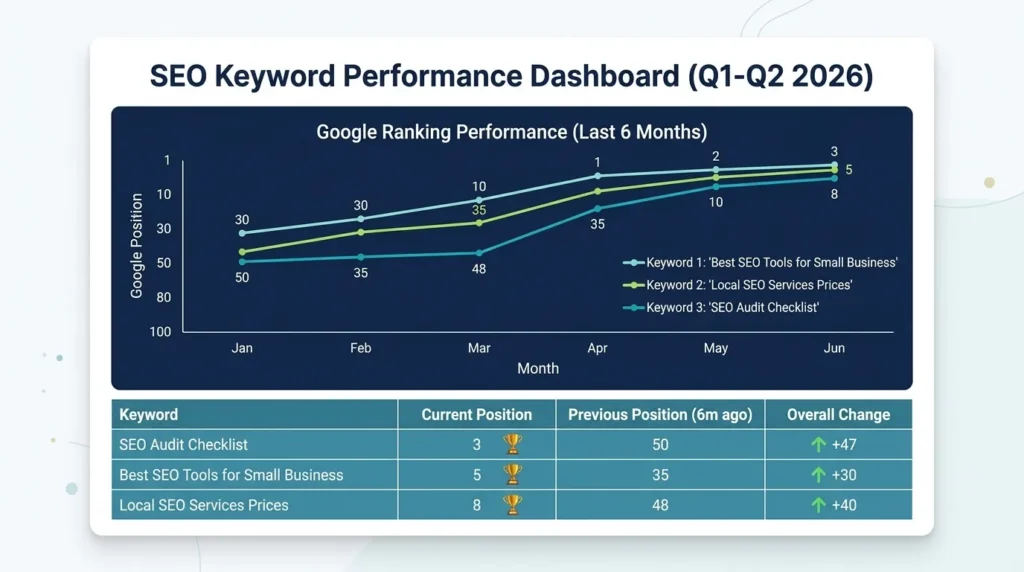
Google Search Console is the most accurate and free ranking tracking tool available. The Performance report shows your average position for every keyword your site appears for. Filter by specific pages to track how individual optimized pages are performing for their target keywords. Check every two to four weeks for meaningful movement.
Rank Tracking Tools
Tools like Ahrefs Rank Tracker, SEMrush Position Tracking, and Mangools SERPWatcher allow you to track specific target keywords over time and receive automated alerts when rankings change significantly. These tools are particularly useful for monitoring competitive keywords where small ranking changes have significant traffic impact.
What to Do With Ranking Data
If a page is ranking in positions 5 to 15 for its target keyword — search for the keyword and study the top three results. Identify what those pages offer that yours does not — more comprehensive coverage, better structure, stronger examples, more backlinks — and improve your page accordingly. These near-page-one positions are your highest-value optimization opportunities.
If a page is ranking beyond position 30 for its target keyword after three or more months of indexing, reassess whether the keyword difficulty is appropriate for your current domain authority or whether the content needs significant quality improvement.
Frequently Asked Questions About Keyword Research for SEO
Q: What is keyword research for SEO and why is it important?
Keyword research for SEO is the process of identifying the exact search terms your target audience uses when looking for products, services, or information related to your business. It is important because it ensures your content and optimization efforts target real search demand — connecting your website with users who are actively searching for what you offer. Without keyword research, SEO efforts are based on guesswork rather than data.
Q: How do I start keyword research for SEO with no budget?
Start with completely free tools: Google Autocomplete for keyword ideas, Google Keyword Planner for search volume data, Google Search Console for existing keyword performance, People Also Ask for question keywords, and Google Trends for keyword trend analysis. These free tools provide sufficient data for comprehensive keyword research without any financial investment.
Q: How many keywords should I target per page?
Each page should have one primary keyword that it primarily optimizes for, plus three to five secondary keywords that are semantically related and naturally included in the content. Do not attempt to target too many keywords on a single page — focus produces better results than trying to rank for everything simultaneously.
Q: How do I know if a keyword is too competitive for my website?
Compare the keyword difficulty score (use Ahrefs or SEMrush) to your website’s domain rating or domain authority. If your domain rating is below 20, focus on keywords with difficulty below 20. If your domain rating is 20 to 40, target keywords with difficulty up to 35. As your domain authority grows through consistent link building and content creation, gradually expand your targeting to higher difficulty terms.
Q: What is the difference between keyword research and SEO?
Keyword research is one component of SEO — specifically the research phase that identifies which terms to optimize for. SEO is the broader practice of improving your website to rank for those terms — encompassing content creation, on-page optimization, technical SEO, link building, and performance monitoring. Keyword research informs and guides SEO but is not SEO itself. For the complete picture of how keyword research fits within SEO strategy, read our guide on what SEO is in digital marketing.
Q: How long does it take to rank for a keyword after optimization?
Timeline varies based on keyword difficulty, your domain authority, content quality, and link building. Low-difficulty keywords (KD under 20) can rank within 4 to 8 weeks with good optimization. Moderate difficulty keywords (KD 20 to 40) typically take 3 to 6 months. High difficulty keywords (KD above 40) require 6 to 18 months of consistent SEO effort. This is why a balanced keyword strategy — targeting quick wins alongside long-term goals — is essential for consistent progress.
Q: Should I do keyword research differently for local SEO?
Yes — local keyword research has specific considerations. You add geographic modifiers (city, neighborhood, “near me”) to your service keywords, search volume is typically lower but intent is much higher, and competition is local rather than national. Local keywords also influence Google Business Profile optimization in addition to website content. Our guides on why local SEO is important and Google Business Profile for local SEO cover the local keyword strategy in detail.
Conclusion — Keyword Research Is the Map to Your SEO Success
Keyword research for SEO is not a task you complete once and set aside. It is an ongoing strategic process — a continuous conversation with your market about what your potential customers are looking for, how they are looking for it, and where the opportunities exist to connect your business with their search intent.
Every great piece of content that ranks on Google’s first page, every service page that generates qualified leads, and every blog post that attracts your ideal customers starts with keyword research. It is the foundation beneath every successful SEO strategy — the intelligence that transforms SEO from guesswork into a data-driven growth system.
For businesses in Pakistan — whether in Lahore, Karachi, Islamabad, or beyond — the opportunity in keyword research is particularly significant. Most local competitors have not invested in serious keyword research, leaving clear opportunities for businesses that do to capture significant organic traffic at lower competition levels than global markets.
Start with the free tools. Build your seed keyword list, expand it into a comprehensive research document, evaluate search intent for every term, and map your keywords to specific pages. Then create content that genuinely satisfies what your audience is searching for — and track your rankings consistently to measure results and identify optimization opportunities.
At SiteNova Agency, keyword research is the first step in every SEO strategy we build for clients across Pakistan and the United States. Our team conducts comprehensive keyword research — identifying primary targets, long-tail opportunities, competitor gaps, and local keyword clusters — then builds complete SEO strategies around those findings to drive sustainable organic growth.
To complete your SEO education, explore our full series: understand what digital marketing is, learn what SEO means in digital marketing, understand why local SEO is important, master Google Business Profile for local SEO, and now put it all together with keyword research — the strategic foundation that connects every other SEO discipline.