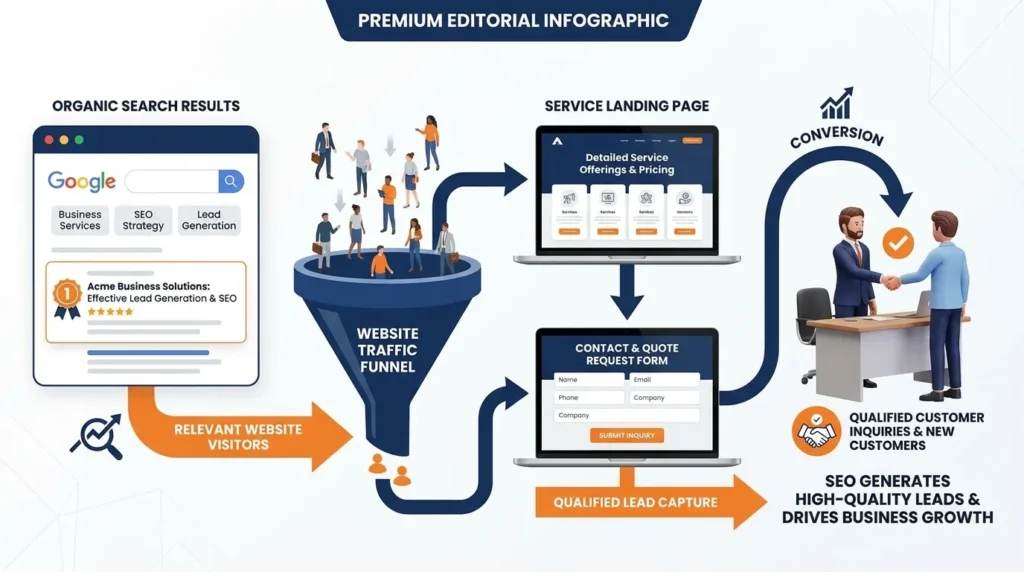
Getting visitors to your website is useful, but what happens after they arrive? If people read your content and leave without contacting you, requesting a quote, or exploring your services, your website may not be generating the business opportunities you need.
Learning how to generate leads through SEO helps you attract people who are actively searching for solutions related to your business. Instead of focusing only on rankings and traffic, you can build a search strategy that connects the right audience with relevant pages, useful information, and clear next steps.
For small businesses, this approach can create opportunities to attract potential customers without relying entirely on paid advertising. However, SEO does not produce instant or guaranteed results. You need to understand your audience, target relevant searches, publish useful content, and make it easy for interested visitors to contact you.
In this guide, you will learn nine practical steps to turn organic search traffic into qualified leads, measure your progress, and improve your website’s lead generation process.
Table of Contents
- What Is SEO Lead Generation?
- Why SEO Is Important for Lead Generation
- How to Generate Leads Through SEO: 9 Practical Steps
- How to Measure SEO Lead Generation Results
- Common SEO Lead Generation Mistakes
- How Long Does SEO Lead Generation Take?
- Frequently Asked Questions
- Final Thoughts
What Is SEO Lead Generation?
SEO lead generation is the process of using search engine optimization to attract relevant visitors and encourage them to take an action that expresses interest in your business.
That action might include submitting a contact form, requesting a quotation, booking a consultation, calling your business, or downloading a useful resource.
Imagine that you run a web design agency. Someone searches Google for “WordPress website designer for small businesses.” They discover your service page, review your portfolio, and submit a form asking about your pricing.
That visitor has become a lead because their search and subsequent action indicate a potential need for your service.
SEO lead generation involves more than ranking for popular keywords. It combines several activities:
- Understanding what potential customers search for.
- Creating content that matches search intent.
- Improving organic visibility in search engines.
- Directing visitors to relevant service or landing pages.
- Providing clear calls to action.
- Measuring inquiries and conversions.
The main goal is to attract visitors who are likely to need what you offer and give them a clear path to becoming customers.
Why SEO Matters for Lead Generation
SEO can help businesses reach people who are already looking for information, products, or services. This makes organic search a valuable channel for businesses that want to build a more consistent source of potential customers.
Reach People With a Specific Need
A person searching for “what is website maintenance” may be researching a problem. Someone searching for “website maintenance service for small business” may be closer to hiring a provider.
Understanding these differences helps you create the right content for each stage of the customer journey.
Build Long-Term Organic Visibility
A useful page can continue attracting search traffic after publication if it earns visibility and remains relevant. Unlike paid advertising, organic search does not charge you for each click, although SEO still requires time, expertise, and ongoing work.
Build Trust Before the First Conversation
Helpful articles, clear service pages, genuine examples, and transparent information help potential customers evaluate your business before contacting you.
Support Other Marketing Channels
SEO content can also support email marketing, social media, and sales conversations. A helpful article can answer a customer’s question before a consultation and give your business a useful resource to share.
SEO is not automatically the best channel for every business. Its value depends on whether your audience uses search engines, whether relevant search demand exists, and whether your business can compete for that visibility.
How to Generate Leads Through SEO: 9 Practical Steps
1. Understand Your Ideal Customer and Their Search Intent
Before researching keywords or publishing articles, identify the people you want to attract.
Ask yourself:
- What problems do my potential customers want to solve?
- What services or products are they looking for?
- What questions do they ask before making a decision?
- What concerns might prevent them from contacting a provider?
- What information do they need before they feel ready to buy?
For example, a business owner searching for “why is my website not generating leads” may need educational guidance. A person searching for “SEO services for a small business” may be comparing providers.
These searches reveal different levels of buying intent.
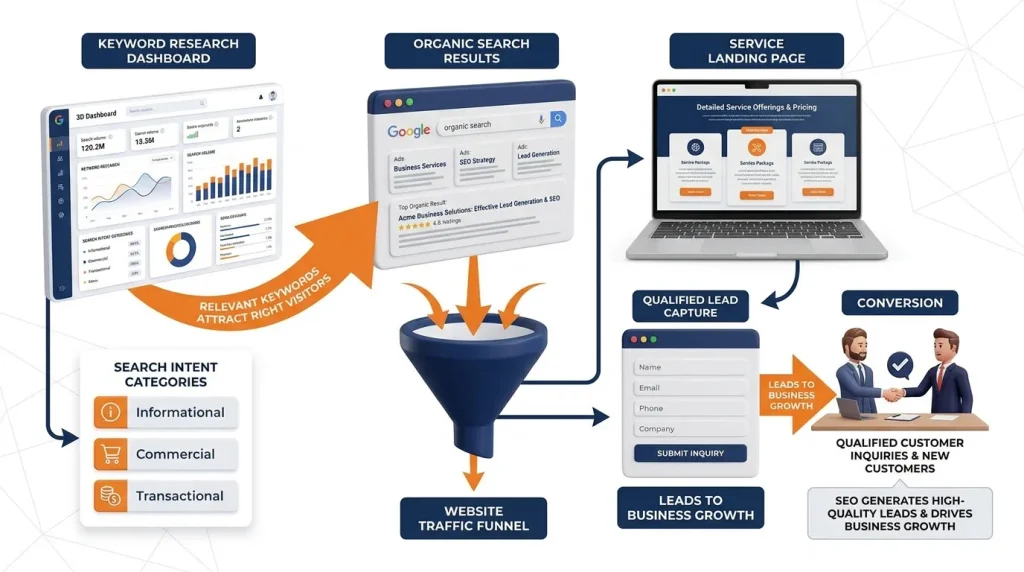
Search intent generally falls into four broad categories:
- Informational intent: The user wants to learn something.
- Commercial investigation: The user is comparing options or providers.
- Transactional intent: The user is ready to take an action or purchase.
- Navigational intent: The user wants to find a particular website or business.
A strong SEO strategy addresses the needs of your audience across these stages. Educational content can introduce your business to potential customers, while relevant service pages can help those who are ready to enquire.
You can also read our guide on lead generation ideas for small businesses for more ways to attract and engage potential customers.
2. Choose Keywords That Can Attract Qualified Leads
Keyword research helps you understand how people search for your services and which topics deserve attention.
However, not every keyword with a high search volume will generate valuable leads. A broad keyword may attract many visitors who are not interested in your offer, while a more specific search may bring fewer but more relevant prospects.
Start by grouping keywords according to their purpose.
Informational keywords
These help you attract people who are researching a problem.
Examples:
- How to generate leads through SEO
- How SEO helps small businesses
- Why a website is not generating leads
- How to improve organic traffic
Commercial keywords
These indicate that a searcher may be comparing solutions.
Examples:
- Best SEO services for small businesses
- SEO agency for lead generation
- SEO consultant for small business
- Professional keyword research services
Service-focused keywords
These are closely connected to an offer.
Examples:
- SEO services for small businesses
- Website SEO audit service
- Local SEO specialist
- SEO content writing services
The right keywords depend on the services you actually provide and the markets you serve. Do not target a service or location that you cannot genuinely support.
Use keyword research tools, Google Search Console data where available, and relevant search results to evaluate search intent, competition, and potential business value.
For a step-by-step process, follow our guide on how to do keyword research for SEO.
3. Create Helpful Content That Answers Real Questions
Once you understand your audience and target keywords, create content that addresses their problems clearly and thoroughly.
Content marketing supports SEO lead generation by introducing your business to people who are researching a topic. The content should help readers understand the issue, evaluate possible solutions, and identify a sensible next step.
For example, a web design agency might publish an article about common reasons a website fails to generate inquiries. That article could explain unclear messaging, poor mobile usability, weak calls to action, and irrelevant traffic.
Within the article, you could link naturally to a relevant service page for readers who need professional assistance.
Useful content formats include:
- Detailed how-to guides.
- Problem-solving articles.
- Service comparisons.
- Practical checklists.
- Frequently asked questions.
- Case studies based on genuine results.
- Industry-specific guides.
Avoid writing content simply to repeat a keyword. Give readers useful explanations, examples, and actionable advice. Make sure your content reflects your expertise and does not promise results you cannot substantiate.
If you want to improve the quality and structure of your articles, explore our guide to SEO content writing.
4. Optimize Your Service Pages for Search and Conversions
Blog posts can attract relevant visitors, but service pages often provide the information people need before contacting your business.
A service page should explain what you offer, who it is for, what problem it solves, and how a potential customer can get started.
For example, a page offering SEO services could include:
- A clear headline describing the service.
- An explanation of the problems it addresses.
- Details of the work included.
- Your process and expected communication.
- Relevant examples or genuine testimonials, if available.
- Answers to common customer questions.
- A clear contact or consultation option.
Use your target keyword naturally in the page title, main heading, relevant subheadings, and body content where appropriate. Write for people first rather than forcing the same phrase into every section.
Avoid creating multiple pages that provide nearly identical information just to target variations of a keyword. Each important page should have a clear purpose.
Your service pages should also be easy to navigate on mobile devices, load reliably, and make contact information easy to find.
5. Improve Technical SEO and Website Usability
Even excellent content may struggle to perform if search engines cannot access important pages or visitors encounter a poor website experience.
Technical SEO helps search engines crawl, understand, and index your website. Website usability helps visitors find information and complete the actions you want them to take.
Start with these checks:
- Confirm that important pages can be crawled and indexed.
- Review your XML sitemap and robots.txt configuration.
- Fix broken internal links and unnecessary redirect chains.
- Use descriptive page titles and clear heading structures.
- Check your website on mobile devices.
- Improve slow-loading pages where possible.
- Make sure contact forms work correctly.
- Check that HTTPS is configured properly.
- Review Core Web Vitals for potential user-experience issues.
Use our technical SEO checklist to review common technical issues.
You can also consult Google’s official SEO Starter Guide for guidance on helping search engines understand your content.
Remember that technical improvements do not guarantee rankings or leads. Their purpose is to remove obstacles and create a better foundation for your SEO efforts.
6. Build a Clear Internal Linking Structure
Internal links connect one page on your website to another. They help readers discover related information and can help search engines understand how your pages relate to one another.
For lead generation, internal links should guide readers toward the next useful resource.
Imagine that a visitor lands on a blog post about keyword research. You could link to a related SEO service page for readers who need professional help. Someone reading a technical SEO guide might benefit from a website audit or maintenance service page.
Follow these practices:
- Link to pages that genuinely relate to the current topic.
- Use descriptive anchor text that explains the destination.
- Connect relevant blog posts with appropriate service pages.
- Make important pages accessible through your navigation or other internal links.
- Review links regularly to ensure they work.
For example, within a relevant paragraph, you could write: “If you need help identifying technical problems that may affect your website, explore our free SEO audit page.”
Only use that wording if the destination accurately describes the service or offer available on the page.
Avoid adding links to unrelated pages just to increase the total number of internal links. A useful linking structure prioritizes relevance and navigation.
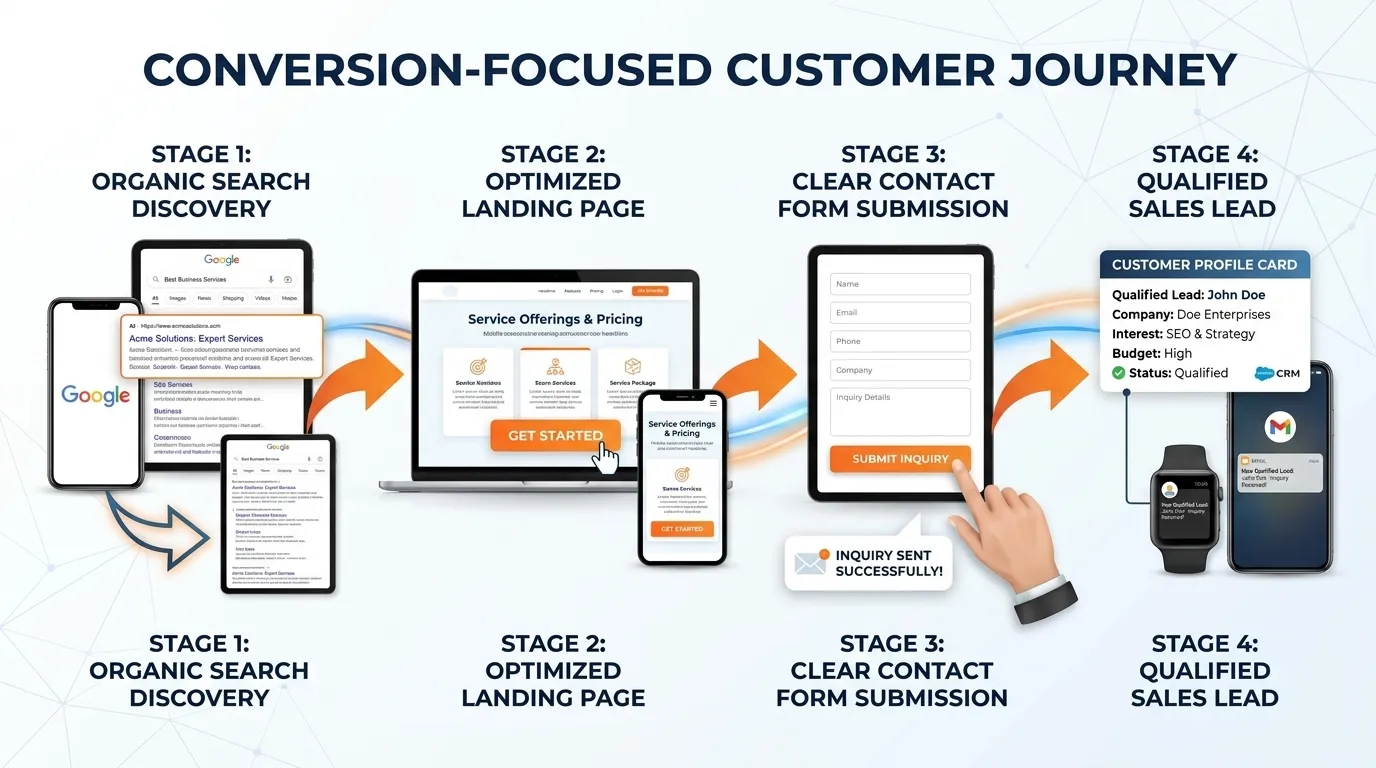
7. Optimize Calls to Action and Lead Capture Forms
Attracting organic traffic is only part of the process. Your website must also make it easy for interested visitors to contact you.
A call to action (CTA) tells a reader what to do next. Depending on the page, that action might be requesting a quote, booking a consultation, downloading a resource, or asking a question.
Match your CTA to the visitor’s likely needs.
For an educational blog post, a useful next step might be a related guide or a relevant service page. For a service page, a quote request or consultation may be more appropriate.
To improve lead capture:
- Use clear, specific button text.
- Place the primary CTA where visitors can find it easily.
- Keep contact forms as short as practical.
- Explain what happens after someone submits a form.
- Make forms accessible and usable on mobile devices.
- Test form submissions and email notifications.
- Provide a suitable privacy notice.
Do not assume every visitor is ready to buy. Some may need additional information before contacting you. A useful resource or a clear explanation of your process can help them move forward.
8. Use Local SEO If You Serve a Specific Area
For businesses that serve customers in particular locations, local SEO can help attract relevant searches with geographic intent.
A potential customer might search for a service followed by a city or neighborhood. If your business genuinely serves that area, a well-optimized website and an eligible Google Business Profile can help people discover it.
Begin by making your business details accurate and consistent. Add useful information about your services, service areas, opening hours where applicable, and contact methods.
You can also:
- Create helpful location-specific content where it serves a real audience.
- Encourage genuine customer reviews when appropriate.
- Include relevant local details on service pages.
- Keep your Google Business Profile updated if eligible.
- Make it easy for customers to contact you.
Google explains that local results are influenced by relevance, distance, and prominence. Review its official guidance on improving local rankings.
Do not create thin pages for dozens of locations you do not meaningfully serve. Local content should help customers understand the service available to them, not simply repeat city names.
9. Track Results and Improve Your SEO Strategy
SEO lead generation becomes easier to manage when you measure meaningful outcomes rather than focusing exclusively on rankings or traffic.
Use Google Search Console to review search queries, impressions, clicks, and the pages that attract organic visitors. Use website analytics, where correctly configured, to understand what visitors do after landing on your site.
Track metrics such as:
Organic traffic: How many visitors arrive from unpaid search results?
Qualified leads: How many inquiries fit your target customer profile?
Lead conversion rate: What proportion of relevant visitors complete a lead action?
Lead source: Which landing pages or channels contribute to inquiries?
Customer acquisition cost: How much does it cost to acquire a paying customer, including the costs you decide to count?
For example, if an article attracts traffic but produces no inquiries, review whether it matches the audience you want to reach and whether it offers a relevant next step. If a service page attracts fewer visitors but generates qualified inquiries, it may be especially valuable to your business.
Use a consistent tracking method, and make sure forms, phone calls, or other lead actions are recorded accurately where possible.
SEO improvements often take time. Review trends over an appropriate period rather than making major decisions based on a few days of data.
How to Measure SEO Lead Generation Results
A simple measurement process helps you determine whether your SEO work is contributing to business goals.
Lead Conversion Rate
The lead conversion rate measures the percentage of visitors who complete your chosen lead action.
Formula:
Lead conversion rate = (Number of leads ÷ Number of visitors) × 100
For example, if a page receives 400 visitors and 12 people submit an inquiry form, its lead conversion rate is 3%.
This is an illustrative calculation, not a universal performance benchmark.
Qualified Lead Rate
Not every inquiry is a potential sale. Qualified lead rate measures the proportion of leads that match your criteria.
Formula:
Qualified lead rate = (Qualified leads ÷ Total leads) × 100
If you receive 20 inquiries and 8 are a good fit for your services, your qualified lead rate is 40%.
Cost Per Lead
SEO is not free simply because organic clicks do not have a per-click advertising charge. Content production, technical work, tools, and staff time can all involve costs.
Formula:
Cost per lead = Total SEO lead generation costs ÷ Number of leads generated
Decide which costs to include and use the same method when comparing performance over time.
Leads by Landing Page
Record which pages contribute to inquiries. This helps you identify whether service pages, blog posts, local pages, or other landing pages are attracting useful prospects.
Where possible, use reliable analytics and CRM data to connect initial website activity with qualified leads and eventual customers. Attribution can be imperfect, so avoid assuming that a single page or click explains every conversion.
Common SEO Lead Generation Mistakes
Targeting Traffic Instead of Business Intent
A keyword can attract visitors without attracting potential customers. Consider whether the search topic relates to the audience, service, and business outcome you want.
Ignoring the Conversion Path
A visitor may find your content useful but leave because there is no relevant next step. Add helpful links, clear CTAs, and accessible contact options where appropriate.
Publishing Thin or Repetitive Content
Articles that repeat the same advice without adding useful information can provide a poor experience. Prioritize original explanations, specific examples, and content that fully addresses the reader’s question.
Neglecting Existing Service Pages
Businesses sometimes focus heavily on publishing blogs while leaving important service pages unclear or difficult to use. Review both content and conversion paths.
Expecting Instant Results
Organic visibility can take time to develop. Avoid promising a specific ranking, lead count, or timeline that you cannot guarantee.
Failing to Follow Up
A lead may lose interest if the business does not respond. Establish a reliable process for acknowledging inquiries, answering questions, and recording next steps.
How Long Does SEO Lead Generation Take?
There is no universal timeline for generating leads through SEO.
A website with established visibility and relevant service pages may already receive inquiries from organic search. A new website with few indexed pages may need considerably more time to build visibility and collect meaningful performance data.
Your results depend on several factors:
- The age, condition, and history of your website.
- Search demand and competition.
- The relevance and quality of your content.
- Technical SEO and website usability.
- The strength of your service offer.
- Your target location and audience.
- The effectiveness of your conversion process.
Focus on measurable improvements rather than guaranteed deadlines. Monitor indexing, relevant search visibility, organic visits, lead actions, and the quality of inquiries.
If rankings improve but leads do not, investigate the match between your keywords, pages, offer, and audience. If your website receives very little relevant traffic, improve discoverability and content before expecting a high volume of inquiries.
Frequently Asked Questions
How do you generate leads through SEO?
Start by understanding your target audience, researching relevant keywords, and creating content that matches search intent. Optimize your service pages, improve technical SEO, add relevant internal links, make contact forms easy to use, and measure qualified inquiries from organic traffic.
Can SEO generate leads for a small business?
Yes. SEO can help small businesses attract people who search for relevant services or solutions. Results depend on demand, competition, website quality, the offer, and the effectiveness of the conversion process.
What is the difference between SEO and lead generation?
SEO is a set of practices that improves a website’s visibility in organic search results. Lead generation is the broader process of attracting potential customers and encouraging them to express interest. SEO can be one channel within a lead generation strategy.
Which keywords are best for SEO lead generation?
The best keywords are relevant to your audience, services, and business goals. Specific service-related and commercial-intent keywords may attract people closer to making a decision, while informational keywords can help introduce your business to people researching a problem.
Does more organic traffic mean more leads?
Not necessarily. Traffic can increase without producing more inquiries if visitors are not relevant, the page does not match search intent, or the website lacks a clear conversion path. Track qualified leads and conversions alongside traffic.
Is SEO lead generation free?
Organic search clicks do not have a direct cost per click like paid advertising, but SEO requires resources. Content creation, technical improvements, tools, and professional assistance may all involve costs.
How can I measure leads from SEO?
Use Google Search Console to understand organic search performance, and configure website analytics or a CRM to record lead actions and their sources where possible. Review qualified inquiries, conversion rates, and eventual sales rather than relying only on impressions and clicks.
Final Thoughts
Learning how to generate leads through SEO means looking beyond search rankings. The real opportunity is to connect your website with people who need your services, give them useful information, and make the next step clear.
Start with keyword research and search intent. Build content that solves genuine problems, improve the pages that explain your services, and remove obstacles that make contacting your business difficult. Then track qualified inquiries and refine your approach using the results.
You do not need to implement every tactic at once. Begin with the improvements most relevant to your website and audience, and build a consistent process over time.
If your business needs help improving its search visibility, content strategy, or website experience, explore the relevant resources and services at SiteNova Agency to determine which next step fits your goals.
Good that the guide shifts the focus from rankings to what happens after the visit. Plenty of service sites get traffic but give visitors no clear next step, so the enquiry never comes. I would be interested in how you suggest measuring lead quality from organic search versus just counting form fills.