
Table of Contents
- What Is SEO Content Writing?
- Why SEO Content Writing Matters for Every Business
- SEO Content Writing vs Regular Content Writing
- Core Elements of SEO Content Writing
- How to Write an SEO-Optimized Title Tag and Meta Description
- How to Structure SEO Content — Headings, Subheadings, and Flow
- Keyword Usage in SEO Content Writing
- How to Write for Search Intent
- LSI Keywords and Semantic SEO in Content Writing
- E-E-A-T and How It Affects Your Content Rankings
- How Long Should SEO Content Be?
- Internal and External Linking in SEO Content Writing
- SEO Content Writing for Different Content Types
- How to Optimize Images in SEO Content
- Common SEO Content Writing Mistakes to Avoid
- SEO Content Writing Tools
- SEO Content Writing for Pakistani Businesses
- Frequently Asked Questions
- Conclusion
What Is SEO Content Writing?
SEO content writing is the practice of creating written content that is simultaneously valuable to human readers and optimized for search engine visibility. It is the discipline that sits at the intersection of great writing and technical SEO — producing content that genuinely helps your audience while satisfying the signals Google uses to determine which pages deserve top rankings in search results.
The term “SEO” in SEO content writing stands for Search Engine Optimization — the process of improving your online content so search engines like Google understand its relevance, authority, and value, and rank it prominently for the search queries your target audience uses. SEO content writing applies this optimization process directly to the words, structure, and formatting of written content — from blog posts and service pages to landing pages and product descriptions.
Critically, modern SEO content writing is not about tricking search engines or stuffing keywords into text. Google’s algorithm in 2026 is sophisticated enough to distinguish genuinely helpful, expertly written content from content created solely to manipulate rankings. The most effective SEO content writing serves both goals simultaneously — it is content so genuinely useful to human readers that search engines have no choice but to rank it.
For businesses in Pakistan looking to grow their organic search visibility, understanding what SEO content writing is — and how to do it correctly — is one of the highest-impact investments in digital marketing knowledge available. This guide covers every element of professional SEO content writing from foundational principles to advanced techniques.
This is part of our ongoing digital marketing series at SiteNova Agency. Before diving into SEO content writing specifically, we recommend reading our guides on what SEO is in digital marketing and how to do keyword research for SEO — both provide essential context that makes SEO content writing strategy significantly more effective.
Why SEO Content Writing Matters for Every Business
Every business that wants to be found on Google needs SEO content writing. Here is precisely why it matters so much in 2026:
Content Is What Google Ranks
Search engines do not rank websites — they rank individual pages of content. Google’s entire purpose is to find the best possible written answer to every search query and deliver it to the user. Without well-written, properly optimized content, your website has nothing for Google to evaluate, understand, and rank. SEO content writing is what gives Google the material it needs to identify your pages as the best answer to your target search queries.
It Drives Organic Traffic Without Ongoing Ad Spend
Unlike Google Ads — where traffic stops the moment your budget runs out — SEO content writing builds a permanent organic asset. A well-written, properly optimized blog post can continue ranking on page one of Google and driving qualified traffic to your website for years after it is published, without any ongoing financial investment. This compounding return on investment is what makes SEO content writing one of the highest-ROI digital marketing activities for businesses of any size.
It Builds Authority and Trust
Consistently publishing high-quality SEO content positions your business as an expert in your field. When potential customers repeatedly encounter your content while researching their problems and questions, they develop familiarity and trust with your brand before they ever contact you. This trust dramatically improves conversion rates when those users are ready to make a purchasing decision.
It Supports Every Other Digital Marketing Channel
SEO content writing does not operate in isolation — it strengthens every other digital marketing channel simultaneously. Your social media posts link to your SEO content. Your email newsletters feature your blog articles. Your Google Ads landing pages use SEO-optimized copy. Your Google Business Profile links to your optimized service pages. Quality SEO content is the foundation that makes every other channel more effective.
SEO Content Writing vs Regular Content Writing
Understanding the difference between SEO content writing and regular content writing clarifies what makes SEO content writing a distinct and specialized discipline.
| Factor | Regular Content Writing | SEO Content Writing |
|---|---|---|
| Primary audience | Human reader only | Human reader + search engines |
| Keyword strategy | No specific keyword targeting | Researched primary and secondary keywords |
| Structure | Writer’s preference | SEO-optimized heading hierarchy |
| Length | Based on topic need | Based on search intent and competitive analysis |
| Meta elements | Often absent | Title tag and meta description optimized |
| Internal linking | Incidental | Strategic and purposeful |
| Search intent | Not considered | Central to content planning |
| Performance tracking | Views and engagement | Rankings, organic traffic, conversions |
| Topic selection | Based on interest or intuition | Based on keyword research and demand data |
| E-E-A-T signals | Variable | Deliberately built into content |
Regular content writing produces content that may be excellent but invisible in search — because without SEO optimization, Google cannot identify it as the best answer to any specific search query. SEO content writing produces content that is equally excellent for human readers but also structured, optimized, and signaled in ways that allow Google to confidently rank it for target keywords.
The best SEO content writing does not feel optimized to the reader — it reads naturally, flows well, and delivers genuine value. The optimization work happens in keyword research, structural decisions, meta elements, and linking strategy — not in forcing awkward keyword repetitions into otherwise good writing.
Core Elements of SEO Content Writing
Professional SEO content writing combines several interconnected elements that work together to produce content that ranks and converts. Understanding each element is essential for producing consistently effective SEO content.
Primary Keyword Targeting
Every piece of SEO content is built around one primary keyword — the specific search term the content is designed to rank for. This keyword is identified through keyword research, selected based on search volume, keyword difficulty, and search intent alignment, and then woven naturally into the content’s most important positions.
Comprehensive Topic Coverage
Google rewards content that comprehensively covers a topic — answering not just the primary question but the related questions, subtopics, and considerations that users searching the primary keyword also care about. Content gaps — aspects of a topic that your content fails to cover that competing content addresses — directly weaken rankings.
Natural Keyword Integration
Target keywords appear at natural frequency throughout the content — in the introduction, in subheadings, and throughout the body — without forced repetition that disrupts the reading experience. Keyword density is not a metric to optimize toward a specific percentage — it is a consequence of writing thoroughly about your topic.
Authoritative, Accurate Information
SEO content writing must be factually accurate and demonstrate genuine expertise. Google’s E-E-A-T framework — Experience, Expertise, Authoritativeness, and Trust — assesses the credibility of content and its author. Content written by subject matter experts with verifiable credentials and first-hand experience consistently outperforms generic content on the same topics.
Engaging, Readable Prose
Even the most technically optimized content fails if users immediately leave because it is unpleasant to read. SEO content writing requires clear, direct prose — short paragraphs, active voice, concrete examples, and a tone appropriate for the target audience. High bounce rates and low time-on-page signal poor content quality to Google and directly damage rankings.
Strategic Structure
SEO content is organized with a logical, purposeful structure — using heading tags (H1, H2, H3) to create a clear content hierarchy that both readers and search engines can navigate. This structure helps Google understand the scope and organization of your content, and helps readers quickly find the specific information they need.
How to Write an SEO-Optimized Title Tag and Meta Description
The title tag and meta description are the first elements of SEO content writing — they appear in search results before a user ever sees your content and directly determine whether anyone clicks through to read it.
Title Tag Optimization
Your title tag is the clickable blue headline in Google search results. For SEO content writing, an effective title tag:
Includes the primary keyword near the beginning — Google gives more weight to words that appear earlier in the title. “SEO Content Writing — Complete Guide for 2026” performs better than “A Complete Guide to the Art of SEO Content Writing.”
Stays within 55 to 60 characters — titles longer than 60 characters are truncated in search results, cutting off potentially important information.
Is compelling to human readers — beyond ranking, your title must make users want to click. Numbers, power words, and clear value propositions improve click-through rates. “What Is SEO Content Writing? Complete Guide” outperforms “SEO Content Writing Information.”
Includes your brand name — adding your brand name to the end of the title — “| SiteNova Agency” — builds brand recognition among searchers who see your results repeatedly.
Meta Description Optimization
Your meta description is the text summary below your title in search results. While not a direct ranking factor, it significantly influences click-through rate — which does influence rankings indirectly.
An effective SEO content writing meta description:
Includes the primary keyword naturally — Google bolds keywords in meta descriptions that match the user’s search query, making your result more visually prominent.
Stays within 150 to 160 characters — longer descriptions are truncated.
Communicates clear value — tell the reader exactly what they will learn or get by clicking. Specificity outperforms vague promises.
Includes a soft call to action — “Learn how,” “Discover,” “Find out” — action language increases click-through rates.
Includes brand name — “SiteNova Agency explains” positions the content as coming from a credible source.
How to Structure SEO Content — Headings, Subheadings, and Flow
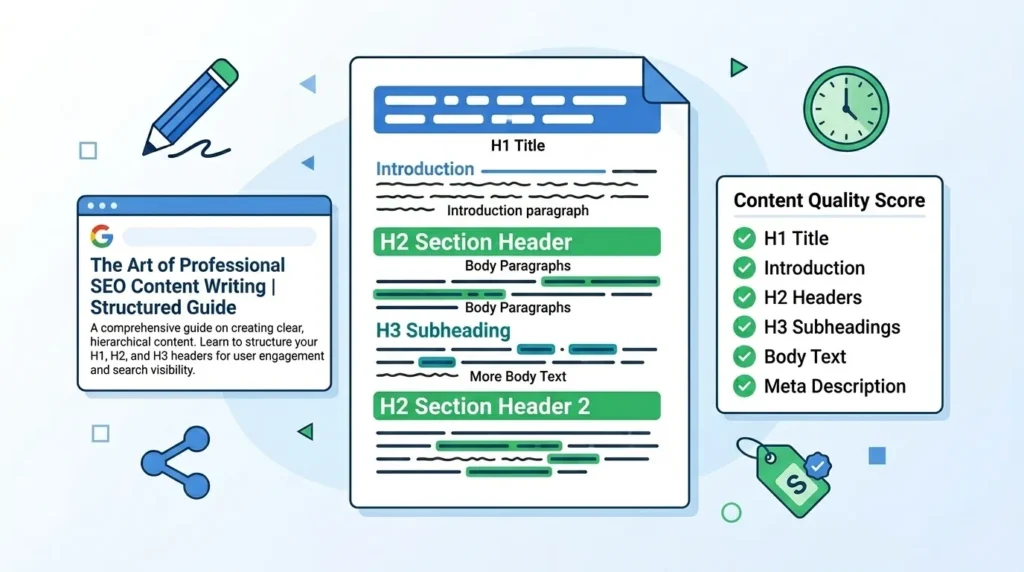
Content structure is one of the most important — and most commonly neglected — elements of SEO content writing. Proper heading structure serves three simultaneous purposes: it helps Google understand your content’s topic hierarchy, it helps readers navigate to the information they need, and it improves the visual readability of long-form content.
H1 — One Per Page, Primary Keyword Included
Every page should have exactly one H1 heading — the main title of the page. It should include your primary keyword and clearly communicate what the page is about. The H1 should appear once, at the top of the page content, and should match or closely align with your title tag.
H2 — Main Section Dividers
H2 headings divide your content into major sections. Each H2 should represent a distinct subtopic within your main subject. In SEO content writing, at least two to three H2 headings should include your primary keyword or close synonyms — this reinforces topical relevance signals to Google. For a 2,500-word article, aim for six to ten H2 headings that create a logical flow through the topic.
H3 — Subsections Within H2 Sections
H3 headings break H2 sections into specific subtopics. They are particularly useful for listicle-style content, step-by-step guides, and comparison content where multiple items within a section need individual labels. H3s can include secondary keywords and semantic variations of your primary keyword.
Paragraph Length and Readability
SEO content writing uses short paragraphs — typically two to four sentences maximum. Long, dense paragraphs create visual overwhelm that increases bounce rates. White space — the visual breathing room created by paragraph breaks — makes content feel more accessible and keeps readers engaged longer.
Table of Contents
For long-form SEO content — articles over 1,500 words — a table of contents at the beginning significantly improves user experience and can generate sitelinks in Google search results that increase your listing’s visual real estate and click-through rate.
Keyword Usage in SEO Content Writing
Proper keyword usage is the technical heart of SEO content writing — determining how and where your target keywords appear within your content to maximize their ranking signal without creating unnatural, forced text.
Primary Keyword Placement
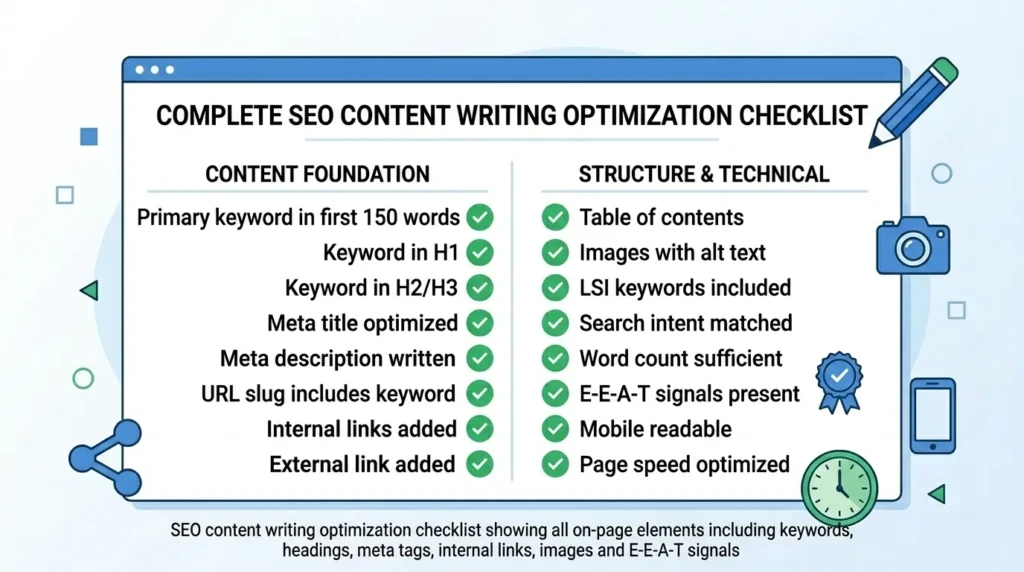
In professional SEO content writing, your primary keyword must appear in these critical positions:
Within the first 150 words — ideally in the very first sentence or first paragraph. Google gives significant weight to keywords that appear early in content as signals of topical relevance.
In the H1 heading — the most prominent heading on the page must include your primary keyword.
In two to three H2 subheadings — naturally woven into section headings throughout the content.
In the meta title and meta description — as covered in Section 5.
In the URL slug — your page URL should include your primary keyword: /blog/what-is-seo-content-writing.
In image alt text — at least one image alt text should include the primary keyword naturally.
Throughout the body content — appearing at natural frequency across the full length of the content without forced repetition.
Keyword Density — The Right Approach
Keyword density — the percentage of times your keyword appears relative to total word count — is not a metric to optimize toward a specific number. Targeting “2% keyword density” or “use the keyword every 100 words” leads to forced, unnatural keyword insertion that harms readability and can trigger spam signals.
The correct approach is to write thoroughly and naturally about your topic. When you write a comprehensive article about SEO content writing, the phrase “SEO content writing” will naturally appear at appropriate frequency — because you are writing about SEO content writing. The keyword density emerges naturally from thorough coverage, not from mechanical insertion.
Keyword Variants and Synonyms
Use keyword variants and synonyms throughout your content to avoid repetitive language while maintaining topical relevance. For “SEO content writing,” appropriate variants include: SEO writing, search engine optimized content, SEO copywriting, content optimization, optimized content creation. Using these variants naturally throughout your content satisfies both readability and the semantic signals that tell Google your content comprehensively covers the topic.
How to Write for Search Intent
Writing for search intent is the single most important strategic decision in SEO content writing. Content that mismatches search intent — regardless of how well written or keyword-optimized it is — will not rank consistently because Google will not consider it the best answer to the query.
As covered in our keyword research for SEO guide, search intent falls into four categories: informational, navigational, commercial investigation, and transactional. Each requires a different content approach in SEO content writing.
Writing for Informational Intent
Informational queries — “what is SEO content writing,” “how does Google Ads work,” “why is local SEO important” — require comprehensive educational content that thoroughly explains the topic. The reader wants to learn, not buy. Effective SEO content writing for informational intent:
- Answers the primary question directly and early
- Covers all major subtopics related to the query
- Uses clear explanations with concrete examples
- Anticipates and answers follow-up questions
- Is written in an accessible, educational tone
Writing for Commercial Investigation Intent
Commercial investigation queries — “best SEO content writing tools,” “SEO agency vs freelancer,” “Ahrefs vs SEMrush” — require comparison and evaluation content. The reader is researching before making a decision. Effective SEO content writing for commercial investigation intent:
- Provides balanced, honest comparison of options
- Includes specific details and data that inform decisions
- Addresses the criteria decision-makers actually care about
- Offers a clear recommendation based on different use cases
Writing for Transactional Intent
Transactional queries — “hire SEO content writer,” “SEO content writing service Pakistan,” “buy SEO tools” — require service pages and landing pages focused on conversion. The reader is ready to act. Effective SEO content writing for transactional intent:
- Leads with the value proposition and primary benefit
- Includes social proof — testimonials, case studies, results
- Makes the conversion action clear and easy — contact form, phone number, booking link
- Addresses common objections directly
- Is concise and conversion-focused rather than educational
LSI Keywords and Semantic SEO in Content Writing
Modern SEO content writing goes beyond primary keyword targeting to encompass LSI keywords and semantic SEO — concepts that significantly influence how Google evaluates content quality and topical authority.
What Are LSI Keywords in SEO Content Writing?
LSI keywords — Latent Semantic Indexing keywords — are terms that are semantically related to your primary keyword and naturally appear in well-written content about that topic. They are not synonyms but contextually associated words that signal to Google that your content comprehensively covers the subject.
For an article about SEO content writing, LSI keywords include: keyword research, search intent, on-page optimization, meta description, heading structure, organic traffic, content strategy, SERP rankings, topical authority, E-E-A-T, readability, content gap, word count, internal linking.
Including these terms naturally — not forced — in your content tells Google that your article covers SEO content writing comprehensively, not superficially.
Topical Authority Through Content Clusters
Semantic SEO in content writing extends beyond individual articles to content cluster strategy — where a website publishes interconnected content that collectively demonstrates deep expertise in a subject area. A pillar page covering a broad topic (like this guide on SEO content writing) is supported by cluster pages covering specific subtopics (keyword research, heading structure, search intent, content length) — all interlinked.
This is precisely the strategy we are building through our content series at SiteNova Agency — each blog post on digital marketing, SEO, local SEO, keyword research, Google Ads, and SEO content writing forms an interconnected cluster that collectively builds our topical authority across the digital marketing subject area.
NLP Terms in SEO Content Writing
Natural Language Processing (NLP) terms are the specific entities, concepts, and relationships that Google’s AI systems look for when evaluating content quality. Including relevant NLP terms naturally in your SEO content writing — industry-specific terminology, established concepts, verified entities — signals expertise and depth to Google’s quality assessment systems.
E-E-A-T and How It Affects Your Content Rankings
E-E-A-T — Experience, Expertise, Authoritativeness, and Trust — is Google’s framework for evaluating content quality. It is central to understanding how Google decides which content deserves top rankings and directly impacts how SEO content writing should be approached in 2026.
Experience
The first E — Experience — was added to Google’s quality evaluator guidelines in 2022, reflecting Google’s increasing emphasis on first-hand experience in content creation. Content written by someone with direct, personal experience with the subject matter is evaluated more favorably than content aggregated from other sources without original insight.
In SEO content writing, demonstrating experience means including specific examples from real situations, data from actual client campaigns, personal observations from direct practice, and unique insights that only someone who has genuinely done the work would know.
Expertise
Expertise signals that the content author has deep knowledge and formal or demonstrated competency in the subject matter. SEO content writing builds expertise signals through accurate, detailed information, correct use of industry terminology, comprehensive coverage of complex topics, and author bios that clearly establish credentials and background.
Authoritativeness
Authoritativeness measures the recognition your brand and content receive from others in your field. External websites linking to your content, mentions in industry publications, citations by other experts, and prominent placement in search results all contribute to authoritativeness. High-quality SEO content writing that earns backlinks naturally — because other websites want to reference it — builds authoritativeness over time.
Trust
Trust is the foundation of E-E-A-T — and in 2026 it is arguably the most weighted signal. Trust signals in SEO content writing include accurate factual claims with verifiable sources, transparent authorship with real names and credentials, clear disclosure of commercial relationships, consistent NAP information for local businesses, secure HTTPS website, and professional presentation without deceptive elements.
For Pakistani businesses, building E-E-A-T through SEO content writing means publishing content under real author names with genuine credentials, citing authoritative sources, demonstrating local market knowledge and first-hand client experience, and maintaining accuracy and transparency across all published content.
How Long Should SEO Content Be?
Content length is one of the most debated questions in SEO content writing — and the answer is more nuanced than any single word count recommendation.
The Right Answer — As Long as the Topic Requires
The correct length for SEO content is determined by search intent and competitive analysis — not by an arbitrary word count target. Some search queries are best answered in 800 words. Others require 3,000 words to cover comprehensively. The goal of SEO content writing is to answer the user’s question completely — no more, no less.
How to Determine the Right Length
Search your target keyword and analyze the word counts of the top five ranking results. These pages represent what Google currently considers the best answers to that query. If the top-ranking pages average 2,000 words, your content should be at minimum equally comprehensive — and ideally more thorough without padding.
Use tools like Ahrefs or SEMrush to identify content gaps — topics the top-ranking pages cover that your planned content does not. Filling these gaps typically requires additional content length.
General Length Guidelines by Content Type
While intent should guide length, these general benchmarks are useful starting points:
- Blog posts — informational: 1,500 to 3,000 words for comprehensive coverage
- Ultimate guides and pillar content: 3,000 to 8,000 words for comprehensive topic coverage
- Service pages: 800 to 1,500 words — enough to comprehensively explain the service, its benefits, process, and call to action
- Location pages: 600 to 1,200 words — unique, locally relevant content for each page
- Product pages: 300 to 800 words — comprehensive product description with specifications and benefits
- FAQ pages: Variable — enough to fully answer each question with genuinely useful detail
Quality Over Quantity
A critical principle of SEO content writing: a focused 1,200-word article that completely satisfies search intent will consistently outrank a padded 3,000-word article that adds length through repetition and filler. Word count is never the goal — comprehensive, useful content is the goal. Length is a consequence of achieving that goal.
Internal and External Linking in SEO Content Writing
Linking strategy is an essential but frequently underutilized element of SEO content writing. Both internal links — links to other pages on your own website — and external links — links to authoritative sources on other websites — serve important SEO functions.
Internal Linking Strategy
Internal links connect related pages on your website, distributing page authority, helping Google discover and understand your content structure, and keeping readers engaged with additional relevant content.
Effective internal linking in SEO content writing:
Links to relevant related content — every internal link should make sense to the reader as a natural next step. Our content in this very article links to our guides on keyword research, SEO fundamentals, local SEO, and Google Ads — because readers interested in SEO content writing are logically interested in these related topics.
Uses descriptive anchor text — the clickable text of an internal link should describe the destination page’s content — “how to do keyword research for SEO” rather than “click here.” Descriptive anchor text tells both readers and Google what the linked page is about.
Links to cornerstone content — your most important, comprehensive pages should receive the most internal links from other pages on your site, signaling to Google that these pages are your most authoritative resources.
Follows a logical content hierarchy — pillar pages link to cluster pages, cluster pages link back to pillar pages, and related cluster pages link to each other — creating a content web that distributes authority throughout your site.
External Linking Strategy
External links — linking from your content to authoritative external sources — are an important trust signal in SEO content writing that many writers incorrectly avoid out of fear of “sending users away.”
Linking to authoritative, relevant external sources:
- Supports your factual claims with verifiable references
- Signals to Google that your content is well-researched and transparent
- Builds trust with readers who see you are comfortable referencing credible sources
- Satisfies Yoast SEO’s outbound link requirement for fully green optimization
Link only to genuinely authoritative, relevant sources — Google, government websites, established industry publications, peer-reviewed research. Avoid linking to competitors or low-quality sources.
For SEO content writing best practices and official content quality guidance, Google’s Search Quality Evaluator Guidelines provide the authoritative reference document that all professional SEO content writers should be familiar with.
SEO Content Writing for Different Content Types
SEO content writing principles apply across all written content formats — but the specific application varies by content type. Understanding how to adapt SEO content writing for each format ensures your entire website benefits from optimization.
Blog Posts and Articles
Blog posts are the most common vehicle for SEO content writing — targeting informational and question-based keywords to drive organic traffic and build topical authority. Effective blog SEO content writing targets one specific keyword per post, covers the topic comprehensively, includes a clear table of contents for long posts, uses abundant subheadings for readability, and includes internal links to related service pages to move readers toward conversion.
Service Pages
Service page SEO content writing targets transactional keywords with commercial intent. Every service page should have a unique primary keyword, a clear value proposition in the first paragraph, specific descriptions of what the service includes and excludes, social proof elements (testimonials, case studies, results), a clear call to action, and FAQs addressing common objections. Avoid thin service pages that simply list bullet points — Google consistently ranks service pages with substantive, specific content over generic placeholder pages.
Location Pages
Location page SEO content writing targets city-specific keywords for businesses serving multiple geographic areas. Each location page must contain unique content — not just the same page with the city name replaced. Include locally specific information: knowledge of the local market, local client examples, local contact information, and local relevance signals that demonstrate your genuine presence and expertise in that area.
Our locations pages for Pakistani cities are built on exactly these principles — unique, locally relevant SEO content for each target city rather than duplicate pages with swapped city names.
Landing Pages
Landing page SEO content writing serves a dual purpose — ranking for a target keyword while converting visitors into leads or customers. The tension between comprehensive content (good for SEO) and focused conversion copy (good for conversion) requires careful balance. The solution is comprehensive content that is organized to serve the conversion goal — answering questions and addressing objections within a structure that consistently guides the reader toward the desired action.
Product Descriptions
E-commerce product description SEO content writing targets specific product-related search queries while serving readers who are evaluating purchase decisions. Effective product descriptions are specific and detailed rather than generic, highlight unique benefits rather than just features, include relevant specifications that searchers need to make decisions, and use the language customers actually use when searching for the product.
How to Optimize Images in SEO Content
Images are an often-overlooked element of SEO content writing — yet they contribute meaningful ranking signals and significantly impact the user experience that influences those rankings.
File Naming
Name your image files descriptively before uploading them. “seo-content-writing-structure-diagram.jpg” provides more relevance signal than “image001.jpg.” Include your primary keyword in at least one image file name per page.
Alt Text
Alt text — the alternative text attribute on image HTML tags — serves two purposes: it describes the image to visually impaired users using screen readers, and it tells Google what the image depicts. Every image in SEO content should have descriptive alt text that accurately describes the image content and, where natural, includes relevant keywords.
Do not keyword stuff alt text — “SEO content writing SEO content writing guide SEO” is both unhelpful and potentially penalized. Write alt text as a genuine description: “SEO content writing structure diagram showing H1 H2 H3 heading hierarchy with meta description example.”
Image Compression and Loading Speed
Large, uncompressed images significantly slow page loading — one of the most damaging factors for both Core Web Vitals scores and user experience. Compress all images before uploading using tools like TinyPNG or ShortPixel. Convert images to WebP format where possible — WebP files are 25 to 35% smaller than equivalent JPEG files with no perceptible quality difference.
Image Relevance
Every image in SEO content should be genuinely relevant to the surrounding content — either illustrating a concept explained in the text, visualizing data referenced in the article, or demonstrating a process described nearby. Decorative stock photos that bear no relationship to the content around them add visual noise without SEO value.
Common SEO Content Writing Mistakes to Avoid
Even experienced writers make these SEO content writing mistakes that significantly reduce content performance in search:
Writing Without Keyword Research
Creating content based on topics that seem interesting or relevant — without verifying actual search demand through keyword research — produces content that may be excellent but invisible in search. Every piece of SEO content should be built around a keyword with verified search volume and realistic ranking opportunity. Our complete guide on how to do keyword research for SEO covers the full process.
Ignoring Search Intent
Writing a blog post for a transactional keyword, or a service page for an informational keyword, mismatches your content format with what Google knows users want. Always search your target keyword before creating content and align your content type with what is already ranking.
Keyword Stuffing
Forcing your primary keyword into content at unnaturally high frequency — repeating it every second or third sentence, inserting it into headings where it does not belong, or adding it to image alt text regardless of relevance — is a black hat practice that Google penalizes. For a comprehensive understanding of which SEO practices to avoid, our guide on white hat vs black hat SEO covers keyword stuffing and other penalized tactics in detail.
Thin Content
Publishing short, superficial content that touches on a topic without genuinely covering it produces pages that Google considers low quality. Thin content — typically pages with fewer than 300 words or pages that address a topic with insufficient depth — either fails to rank or actively damages site-wide ranking quality through Google’s Helpful Content system.
No Internal Links
Publishing SEO content without internal links wastes a significant ranking opportunity. Every piece of content should link to at least two to three relevant pages on your own website — distributing authority, helping Google understand your site structure, and keeping readers engaged with additional valuable content.
Copying Competitor Content
Rewriting competitors’ content — even substantially — produces derivative content that rarely outperforms the original. Google rewards original analysis, unique insights, first-hand examples, and novel perspectives. Your SEO content writing should cover the same topics your competitors cover — because those topics have proven search demand — but from your unique angle, with your unique examples and expertise.
Neglecting Content Updates
SEO content writing is not a one-time activity. Content published in 2024 may become outdated, factually inaccurate, or outranked by fresher, more comprehensive competitor content in 2026. Regularly auditing and updating your published content — refreshing statistics, adding new examples, expanding thin sections — maintains and often improves existing rankings.
SEO Content Writing Tools
The right tools make SEO content writing more efficient and more effective. Here are the most valuable tools for each stage of the content writing process:
Keyword Research Tools
Google Keyword Planner — free search volume data directly from Google. Ahrefs and SEMrush — comprehensive keyword research with difficulty scores, competitor analysis, and content gap identification. Google Search Console — shows which keywords your existing content already ranks for.
Content Planning and Optimization
Surfer SEO — analyzes top-ranking pages for your target keyword and provides data-driven recommendations for content length, keyword usage, heading structure, and NLP terms to include. Clearscope — similar to Surfer SEO, focusing on content grade based on semantic term coverage. MarketMuse — AI-powered content planning and optimization recommendations.
Writing and Editing
Hemingway Editor — highlights overly complex sentences, passive voice, and readability issues. Grammarly — grammar, spelling, and style checking with SEO-relevant readability scores. Google Docs — collaborative writing environment with commenting and revision history.
On-Page SEO Checking
Yoast SEO (WordPress) — real-time on-page SEO analysis including keyphrase density, readability, internal linking, meta elements, and outbound links. Rank Math (WordPress) — similar to Yoast with additional features including schema markup and keyword rank tracking.
Content Performance Tracking
Google Search Console — monitors keyword rankings, impressions, and click-through rates for all published content. Google Analytics — tracks user behavior on content pages including time on page, bounce rate, and conversion attribution.
SEO Content Writing for Pakistani Businesses
SEO content writing for Pakistani businesses requires understanding both universal SEO principles and the specific characteristics of Pakistan’s digital market that influence content strategy.
Language Considerations
Pakistani businesses face a unique content strategy decision — English or Urdu? For most professional services, B2B companies, and businesses targeting educated urban audiences, English SEO content writing is appropriate and reaches the largest searchable audience on Google Pakistan. For consumer-facing businesses targeting broader demographics — retail, food, healthcare — Urdu content can reach significant audiences that English content misses entirely.
The most comprehensive strategy is creating content in both languages — an English blog post and an Urdu version covering the same topic with locally relevant examples. This bilingual approach doubles the keyword opportunities available while serving both language segments of Pakistan’s online audience.
Local Relevance in Content
SEO content writing for Pakistani businesses should consistently incorporate local relevance signals — mentioning specific Pakistani cities, referencing local market conditions, using Pakistani business examples, and addressing the specific challenges and opportunities relevant to businesses operating in Pakistan’s economic environment.
Generic content written without any Pakistani market context competes directly against international content with far greater domain authority. Locally specific content occupies a unique position that international competitors cannot replicate — giving Pakistani SEO content writers a genuine advantage in their domestic market.
Cultural Appropriateness
Effective SEO content writing for Pakistani audiences requires cultural sensitivity and awareness. Religious observances — Ramadan, Eid, Islamic calendar events — influence consumer behavior and content relevance seasonally. Formal and respectful tone is generally appropriate for professional services content. Local idioms and references, used appropriately, build connection with Pakistani readers that generic content cannot achieve.
Pakistani Business Keywords
Many high-value SEO content writing opportunities in Pakistan exist because international content does not target Pakistan-specific keywords. “Digital marketing agency Lahore,” “SEO services Pakistan,” “web design company Karachi” — these terms have real search volume but face primarily local competition rather than the global competition that generic terms face. SEO content writing that targets these Pakistan-specific opportunities produces faster, more achievable rankings than competing for generic international terms.
Frequently Asked Questions About SEO Content Writing
Q: What is SEO content writing in simple terms?
SEO content writing is writing that is designed to rank on Google. It combines great writing — content that is genuinely useful, well-organized, and easy to read — with search engine optimization techniques like keyword targeting, proper heading structure, meta tag optimization, and strategic internal linking. The goal is content that satisfies both human readers and Google’s ranking algorithm simultaneously.
Q: Is SEO content writing different from copywriting?
Yes — though there is significant overlap. Copywriting focuses primarily on persuading readers to take a specific action — buy, sign up, contact. SEO content writing focuses on earning search engine rankings while providing genuine value to readers. SEO landing page copy combines both disciplines — it must rank in search while converting visitors. The best SEO content writers are skilled in both.
Q: How long does it take for SEO content to rank on Google?
New SEO content typically begins appearing in Google search results within days to weeks of publication. Reaching the first page for competitive keywords usually takes 3 to 6 months of consistent publication and optimization. Lower-competition, long-tail keywords can reach page one faster — sometimes within 4 to 8 weeks. The timeline depends on keyword difficulty, your domain authority, content quality, and the strength of your internal and external linking. For a complete understanding of SEO timelines, our guide on what SEO is in digital marketing covers the full ranking timeline in detail.
Q: How many keywords should I use in SEO content writing?
Each piece of content should have one primary keyword it primarily targets, plus several secondary keywords and LSI terms that naturally appear throughout the content. There is no specific number of times you should use your primary keyword — write naturally and thoroughly about your topic, and appropriate keyword frequency emerges naturally. Forcing keywords at specific intervals creates unnatural text that hurts both readability and rankings.
Q: Can I do SEO content writing myself or do I need a professional?
Basic SEO content writing — keyword research, proper heading , meta tag optimization, and natural keyword usage — can be learned and applied independently with the right knowledge and tools. Professional SEO content writers bring deeper expertise in semantic optimization, competitive content analysis, E-E-A-T signal building, and conversion-focused writing that typically produces faster and stronger results than self-produced content. For businesses with significant organic traffic goals, professional SEO content writing services typically deliver stronger ROI than in-house production without specialist training.
Q: What is the most important element of SEO content writing?
If forced to choose one element, search intent alignment is the most important. Content that perfectly matches what users want to find when they search your target keyword — in the right format, at the right depth, answering the right questions — will outperform technically superior content that mismatches search intent. Get the intent right first, then optimize everything else around it.
Conclusion — SEO Content Writing Is the Engine of Organic Growth
SEO content writing is not a single skill or a simple checklist — it is a discipline that combines strategic keyword research, deep subject matter expertise, technical optimization knowledge, and genuine writing craft into content that earns rankings through quality rather than manipulation.
Every first-page ranking your website achieves, every qualified visitor who finds your business through organic search, and every lead generated without paid advertising is a direct result of effective SEO content writing. It is the most sustainable, highest-ROI content investment available to businesses of any size — building a growing library of organic assets that work continuously to attract your target audience.
For businesses in Pakistan — where the majority of competitors have not yet invested in serious SEO content writing — the opportunity is exceptional. The businesses that invest now in building comprehensive, expertly written, properly optimized content libraries will establish organic search positions that compound in value over time and become increasingly difficult for later entrants to challenge.
The principles covered in this guide — keyword targeting, search intent alignment, E-E-A-T signal building, comprehensive topic coverage, strategic linking, and ongoing content optimization — are the same principles our team at SiteNova Agency applies to every piece of content we produce for clients across Pakistan and internationally.
At SiteNova Agency, SEO content writing is central to every digital marketing strategy we build. Our content team combines keyword research expertise, subject matter knowledge, and technical SEO optimization to produce content that ranks, attracts qualified traffic, and converts readers into customers — consistently and sustainably.
To complete your digital marketing and SEO education, explore our full series: what digital marketing is, what SEO is in digital marketing, white hat vs black hat SEO, why local SEO is important, Google Business Profile for local SEO, how to do keyword research for SEO, and how does Google Ads work — each post building the complete digital marketing knowledge base that powers sustainable online business growth.